A ritual of mine is watching the Director's Cut of Woodstock every August. From the opening, showing the construction of the stage and interviews with the promoter who put it all together, to the sight of tens of thousands of young people gathering, to the mud-parties, through all the performances, from mediocre to awesome, it is a way to celebrate music, freedom, and a moment in time that can never come back.
The "headliner" - the star of the show - was to be Jimi Hendrix. He was gonna close on Sunday night with a blistering set. He was being well paid for it, too. Then, the rains came, the travel snafus, the schedule snafus, the performer snafus. The end result of all these issues was simple enough. Instead of playing in front of half a million people as the sun set on Sunday night, Jimi, and his cobbled-together group of musicians (not really a band; listening to the complete performance on CD makes you wonder why he brought them together; when he says "We're just jamming, that's all," he's right, because they had only rehearsed together once), Jimi played early on a Monday as people were streaming away from the festival. All the same, as a musician he showed why he had earned top billing, even if his band was not up to par. His set list, from old material to material he was developing for future releases ("Isabella", "I Hear My Train A-Comin'"), Hendrix made his guitar weep from the strain he put on it. He had been doing the national anthem for a while in performances, and would open his Isle of Wight Festival set (his last big performance before choking on his own puke, stupid bastard) with "God Save The Queen".
So, of all the songs that make me think, "Summer!", it's our national anthem that makes the cut.
Friday, October 28, 2011
Thursday, October 27, 2011
Seasons In The Sun
Only half the seasons have songs that take me there. Autumn, which we've already addressed. Summer, of course, has too many, which will make tomorrow's task extremely difficult.
I had to wrack my brain for a "spring" song. In the spring of 1995, I taught a couple community college classes at Greensville Correctional Center outside Jarratt, VA. Spending four hours a week locked in a room with convicted felons discussing western culture and American political processes was an interesting experience, to say the least. The short drive from our home to the prison allowed for one or two songs, at most. I discovered Seal's first release that spring, and of all the songs on that first recording, the one that makes me think of those drives, the move from freedom to incarceration, the uneasy feeling in my gut when the door closed behind me, and the constant surprise at the men's desire to learn (and the occasional surprise when they showed up their instructor!) - it's "Future Love Paradise".
It was a marvelous spring that year, too. April and May, 1995, with the exception of April 19th, when the Murrah Federal Office Building was blown up, were gorgeous, wonderful days. The humidity was low until after Memorial Day. We got our first dog. Lisa's grandmother came for an extended visit, helping us out with the initial training of our fast-growing Great Dane puppy (including going down in to a ditch to retrieve her because we has stupidly made her tie-out chain long enough to allow her to go down in the ditch).
Most of all, though, the song is a hopeful one. Spring is a season of hope, born out of the long dead season of winter. As the light returns, the earth warms, the dogwood blooms, the shadows shorted, it reminds us that there are possibilities, still, in this world. "Future Love Paradise" gives a glimpse of these possibilities.
I had to wrack my brain for a "spring" song. In the spring of 1995, I taught a couple community college classes at Greensville Correctional Center outside Jarratt, VA. Spending four hours a week locked in a room with convicted felons discussing western culture and American political processes was an interesting experience, to say the least. The short drive from our home to the prison allowed for one or two songs, at most. I discovered Seal's first release that spring, and of all the songs on that first recording, the one that makes me think of those drives, the move from freedom to incarceration, the uneasy feeling in my gut when the door closed behind me, and the constant surprise at the men's desire to learn (and the occasional surprise when they showed up their instructor!) - it's "Future Love Paradise".
It was a marvelous spring that year, too. April and May, 1995, with the exception of April 19th, when the Murrah Federal Office Building was blown up, were gorgeous, wonderful days. The humidity was low until after Memorial Day. We got our first dog. Lisa's grandmother came for an extended visit, helping us out with the initial training of our fast-growing Great Dane puppy (including going down in to a ditch to retrieve her because we has stupidly made her tie-out chain long enough to allow her to go down in the ditch).
Most of all, though, the song is a hopeful one. Spring is a season of hope, born out of the long dead season of winter. As the light returns, the earth warms, the dogwood blooms, the shadows shorted, it reminds us that there are possibilities, still, in this world. "Future Love Paradise" gives a glimpse of these possibilities.


Wednesday, October 26, 2011
God In Big And Small - A Response to Richard Beck
Richard Beck muses on the "bigness" of God in so much contemporary worship and Protestant practice.
It is an inescapable contradiction, one that cannot be resolved by reason or practice. At the heart of the Christian profession of the Gospel is the declaration that we as believers are a community gathered around the murdered body of a radical opponent of Empire. The proclamation of his resurrection from the dead, which destroys the one power all Empires have - the power of life and death, particularly for those who oppose them - is now shown to be hollow. All the same, this proclamation, conducted in fellowship with others, forms not only a nucleus of resistance against violence and destruction. In its dedication to the humility and willingness to sacrifice for others, it seems to replicate the powerlessness that renders, for those who bow before the altar of Empire, any set of values worthless.
The conundrum is inescapable - God demonstrates Divine power, the ultimate power over death and destruction, over Empire and conquest, over temporal negation and transcendent evil, by refusing to demonstrate that power. As the Body of Christ, the Church is called to incarnate this reality in our lives, in our worship, in our practice of the sacraments, in our evangelizing. Transcendence and immanence, the awesome grandeur of God and the broken, bleeding body on the gibbet, are not "dialectic"; they are the very real mystery at the heart of the Gospel.
I would agree an over-emphasis on either side of the equation can overshadow the inherent connection between each side. My own experience of worship has been, if anything, stressing the immanence, the "smallness" of God in being concerned with whether or not I, or any other individual, spends eternity in heaven or hell. As if that were the point of it all. At its best, however, Christian worship that affirms both God's transcendence and immanence, God's awesome might and God's total weakness ("even death on a cross" as a certain tent-making evangelist once wrote), leaves the mystery at the heart of Christian proclamation open, the wound in the side of the Savior. There are no answers to this mystery; it is what it is, and we must live it out, even to the point of registering our complaints at the far-too-many Christ-like corpses around the planet. In so doing, however, we cannot allow our grief and rage at Divine silence in the face of the cry of abandonment to overcome the great "nevertheless . . ." that comes with Easter. Both are a necessary part of the narrative, the call, the liturgy, and the life of the Christian.
God is both big and small. It's all right there in the passion narratives. We cannot escape it. We must only embrace it, and live it out the best we can.
One of the things I've noticed in this regard--something, to be sure, not unique to this age group or generation--is the prominence of a focus on God's bigness. Worship that seems to move my college students, and many other Christians, tends to focus on God's transcendence and awesomeness. "Awesome" just might be the most common word my students, and many other Christians, use to describe God.He answers, in part, by quoting from Wiesel's Night, as a way of seeing God's smallness in the executed corpse of a Nazi gallows. He then asks:
This focus on God's bigness is often used in worship to create an acute sense of our smallness in relation. Ecstatic worship is often triggered by a felt sense of God's transcendent power, size, and awesomeness. I leave such worship psychologically stunned and overwhelmed by God's bigness. My sense is that a lot of contemporary worship is explicitly aimed at trying to create this experience. And that makes sense. Worship means "to bow down." Thus, to worship God means to "bow down" before God's power and size.
And yet, I wonder about all this. Particularly from a missional perspective. Specifically, I struggle with how the felt sense of smallness I experience in worship is supposed to transition into Christian mission. I do see how an acute sense of our smallness works as a trigger for ecstatic worship, but find it hard to see how that sense of smallness helps Christians learn to eat with tax collectors and sinners.
Put bluntly, I'm wondering this: How does an experience of God's awesomeness help you learn that God is love?
How can we learn to see God's smallness?Which places the conundrum at the heart of our faith front and center - the God who created the Universe, made of no people a light to the nations, blessed a foreign king as the agent of national salvation, whose countenance cannot be seen by human beings without killing them, hangs there for all to see in the brutalized corpse of Jesus.
--snip--
It is true that God is awesome. But, as Bonhoeffer observed, "God lets himself be pushed out of the world and onto the cross." God "is weak and powerless in the world." God helps us "not by virtue of his omnipotence, but by virtue of his weakness and suffering."
God is small.
God is that little boy hanging from the gallows.
God isn't powerful and mighty.
God is weakness and powerlessness.
So this, again, is what I'm wondering. Might a spirituality of God's bigness and awesomeness be hindering our ability to see the smallness and weakness of God? God as the child hanging on the gallows. God in the body of the demented mental patient. The craving addict. The senile old person in diapers. The starving child. The drooling retarded. The street walking prostitute. The homeless man on the park bench. The queer kid bullied on the playground.
Might our God be too big? Too big for us to see the smallness of God?
Where is God?
God is here--weak and hanging on the gallows.
It is an inescapable contradiction, one that cannot be resolved by reason or practice. At the heart of the Christian profession of the Gospel is the declaration that we as believers are a community gathered around the murdered body of a radical opponent of Empire. The proclamation of his resurrection from the dead, which destroys the one power all Empires have - the power of life and death, particularly for those who oppose them - is now shown to be hollow. All the same, this proclamation, conducted in fellowship with others, forms not only a nucleus of resistance against violence and destruction. In its dedication to the humility and willingness to sacrifice for others, it seems to replicate the powerlessness that renders, for those who bow before the altar of Empire, any set of values worthless.
The conundrum is inescapable - God demonstrates Divine power, the ultimate power over death and destruction, over Empire and conquest, over temporal negation and transcendent evil, by refusing to demonstrate that power. As the Body of Christ, the Church is called to incarnate this reality in our lives, in our worship, in our practice of the sacraments, in our evangelizing. Transcendence and immanence, the awesome grandeur of God and the broken, bleeding body on the gibbet, are not "dialectic"; they are the very real mystery at the heart of the Gospel.
I would agree an over-emphasis on either side of the equation can overshadow the inherent connection between each side. My own experience of worship has been, if anything, stressing the immanence, the "smallness" of God in being concerned with whether or not I, or any other individual, spends eternity in heaven or hell. As if that were the point of it all. At its best, however, Christian worship that affirms both God's transcendence and immanence, God's awesome might and God's total weakness ("even death on a cross" as a certain tent-making evangelist once wrote), leaves the mystery at the heart of Christian proclamation open, the wound in the side of the Savior. There are no answers to this mystery; it is what it is, and we must live it out, even to the point of registering our complaints at the far-too-many Christ-like corpses around the planet. In so doing, however, we cannot allow our grief and rage at Divine silence in the face of the cry of abandonment to overcome the great "nevertheless . . ." that comes with Easter. Both are a necessary part of the narrative, the call, the liturgy, and the life of the Christian.
God is both big and small. It's all right there in the passion narratives. We cannot escape it. We must only embrace it, and live it out the best we can.
In The Bleak Midwinter
Winter is not a season for which I have a song or musical style to associate. Beyond Christmas music, obviously. All the same, there is music that, when I hear it, puts me in mind of a particular time and place in my life that includes winter. Evangelos Odysseas Papathanassiou, better known to the rest of the world as Vangelis, is an anomaly. Not a trained musician, he is among the great composers of the second half of the 20th century. And, he is still composing music.
While composing a series of soundtracks for French television specials, he also composed, performed, and released a series of albums on his own in the 1970's. He was courted by the British band Yes when Rick Wakeman left, and left an indelible impression on the band's lead singer, Jon Anderson. Mostly because Vangelis surrounded himself with fine wine and, in Anderson's words, a whole lot of scantily clad women. Anderson and Vangelis would release several albums together and continue to write music together through the 1990's.
In 1978, he released Heaven and Hell, a two-part suite, with a vocal interlude, "So Long Ago, So Clear", a song featuring Anderson on vocals. The closing section of Part I was picked up by the producers of Carl Sagan's Cosmos television special. The whole first movement, however, is a beautiful, unique piece of music. Toward the end of the first semester of my junior year of college a friend recorded it on tape for me, and it was great background music for doing schoolwork. Not finding a single video of the whole piece, I offer two that have the entirety of Part I:
While composing a series of soundtracks for French television specials, he also composed, performed, and released a series of albums on his own in the 1970's. He was courted by the British band Yes when Rick Wakeman left, and left an indelible impression on the band's lead singer, Jon Anderson. Mostly because Vangelis surrounded himself with fine wine and, in Anderson's words, a whole lot of scantily clad women. Anderson and Vangelis would release several albums together and continue to write music together through the 1990's.
In 1978, he released Heaven and Hell, a two-part suite, with a vocal interlude, "So Long Ago, So Clear", a song featuring Anderson on vocals. The closing section of Part I was picked up by the producers of Carl Sagan's Cosmos television special. The whole first movement, however, is a beautiful, unique piece of music. Toward the end of the first semester of my junior year of college a friend recorded it on tape for me, and it was great background music for doing schoolwork. Not finding a single video of the whole piece, I offer two that have the entirety of Part I:
The Military, Part II
It's taken over a month, but here's some more thoughts on the military, following up on the first one I wrote back on September 13.
I would be lying if I said the US military has been well-used over the past few decades. I would be lying if I said I agreed with our troop deployments since the Reagan years. From Beirut and Grenada to Yemen and Libya, with the possible exception of Kuwait in the first Gulf War, American policy-makers have, by and large, treated the finest military in the world as a useful toy rather than the projection of American power as a way of intimidating our potential foes. The misuse of our military over the past decade has been extravagant, leaving it overstretched, taxing its mental and physical and financial resources, mocking the willingness of tens of thousands of Americans willingly to set aside their own safety and peace of mind in service to the defense of their country. When military leaders are asked to give their assessments of threats, folks across the political spectrum usually howl at what follows: the right carried on when global warming was called the most significant long-term military challenge the US will face; any mention of terrorism makes the Left upset because too often, that word has been used as a code for anti-Muslim sentiment (a situation made worse by recent revelations that the Justice Department has been using anti-Muslim propaganda in seminars).
Then, of course, there are the various criminal acts in which members of the military have engaged. Abu Ghraib. The murder of Iraqi civilians. These haven't helped the image of our troops among those predisposed to think ill of them, here and abroad. Yet, that is not who, nor is it what, our military is.
At its most basic, the military is an instrument of policy. The long history of uniformed deference to civilian control, while certainly staving off any possibility of the dread of a military threat to civilian rule, also leads the military to follow orders one could easily guess the military would not follow, given its druthers. At the same time, when ordered, say, to invade Iraq, or bomb Libya, or send Marines to Beirut (for what reason I'm still trying to figure out; memory is ill-served and the historical record doesn't make a whole lot of sense), the military is ordered to figure out how to do so efficiently and effectively. When the uniformed leaders bring their plans to their civilian leaders - like Donald Rumsfeld - and those plans for troop deployment are cut in half - as happened in the invasion of Iraq - and the military plans included policing after the collapse of local political leadership are completely deleted - as happened with the Iraqi invasion - for some reason, it is the military that takes the brunt of the complaint.
Then, of course, there are the folks who don't quite get that criticizing American foreign or military policy is not a criticism of the military per se, let alone criticism of "the troops". Criticizing DoD budget bloat is not code for being anti-military. It is what it is - criticism of budgetary bloat, a political process that deforms what should be a fiduciary responsibility of the highest priority. In recent years economies have been sought in odd places by the Congressional purse-holders. Pay for troops. Health care for troops and veterans. Physical plant for veterans' hospitals. Body armor and armored troop transports for forces in combat. I could go on.
I have said it several times, and will repeat it, just in case you missed it. We have the finest military in the world. Dedicated, professional, thoughtful, most of all willing to sacrifice the comforts of civilian life for the hazards inherent in uniformed service, we owe them a debt of gratitude that extends far beyond the simple platitudes we too often hear repeated for the services they have rendered in the past decade of wars. We owe them a demand that they be better used by their civilian leaders. We owe them the virtue of being listened to when asked their opinions on matters that relate directly to their mission. We owe them restructuring how we fund them, how we equip them, how we set up their force-structure so they can more effectively do their jobs. No more destructive wars of choice, fought on the cheap, ignoring basic realities such as the chaos that comes from the collapse of indigenous government institutions and the potential for civil and religious strife once a heavy hand is lifted.
I would be lying if I said the US military has been well-used over the past few decades. I would be lying if I said I agreed with our troop deployments since the Reagan years. From Beirut and Grenada to Yemen and Libya, with the possible exception of Kuwait in the first Gulf War, American policy-makers have, by and large, treated the finest military in the world as a useful toy rather than the projection of American power as a way of intimidating our potential foes. The misuse of our military over the past decade has been extravagant, leaving it overstretched, taxing its mental and physical and financial resources, mocking the willingness of tens of thousands of Americans willingly to set aside their own safety and peace of mind in service to the defense of their country. When military leaders are asked to give their assessments of threats, folks across the political spectrum usually howl at what follows: the right carried on when global warming was called the most significant long-term military challenge the US will face; any mention of terrorism makes the Left upset because too often, that word has been used as a code for anti-Muslim sentiment (a situation made worse by recent revelations that the Justice Department has been using anti-Muslim propaganda in seminars).
Then, of course, there are the various criminal acts in which members of the military have engaged. Abu Ghraib. The murder of Iraqi civilians. These haven't helped the image of our troops among those predisposed to think ill of them, here and abroad. Yet, that is not who, nor is it what, our military is.
At its most basic, the military is an instrument of policy. The long history of uniformed deference to civilian control, while certainly staving off any possibility of the dread of a military threat to civilian rule, also leads the military to follow orders one could easily guess the military would not follow, given its druthers. At the same time, when ordered, say, to invade Iraq, or bomb Libya, or send Marines to Beirut (for what reason I'm still trying to figure out; memory is ill-served and the historical record doesn't make a whole lot of sense), the military is ordered to figure out how to do so efficiently and effectively. When the uniformed leaders bring their plans to their civilian leaders - like Donald Rumsfeld - and those plans for troop deployment are cut in half - as happened in the invasion of Iraq - and the military plans included policing after the collapse of local political leadership are completely deleted - as happened with the Iraqi invasion - for some reason, it is the military that takes the brunt of the complaint.
Then, of course, there are the folks who don't quite get that criticizing American foreign or military policy is not a criticism of the military per se, let alone criticism of "the troops". Criticizing DoD budget bloat is not code for being anti-military. It is what it is - criticism of budgetary bloat, a political process that deforms what should be a fiduciary responsibility of the highest priority. In recent years economies have been sought in odd places by the Congressional purse-holders. Pay for troops. Health care for troops and veterans. Physical plant for veterans' hospitals. Body armor and armored troop transports for forces in combat. I could go on.
I have said it several times, and will repeat it, just in case you missed it. We have the finest military in the world. Dedicated, professional, thoughtful, most of all willing to sacrifice the comforts of civilian life for the hazards inherent in uniformed service, we owe them a debt of gratitude that extends far beyond the simple platitudes we too often hear repeated for the services they have rendered in the past decade of wars. We owe them a demand that they be better used by their civilian leaders. We owe them the virtue of being listened to when asked their opinions on matters that relate directly to their mission. We owe them restructuring how we fund them, how we equip them, how we set up their force-structure so they can more effectively do their jobs. No more destructive wars of choice, fought on the cheap, ignoring basic realities such as the chaos that comes from the collapse of indigenous government institutions and the potential for civil and religious strife once a heavy hand is lifted.
Tuesday, October 25, 2011
Reality Gives The Best Ass-Kicking
As per my long-standing policy, I will not entertain comments that question the reality of global warming. While the idea, most recently made plain in an op-ed by Katrina VandenHeuvel in The Washington Post, that near-unanimous acceptance of a theory makes it true, is no way to talk about science, with each and every published scientific study, we find the evidence mounting that (a) the planet is warming at an increasing rate: (b) the reasons for that trend is the burning of fossil fuels, releasing carbon dioxide to the atmosphere that traps heat; (c) absent action about a decade ago, the upward trend of global temperatures and the concomitant climate catastrophes will increase.
A simple graph makes the first point clear enough, even for the scientifically challenged:

Temperatures trending upward over the past 130 years mean . . . c'mon people . . . the planet is getting warmer.
One would think this would be enough to silence people who repeat Sen. James Inhofe's (R-OK) mantra that global warming is a scam. Alas, one would be wrong.
Last week, a team led by physicist Richard Muller released the first fruits of research on global warming. As Kevin Drum noted, Muller was a bit of a darling among climate skeptics. A physicist who insisted that global warming deniers had some good points, he did what scientists do. He went around and gathered money from rich philanthropists, some of whom are climate change troglodytes, and created the Berkeley Earth Surface Temperature (BEST) project. An aside - this is what real scientists do; they actually do research and study stuff, rather than make comments about the size of Al Gore's house. Anyway, BEST used completely different sets of analytical methods, including different statistical methods and modeling and they discovered . . . well, I'll just let Muller tell you what they found:
Yesterday, Charlie Pierce noted another little fun fact:
The planet is getting warmer. The evidence, and scientific study of that evidence, shows that each and every day. This isn't written to scare anyone. I don't hate capitalism (well, I'm not a big fan of it, either . . .), or America, or technology. I don't want to reverse the marvels of the technological revolution so much as continue to create more marvels that are safer for the planet as a whole.
Incidentally, my guess is the couple trolls who occasionally stop by here and insist they do not accept global warming neither know nor care all that much about the issue; as with so much else in Trollistan, my guess is they only see an opportunity to act like a douchebag, and grab hold with both hands. So, yeah, I'm gonna delete your comments as best as I can, if you decide to put some on here.
For folks who genuinely aren't sure, only because of information overload, rest assured - there is good solid information out there. Use some common sense, do some digging (Google can be a friend), and you, too, can come to understand what's going on.
A simple graph makes the first point clear enough, even for the scientifically challenged:
Temperatures trending upward over the past 130 years mean . . . c'mon people . . . the planet is getting warmer.
One would think this would be enough to silence people who repeat Sen. James Inhofe's (R-OK) mantra that global warming is a scam. Alas, one would be wrong.
Last week, a team led by physicist Richard Muller released the first fruits of research on global warming. As Kevin Drum noted, Muller was a bit of a darling among climate skeptics. A physicist who insisted that global warming deniers had some good points, he did what scientists do. He went around and gathered money from rich philanthropists, some of whom are climate change troglodytes, and created the Berkeley Earth Surface Temperature (BEST) project. An aside - this is what real scientists do; they actually do research and study stuff, rather than make comments about the size of Al Gore's house. Anyway, BEST used completely different sets of analytical methods, including different statistical methods and modeling and they discovered . . . well, I'll just let Muller tell you what they found:
In the press release announcing the results, Muller said, "Our biggest surprise was that the new results agreed so closely with the warming values published previously by other teams in the US and the UK." In other words, climate scientists know what they're doing after all.So, first we have the simplest of scientific techniques - a graph that shows temperatures going up. Then, we have a physicist who expressed wariness over climate change models who did his own research and discovered . . . climate change models were right! That's even better than counting the number of published articles!
Yesterday, Charlie Pierce noted another little fun fact:
Of all the Alerts for which I have subcontracted with the firm of Google and Sons, the ones regarding Shishmaref are the ones I open automatically. Shishmaref is a barrier island in arctic Alaska where I spent a week a couple of years ago. Shishmaref is being devoured by the Chukchi Sea. This is because the sea does not freeze as early as it used to freeze, nor does it stay frozen as long as it used to. This is also because Shishmaref has lost most of its permafrost in the ground. Both of these conditions are due to the changes in the global climate that have been wrought by human activity and, of course, have been exaggerated by scientists desperate to suck up that sweet, sweet grant money. Sometime in the next couple of decades, the people of Shishmaref will be the first environmental exiles in North America.What follows is not addressed to folks like Inhofe whom, I would guess, knows that when he denies global warming he is doing so at the behest of his paymasters in the oil and gas industry. I always follow Chomsky's advice, viz., speaking truth to power is useless because the powerful already know the truth. Rather, it is important to speak the truth to folks who feel overwhelmed by information, claims and counter-claims.
The planet is getting warmer. The evidence, and scientific study of that evidence, shows that each and every day. This isn't written to scare anyone. I don't hate capitalism (well, I'm not a big fan of it, either . . .), or America, or technology. I don't want to reverse the marvels of the technological revolution so much as continue to create more marvels that are safer for the planet as a whole.
Incidentally, my guess is the couple trolls who occasionally stop by here and insist they do not accept global warming neither know nor care all that much about the issue; as with so much else in Trollistan, my guess is they only see an opportunity to act like a douchebag, and grab hold with both hands. So, yeah, I'm gonna delete your comments as best as I can, if you decide to put some on here.
For folks who genuinely aren't sure, only because of information overload, rest assured - there is good solid information out there. Use some common sense, do some digging (Google can be a friend), and you, too, can come to understand what's going on.
When the Days Get Shorter And The Nights Get Long
For some reason, hearing British bands puts me in mind of autumn. Not all British bands. The Beatles, The Rolling Stones don't do it for me. The Who, very English, don't. Traffic is more a summer-music band. I try not to think of Led Zeppelin too much at all, any season.
Pink Floyd, though? Man, I hear "Time" or "Dogs" or "Welcome to the Machine", and I can picture myself on some narrow country lane, the spire of a country parish just a couple miles off, the cool, damp English breeze scuttering clouds across the sky.
Another quintessentially British artist that makes me wax autumnal is Kate Bush. Her The Sensual World, which featured David Gilmour on a couple tracks, is among my favorite late-80's albums. She just has that Englishness about her that makes me think fondly of naked trees against a cloudy sky, a crisp wind billowing leaves about.
Pink Floyd, though? Man, I hear "Time" or "Dogs" or "Welcome to the Machine", and I can picture myself on some narrow country lane, the spire of a country parish just a couple miles off, the cool, damp English breeze scuttering clouds across the sky.
Another quintessentially British artist that makes me wax autumnal is Kate Bush. Her The Sensual World, which featured David Gilmour on a couple tracks, is among my favorite late-80's albums. She just has that Englishness about her that makes me think fondly of naked trees against a cloudy sky, a crisp wind billowing leaves about.
Monday, October 24, 2011
Sometimes Music Can Fill The Hole In Your Heart
Ending a relationship with someone, from whichever direction - yours or the other person's - is never easy. It is, in fact, much akin to death. The void in one's life is one that, years later, can still be felt. You never replace those to whom one has said goodbye, voluntarily or not. At best, you learn to live, and smile, and laugh again. You never replace them.
I remember hearing a comedian talking about how, during a breakup, every song on the radio seems to speak to you. Even "Rudolph The Red-Nosed Reindeer"; "She had a nose just like that . . ." It's true. And the best breakup songs, well, they give shape to feelings that, in the midst of the pain and emptiness, we are too afraid to look at too closely.
The early to mid-1970's was a time in music when the lessons from Motown were spreading. While Motown itself was expanding beyond pop sensibilities, the void it left opened up space for soul groups to fill with radio-friendly songs and groups that combined the musical sophistication of Motown with the live presence of acts like The Four Tops, The Temptations, and The Supremes. One of these groups, The Manhattans, has a great song about breaking up that tells the story from the point of view of the one ending the relationship. In the transition from the opening narration by the bass singer to the tenor lead, you get a shift from speech to the kind of grief-stricken weeping that is part of the set-piece of a breakup.
I remember hearing a comedian talking about how, during a breakup, every song on the radio seems to speak to you. Even "Rudolph The Red-Nosed Reindeer"; "She had a nose just like that . . ." It's true. And the best breakup songs, well, they give shape to feelings that, in the midst of the pain and emptiness, we are too afraid to look at too closely.
The early to mid-1970's was a time in music when the lessons from Motown were spreading. While Motown itself was expanding beyond pop sensibilities, the void it left opened up space for soul groups to fill with radio-friendly songs and groups that combined the musical sophistication of Motown with the live presence of acts like The Four Tops, The Temptations, and The Supremes. One of these groups, The Manhattans, has a great song about breaking up that tells the story from the point of view of the one ending the relationship. In the transition from the opening narration by the bass singer to the tenor lead, you get a shift from speech to the kind of grief-stricken weeping that is part of the set-piece of a breakup.
Sunday, October 23, 2011
Heard It In A Love Song So It Can't Be Wrong
For all he was an irascible person (which is a nice way of saying he could be a real dick), Miles Davis' musical persona was one of warmth, vulnerability, passion, and romance. Few musicians were better at creating great backdrops for classy assignations. Music from his Kind of Blue and Sketches of Spain LPs, to be sure, were both popular (by jazz standards) and certainly offered a marvelous musical tapestry if a young man wanted to impress a young woman with his taste, class, and style enough to get her in to bed.
When he wanted to, though, Miles could just do a love song. Period. His release Some Day My Prince Will Come, featuring his beautiful young wife on the cover (after a previous album had featured a leggy blonde, Miles had pitched a fit because, if had shown up anywhere in the country on the arm of that same model, he would have been in a whole lot of trouble), was aided by a special appearance on the title track by tenor saxophonist John Coltrane. 'Trane had been in Miles' band a few years before, but Miles had kicked him out because of 'Trane's growing addiction to heroin. In the intervening years, Coltrane had gotten off drugs and started a quartet of his own. There are various stories about how Coltrane ended up playing on the record, but whatever the case may be, he's there.
In this live recording, from The Blackhawk in San Francisco, April, 1961, Hank Mobley does a great job not so much covering Coltrane as making the song his own.
When he wanted to, though, Miles could just do a love song. Period. His release Some Day My Prince Will Come, featuring his beautiful young wife on the cover (after a previous album had featured a leggy blonde, Miles had pitched a fit because, if had shown up anywhere in the country on the arm of that same model, he would have been in a whole lot of trouble), was aided by a special appearance on the title track by tenor saxophonist John Coltrane. 'Trane had been in Miles' band a few years before, but Miles had kicked him out because of 'Trane's growing addiction to heroin. In the intervening years, Coltrane had gotten off drugs and started a quartet of his own. There are various stories about how Coltrane ended up playing on the record, but whatever the case may be, he's there.
In this live recording, from The Blackhawk in San Francisco, April, 1961, Hank Mobley does a great job not so much covering Coltrane as making the song his own.
Saturday, October 22, 2011
The Soundtrack Of Your Life
Hands down, my favorite movie soundtrack is for the Guy Ritchie film Lock, Stock, and Two Smoking Barrels. The problem comes trying to pick out a song! James Brown, Junior Murvin, Robbie Williams, even an old British pop chestnut from the mid-1960's is on offer. So, let's just go with Pete Wingfield's "18 With a Bullet".
Friday, October 21, 2011
So Many Songs I Wish I Had Written
There are so many songs I'd wish I'd written. Most of them should be obvious by now.
So, rather than obvious, let's go with a surprise.
When I heard the next song, in the depths of the 1980's, I thought it was really good. Each time I heard it, it got better. Even though the band's release after the LP that contained this song was even bigger, had more radio-friendly songs on it, this song stands out as something special. It's simple, got a driving beat you can either dance to or nod your head to. The lyrics are simple and direct. It's the kind of thing you can hear in a club or in an arena and, if the band is cooking and the vibe is right, should work to get people pumped up. So, without further ado . . .
So, rather than obvious, let's go with a surprise.
When I heard the next song, in the depths of the 1980's, I thought it was really good. Each time I heard it, it got better. Even though the band's release after the LP that contained this song was even bigger, had more radio-friendly songs on it, this song stands out as something special. It's simple, got a driving beat you can either dance to or nod your head to. The lyrics are simple and direct. It's the kind of thing you can hear in a club or in an arena and, if the band is cooking and the vibe is right, should work to get people pumped up. So, without further ado . . .
Thursday, October 20, 2011
Dedicated II - Some People Don't Quite Get Some Songs
I always chuckle when people request Eric Clapton's chestnut, "Wonderful Tonight", at wedding receptions. I didn't need to hear an interview with him to know the song was about a guy who's so tired of his woman's nagging, her neediness, that he drinks himself to oblivion and repeats empty compliments just to shut her up. Yet, yeah - folks want to hear it, thinking it's a song about how much someone loves someone else.
"Every Breath You Take" is even worse in this regard. A song of dangerous obsession, I don't know who in my family coined the phrase (it might have been my youngest sister, the cleverest of us by far), I call it "The Stalker's Anthem". Getting requests for that song just creeps me out.
Richmond had a pretty good commercial "alternative" station back in the mid-1990's, when we first moved down there. They even, on occasion, took requests, something most commercial stations just don't do. I was shocked when a woman not only requested, but dedicated "Possession" by Sarah MacLachlan to someone. In . . . love.
The lyrics are taken from letters Ms. MacLachlan received from a "fan" against whom she took out a TRO. There isn't an ounce of love in this song. I called the station and chatted with the on-air personality (I refuse to call him a DJ because, well, he sits in front of a microphone while a tech guy presses a button on a computer to cue up songs) and we both agreed it was kind of sick. The next night he played it again, with my dedication to the people who weren't bright enough to get the song was sick. It's the one and only time, and the last time, I've had a request and dedication on commercial radio - to all the people who think, "I'll kiss you so hard/I'll take your breath away/And after I wipe away the tears/Just close your eyes, dear" is romantic, rather than a threat of physical violence.
"Every Breath You Take" is even worse in this regard. A song of dangerous obsession, I don't know who in my family coined the phrase (it might have been my youngest sister, the cleverest of us by far), I call it "The Stalker's Anthem". Getting requests for that song just creeps me out.
Richmond had a pretty good commercial "alternative" station back in the mid-1990's, when we first moved down there. They even, on occasion, took requests, something most commercial stations just don't do. I was shocked when a woman not only requested, but dedicated "Possession" by Sarah MacLachlan to someone. In . . . love.
The lyrics are taken from letters Ms. MacLachlan received from a "fan" against whom she took out a TRO. There isn't an ounce of love in this song. I called the station and chatted with the on-air personality (I refuse to call him a DJ because, well, he sits in front of a microphone while a tech guy presses a button on a computer to cue up songs) and we both agreed it was kind of sick. The next night he played it again, with my dedication to the people who weren't bright enough to get the song was sick. It's the one and only time, and the last time, I've had a request and dedication on commercial radio - to all the people who think, "I'll kiss you so hard/I'll take your breath away/And after I wipe away the tears/Just close your eyes, dear" is romantic, rather than a threat of physical violence.
Wednesday, October 19, 2011
Dedicated I - Cheesy 80's Metal Edition
Alfred University had a great radio station once upon a time. WALF - 89.5 on your FM dial; 200 watts of stereo power that almost reached outside campus - was the kind of place people imagined college radio was, once upon a time. It had no format, allowing the DJs the opportunity to play whatever they wanted, FCC regulations permitting. Or not, on occasion.
My friend Jim had one of the most eclectic shows on their schedule. When we were juniors, someone - maybe it was him, I don't really remember - found some recordings of old radio serials, and Jim decided to play them during one show. His opening was a mash-up borrowed from, among other things, the opening of that chestnut, the TV Theme Songs LP that was such a huge hit in the mid-1980's. He could play jazz one second, something obscure by Aztec Camera (a truly underrated band) the next.
His good friend Phil had the heavy metal show. Phil found gems amidst the dreck that was heavy metal in the decade that made it popular. When we were seniors, he discovered Auburn, NY's favorite sons, Manowar. They had released an album called Fighting The World whose virtues included a direct rip-off of the cover of KISS's classic Destroyer LP. Don't believe me?

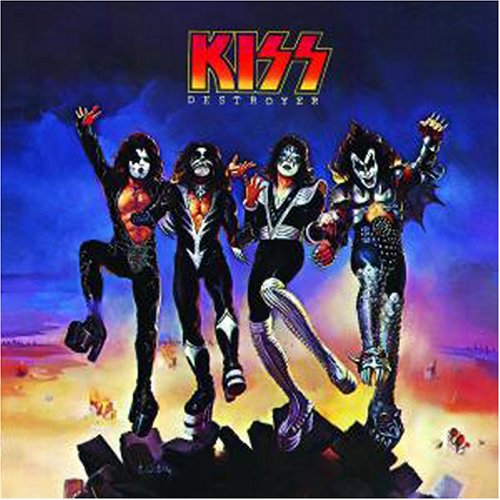
All their songs have a "sword-and-sorcery" theme, as if they hadn't quite escaped the clutches of Robert E. Howard. The cheese factor is extremely high; a bunch of kids from Auburn writing about fighting the world, sharpening their swords, killing the evil hordes is a recipe for hilarity. The opening song, "Defender", was something special. The band had finagled Orson Welles to "narrate" the opening of the song, adding a level of faux-gravitas to their over-the-top songs. This concert clip is pretty cool only because the bass player does a fantastic job on the intro, playing his eight string for all its worth.
My friend Jim had one of the most eclectic shows on their schedule. When we were juniors, someone - maybe it was him, I don't really remember - found some recordings of old radio serials, and Jim decided to play them during one show. His opening was a mash-up borrowed from, among other things, the opening of that chestnut, the TV Theme Songs LP that was such a huge hit in the mid-1980's. He could play jazz one second, something obscure by Aztec Camera (a truly underrated band) the next.
His good friend Phil had the heavy metal show. Phil found gems amidst the dreck that was heavy metal in the decade that made it popular. When we were seniors, he discovered Auburn, NY's favorite sons, Manowar. They had released an album called Fighting The World whose virtues included a direct rip-off of the cover of KISS's classic Destroyer LP. Don't believe me?
All their songs have a "sword-and-sorcery" theme, as if they hadn't quite escaped the clutches of Robert E. Howard. The cheese factor is extremely high; a bunch of kids from Auburn writing about fighting the world, sharpening their swords, killing the evil hordes is a recipe for hilarity. The opening song, "Defender", was something special. The band had finagled Orson Welles to "narrate" the opening of the song, adding a level of faux-gravitas to their over-the-top songs. This concert clip is pretty cool only because the bass player does a fantastic job on the intro, playing his eight string for all its worth.
Tuesday, October 18, 2011
Cleaning House
When the Rev. Mrs. and I clean the house together, we enjoy pretty much anything by Pat Metheny (except for his noise record, Zero Tolerance For Silence). Even though he's doing acoustic covers of The Association and insisting in interviews that The Carpenters are both cool and musically sophisticated, he has also produced some truly marvelous music over the decades. With long-time collaborator Lyle Mays, and in this video clip with bassist Mark Egan doing a fair-to-middlin' imitation of the late great Jaco Pastorius, Pat created a sound and style that is recognizable the moment you hear it.
I don't get the urge to dust and vacuum when I hear this, but I don't get the urge not to, either.
I don't get the urge to dust and vacuum when I hear this, but I don't get the urge not to, either.
Monday, October 17, 2011
You're Never Too Old To Have A Crush On Someone Famous
My favorite line from WKRP in Cincinatti has always been, "Hey Venus, let's go look at some Carly Simon album covers." See, my oldest sister had a couple old Carly Simon records, so I knew instantly what Johnny Fever was talking about.

When I was a teenager, there was only one female performer who impressed me . . . umm . . . that way. Grace Slick. Man . . .

I entered adulthood free from the kinds of juvenile attachments to celebrities that are the domain of youth.
Then, I saw Cassandra Wilson perform.
The voice and the person go together to create this aura of transcendent beauty. She is one of the few people who, if I managed to actually meet, I would be at a complete loss as to what to say. She's probably smack me to get my eyes back in their sockets.

When I was a teenager, there was only one female performer who impressed me . . . umm . . . that way. Grace Slick. Man . . .

I entered adulthood free from the kinds of juvenile attachments to celebrities that are the domain of youth.
Then, I saw Cassandra Wilson perform.
The voice and the person go together to create this aura of transcendent beauty. She is one of the few people who, if I managed to actually meet, I would be at a complete loss as to what to say. She's probably smack me to get my eyes back in their sockets.
Sunday, October 16, 2011
Willing To Be Convinced
My knee-jerk reaction to Friday's announcement that around 100 American military personnel were being sent to several African nations - Uganda, Sudan, the Central African Republic - to aid locals in their fight against the Lord's Resistance Army and search for the leader, Joseph Kony was negative.
After some time to think, I am still wary. All the same, I am willing to be convinced. I doubt I would ever be completely happy with a project like this. We are still bogged down in Afghanistan; we have 47,000 troops in Iraq (although the Obama Administration has signaled they will meet the end-of-the-year deadline to bring the bulk of them home); our participation in the Libyan Civil War, in the midst of these other military endeavors, certainly presented strains on logistics, intelligence, supply, and other matters.
Add to that 100 troops, even if highly-trained special forces - Army Rangers, Marines, who knows what - hardly seems large enough to make a serious contribution to the struggle against what amounts to nihilistic terrorist organization. The brief, as it has been explained, is the troops are there to assist. They are to engage in defensive combat only, although the Canadian National Post is correct that any meeting would result in combat. Before American troops entered Afghanistan in the wake of the 9/11 attacks, a small spec-ops force made it as far as the building housing the ruling Taliban, and were wiped out. Too small a force, far from any conceivable supply line is not a recipe for an easy time.
On the other hand, the LRA is despicable. Seeming to enjoy violence for the sake of violence, kidnapping and inducting child-soldiers, using girls as sex slaves, whole-sale slaughter the rule rather than the exception, the LRA has no indigenous support, relying on threats of violence and terrorizing locals to keep them in line.
A larger force, with the potential for future systematic military deployment - creating a future base, in other words - would certainly be more worrying. The area of Africa in question, like much of the continent, is resource rich; the Chinese, in particular, have been investing heavily in creating sustaining extraction infrastructure in various areas of the continent. In some ways, the US sending a small force without creating the infrastructure necessary for long-term occupation does seem to contradict the usual neo-colonial criticisms of such actions. If any country would be aided by the eradication of the LRA, it would be China.
I'm still not convinced this is either wise or good policy. It has much to recommend it. It also has much going against it. Pres. Obama does seem to grasp that, rather than massed armies with tanks, artillery, and air cover, for right now the best military force is small, highly-trained, and mobile. He has used special forces against Somali pirates, Osama Bin Laden, and probably so many others of which we shall never hear. Dispatching such forces may signal a decision on how he envisions future American military force structure (along with the explosion in the use of UAVs by the Air Force). If successful, it may well succeed in multiple ways.
Call me wary, but willing to be convinced that this is good policy. On simple humanitarian grounds, it seems wise. Nation-states aren't in the humanitarian business, in particular their militaries. So, convince me, one way or another.
After some time to think, I am still wary. All the same, I am willing to be convinced. I doubt I would ever be completely happy with a project like this. We are still bogged down in Afghanistan; we have 47,000 troops in Iraq (although the Obama Administration has signaled they will meet the end-of-the-year deadline to bring the bulk of them home); our participation in the Libyan Civil War, in the midst of these other military endeavors, certainly presented strains on logistics, intelligence, supply, and other matters.
Add to that 100 troops, even if highly-trained special forces - Army Rangers, Marines, who knows what - hardly seems large enough to make a serious contribution to the struggle against what amounts to nihilistic terrorist organization. The brief, as it has been explained, is the troops are there to assist. They are to engage in defensive combat only, although the Canadian National Post is correct that any meeting would result in combat. Before American troops entered Afghanistan in the wake of the 9/11 attacks, a small spec-ops force made it as far as the building housing the ruling Taliban, and were wiped out. Too small a force, far from any conceivable supply line is not a recipe for an easy time.
On the other hand, the LRA is despicable. Seeming to enjoy violence for the sake of violence, kidnapping and inducting child-soldiers, using girls as sex slaves, whole-sale slaughter the rule rather than the exception, the LRA has no indigenous support, relying on threats of violence and terrorizing locals to keep them in line.
A larger force, with the potential for future systematic military deployment - creating a future base, in other words - would certainly be more worrying. The area of Africa in question, like much of the continent, is resource rich; the Chinese, in particular, have been investing heavily in creating sustaining extraction infrastructure in various areas of the continent. In some ways, the US sending a small force without creating the infrastructure necessary for long-term occupation does seem to contradict the usual neo-colonial criticisms of such actions. If any country would be aided by the eradication of the LRA, it would be China.
I'm still not convinced this is either wise or good policy. It has much to recommend it. It also has much going against it. Pres. Obama does seem to grasp that, rather than massed armies with tanks, artillery, and air cover, for right now the best military force is small, highly-trained, and mobile. He has used special forces against Somali pirates, Osama Bin Laden, and probably so many others of which we shall never hear. Dispatching such forces may signal a decision on how he envisions future American military force structure (along with the explosion in the use of UAVs by the Air Force). If successful, it may well succeed in multiple ways.
Call me wary, but willing to be convinced that this is good policy. On simple humanitarian grounds, it seems wise. Nation-states aren't in the humanitarian business, in particular their militaries. So, convince me, one way or another.
A New 30 Days
In the fall of 1983, Roberta Flack performed at Alfred University with the Rochester Philharmonic Orchestra. Her touring band was with her, but the full orchestra was behind them. Gymnasiums aren't the best sonic environment - two years later, drummer Buddy Rich would mutter, "Fucking gyms" during a break at a gig at AU - but I had great seats in the balcony just above stage left. This was the last gasp, in some ways, of a style of performing like this. One of her collaborators, the great Donny Hathaway, had died. Later that winter, Marvin Gaye would be murdered by his senile father. Michael Jackson's Thriller was rushing out record shop doors faster than most could get it in.
But so were recordings by Sugar Hill Gang and Grand Master Flash. The next year, three guys from Hollis in Brooklyn who called themselves Run D.M.C. would release their first full length album, King of Rock. The musical landscape was about to change.
All the same, the show was phenomenal. Some performers are just must-sees.
But so were recordings by Sugar Hill Gang and Grand Master Flash. The next year, three guys from Hollis in Brooklyn who called themselves Run D.M.C. would release their first full length album, King of Rock. The musical landscape was about to change.
All the same, the show was phenomenal. Some performers are just must-sees.
Saturday, October 15, 2011
The Last Day
This month-long exercise in attempting photography has been an eye-opener for me. Specifically, while I appreciate great photography, I cannot do it.
That being said, here's the many sides of me.

Tomorrow, I start a different thirty-day challenge, because I need structure.
Lisa is the 99%. Randall is become death, and it is sad.
Facebook has a lot of stupid stuff, which I devoutly ignore. They did a "30 Day Song Challenge" a few months back, and it was fun. There have been several improvements, deviations, variations, and the one I like best, which I start tomorrow, follows:
That being said, here's the many sides of me.

Tomorrow, I start a different thirty-day challenge, because I need structure.
Lisa is the 99%. Randall is become death, and it is sad.
Facebook has a lot of stupid stuff, which I devoutly ignore. They did a "30 Day Song Challenge" a few months back, and it was fun. There have been several improvements, deviations, variations, and the one I like best, which I start tomorrow, follows:
DAY 1: A song you've seen performed live
DAY 2: A song by an artist you have a crush on
DAY 3: A song you listen to when cleaning
DAY 4: A song that's been dedicated to you
DAY 5: A song you've requested on the radio
DAY 6: A song you wish you wrote
DAY 7: A song from your favourite soundtrack
DAY 8: A love song
DAY 9: A break up song
DAY 10: A song that reminds you of Autumn
DAY 11: A song that reminds you of Winter
DAY 12: A song that reminds you of Spring
DAY 13: A song that reminds you of Summer
DAY 14: A song you've played on a jukebox
DAY 15: A song from the first album you purchased
DAY 16: A song that describes your home town
DAY 17: A song you misheard the lyrics to
DAY 18: A song from the first group you saw live
DAY 19: A song you loved as a child
DAY 20: A song you listen to when you're in a bad mood
DAY 21: Your favourite music video
DAY 22: A song that describes your world view
DAY 23: A song you listen to in transit
DAY 24: A song you have performed in public
DAY 25: A song from a local band
DAY 26: Your favourite TV theme song
DAY 27: A song you listen to on the weekend
DAY 28: A song that motivates you
DAY 29: A song that's always stuck in your head
DAY 30: A song from the year you were born
Friday, October 14, 2011
The 99 Percent And A Restatement Of Principles
The other day, I saw the following comment on a post at The Daily Howler. I linked to it on Facebook. It reads in part:
I've been blogging for five years, and have yet to make clear I am not the least bit interested in arguing. With anyone. Nor do I make any claim to superior insight, or wisdom, or understanding. I will most certainly call out blatant bigotry when it rears its ugly head; as my policy regarding Holocaust deniers, creationists, and global-warming deniers should make clear, I don't waste time dealing with nonsense, either. Factual error is just that, and I have no real need or inclination to waste time or space with folks who insist on the rough equivalent that 2+2=5.
I am interested, and have always been interested, in how folks view the world. How those views effect the way they live their lives. Even if the choices are such that I could never make them. That was the reason I first attempted, so many years ago, to converse with Neil Simpson. I couldn't care less that he believes I am some kind of non-Christian; I am interested in what he believes and why. He couldn't seem to understand that. It was far more important to him to criticize what I was saying than to take the time to actually read and understand it.
Political, religious, and other differences are important. They are not personal. I have disagreed with folks I respect a great deal, and here's the thing - I still respect them! As I wrote on Facebook, I have friends who are supporting Newt Gingrich for President. I have friends who are Marxists. I have friends who are clergy. I have friends who are atheists. And I think it's wonderful! I read their links and posts and marvel at the differences, and celebrate it.
The Occupy Wall Street movement, with its chant of "We Are The 99%" is an opening to really talk about the real problems we all face. Some of the folks I've seen interviewed sound an awful lot like libertarians. Others sound like, and probably are, various shades of socialists, communists, and anarchists. Rather than label them, or set up some ridiculous notion that even a majority of people will identify with the movement, it might be wise to shut up, listen, and think about the message. Even if we differ in how we understand how we got here, and what to do about it, it might be nice to sit and talk, together, about the simple reality that we all seem to share something in common - we're all, equally - red state and blue state, conservative and liberal, Republican and Democrat - screwed.
The problem with our rank and file is that they get off on being what they regard as morally and intellectually superior to THOSE OTHER PEOPLE--a superiority which they demonstrate by demeaning mainstream Americans, especially white men, while screaming about how THOSE OTHER PEOPLE are bigots. It's insane, but that's what they're doing.Today, Somerby wrote the following. He links to two different Hullabaloo posts, one by David Adkins, the other by Digby, then writes the following:
Who on earth would ever have thought that “the entire 99 percent” was ever going to “rise up against the rest?” Who would have thought that the Occupy movement “is going to sweep the country without any substantial opposition from average Americans?” Using Atkins’ silly construction, who would have pictured “an agreement on rational, sensible policy on which we can all come to consensus?” Who would have thought that this movement’s new math amounted to such a prediction?All of which leads to a simple observation - the biggest hurdle the the OWS folks face isn't ignorance, or ridicule from the mainstream press, or detractors on the right. It's potential ideological allies who will dismiss, deride, and defame potential allies for one simple reason - they don't think like "us"! The Hullabaloo posts make that pretty clear.
In her post, Digby was playing the set-upon victim, as she increasingly likes to do; she pretended it wasn’t “fashionable” to make her statement, which was in fact simply fatuous. Politics is never about getting everyone to agree, and the Occupy movement’s insightful new math doesn’t mean that we are trying to win 99 percent agreement. It means that blue tribal members might approach reds with a broader perspective—might even help some reds come to see that they're part of the 99 too.
--snip--
Poor Digby! She is subjected to so much static for her daring posts. It isn’t just the billionaires who will resist—average Americans will resist too! For ourselves, we have no idea who would have doubted this obvious fact; of course, many average Americans will choose to stay with the reds. The question as one builds a movement is of course different from that.
No one tries to win everyone over. The real question turns on "how many."
How many people in the red tribe might end up seeing themselves as of the 99 percent? There’s no way to know until you approach them—and that’s what tribal tribunes, all through history, have always inveighed against. As she continued, Digby noted that the Tea Party Express was dissing the Occupy folk—and Tea Party Nation was dissing them too! We have no idea why that would be a surprise to any sentient person.
--snip--
Digby’s favorite word is “they.” It’s a word which denies that even one of “those people” could have the human qualities which define our own wonderful tribe. Yes, we know—she doesn't say “all.” But as as you read, where is the emphasis?
Projection is also a mark of such tribals. Those people “have a deep need to see themselves as better than somebody. It’s just who they are,” Digby explains. But that’s pretty much the feeling we get from the headstrong strivers at Hullabaloo, who tell us, in sweeping terms, that those people are “morally repulsive,” “disgusting and shameful,” unable to “feel basic empathy” on the basis of the fact that they saw they've seen a lot of kids squandering student loan money.
As always, the haters have been Where the Wild Things Are. On the basis of their travels, they want you to know that “those people” won't be on your side!
I've been blogging for five years, and have yet to make clear I am not the least bit interested in arguing. With anyone. Nor do I make any claim to superior insight, or wisdom, or understanding. I will most certainly call out blatant bigotry when it rears its ugly head; as my policy regarding Holocaust deniers, creationists, and global-warming deniers should make clear, I don't waste time dealing with nonsense, either. Factual error is just that, and I have no real need or inclination to waste time or space with folks who insist on the rough equivalent that 2+2=5.
I am interested, and have always been interested, in how folks view the world. How those views effect the way they live their lives. Even if the choices are such that I could never make them. That was the reason I first attempted, so many years ago, to converse with Neil Simpson. I couldn't care less that he believes I am some kind of non-Christian; I am interested in what he believes and why. He couldn't seem to understand that. It was far more important to him to criticize what I was saying than to take the time to actually read and understand it.
Political, religious, and other differences are important. They are not personal. I have disagreed with folks I respect a great deal, and here's the thing - I still respect them! As I wrote on Facebook, I have friends who are supporting Newt Gingrich for President. I have friends who are Marxists. I have friends who are clergy. I have friends who are atheists. And I think it's wonderful! I read their links and posts and marvel at the differences, and celebrate it.
The Occupy Wall Street movement, with its chant of "We Are The 99%" is an opening to really talk about the real problems we all face. Some of the folks I've seen interviewed sound an awful lot like libertarians. Others sound like, and probably are, various shades of socialists, communists, and anarchists. Rather than label them, or set up some ridiculous notion that even a majority of people will identify with the movement, it might be wise to shut up, listen, and think about the message. Even if we differ in how we understand how we got here, and what to do about it, it might be nice to sit and talk, together, about the simple reality that we all seem to share something in common - we're all, equally - red state and blue state, conservative and liberal, Republican and Democrat - screwed.
30 Day Photo Challenge, Day 29
I was scanning some old photos this summer and discovered, much to my chagrin, that several of them had scanned black and white. Then, I found that there's a button on our three-in-one scanner/copier/printer that, when pushed, rendered the pictures in b&w. I went back and looked and some of them actually turned out . . . interesting.

Gretchen was particularly photogenic in b&w, being a Harlequin.

This photo of Lisa with then-presiding Bishop Joe Sprague burning the mortgage on the parsonage for Community UMC in LaMoille, IL looks like a newspaper photo. Actually, I took it on a disposable camera. Such is what happens when pictures are rendered b&w.

Lisa and her mother, the day Lisa graduated from Wesley Theological Seminary.
In the category of real b&w photos, at my the recent party celebrating my father's 90th birthday, my cousin put together a small memory book. In it was something I, nearing 46 years old, had never seen - a wedding photo of my parents. March 31, 1954.

Hint: For the last day, expect the unexpected.
Lisa makes hay while the sun shines. Randall captures Cleveland's cheery side.

Gretchen was particularly photogenic in b&w, being a Harlequin.

This photo of Lisa with then-presiding Bishop Joe Sprague burning the mortgage on the parsonage for Community UMC in LaMoille, IL looks like a newspaper photo. Actually, I took it on a disposable camera. Such is what happens when pictures are rendered b&w.

Lisa and her mother, the day Lisa graduated from Wesley Theological Seminary.
In the category of real b&w photos, at my the recent party celebrating my father's 90th birthday, my cousin put together a small memory book. In it was something I, nearing 46 years old, had never seen - a wedding photo of my parents. March 31, 1954.

Hint: For the last day, expect the unexpected.
Lisa makes hay while the sun shines. Randall captures Cleveland's cheery side.
Thursday, October 13, 2011
30 Day Photo Challenge, Day 28
From Genesis' "Supper's Ready" (I'm not sure which member of the band wrote the lyrics:

Late summer flowers are no less beautiful than those that burst forth in spring, you know, Lisa. Sometimes, the pictures are so beautiful you just want the world to stop.
How Dare I Be So Beautiful?
Wandering in the chaos the battle has left,
We climb up the mountain of human flesh,
To a plateau of green grass, and green trees full of life.
A young figure sits still by a pool,
He's been stamped "Human Bacon" by some butchery tool.
(He is you)
Social Security took care of this lad.
We watch in reverence, as Narcissus is turned to a flower.
A flower?

Late summer flowers are no less beautiful than those that burst forth in spring, you know, Lisa. Sometimes, the pictures are so beautiful you just want the world to stop.
Wednesday, October 12, 2011
There's Always Something New Under The Sun, Even If It's A Bad Copy
Sometimes ramming around YouTube, randomly clicking this or that leads to the most interesting finds. For example, I had never heard of a band called Rishloo, and almost immediately I discovered a band taking Tool's approach to tonality, songwriting, arranging. They don't really add much to that general way of creating music, but it does have its moments.
Another Tool-like band is Isis. I think the sonic resemblance is pretty clear here.
Then there is Antithesis. Not sure what to call this other than melodic . . . what? Not quite metal, harder than hard rock, though. Lead singer sounds like a cross between Russell Allen of Symphony X and Steve Walsh of Kansas.
Also, too, I got a release by the unknown band Under the Sun. If the lead singer had sung instead of talked the lyrics, it would vastly improve the record. Maybe a bit more keyboard in the mix, too - it's there, just muffled, not quite muddy, but not clear, either. Mr. Record Reviewer, that's me!
Sargasso Sea - Scale the Summit
Manhunt - Shadow Gallery
Gonna Get Ya - Pete Townshend
ETI: Extra Terrestrial Intelligence - Blue Oyster Cult
Sex Sleep Eat Drink Dream - King Crimson
Golden Road (To Unlimited Devotion) - The Dead, Allstate Arena, May 5, 2009
Wish You Were Here (Live) - Pink Floyd
Day Eight: School - Ayreon
The Joke's On You - Porcupine Tree
Duke's Travels (Live, Archive #2) - Genesis
Because they are too often over-looked these days, or thought of as a band that just did weird, hard-rock novelty songs, it Blue Oyster Cult showing the world how it's done.
Another Tool-like band is Isis. I think the sonic resemblance is pretty clear here.
Then there is Antithesis. Not sure what to call this other than melodic . . . what? Not quite metal, harder than hard rock, though. Lead singer sounds like a cross between Russell Allen of Symphony X and Steve Walsh of Kansas.
Also, too, I got a release by the unknown band Under the Sun. If the lead singer had sung instead of talked the lyrics, it would vastly improve the record. Maybe a bit more keyboard in the mix, too - it's there, just muffled, not quite muddy, but not clear, either. Mr. Record Reviewer, that's me!
Sargasso Sea - Scale the Summit
Manhunt - Shadow Gallery
Gonna Get Ya - Pete Townshend
ETI: Extra Terrestrial Intelligence - Blue Oyster Cult
Sex Sleep Eat Drink Dream - King Crimson
Golden Road (To Unlimited Devotion) - The Dead, Allstate Arena, May 5, 2009
Wish You Were Here (Live) - Pink Floyd
Day Eight: School - Ayreon
The Joke's On You - Porcupine Tree
Duke's Travels (Live, Archive #2) - Genesis
Because they are too often over-looked these days, or thought of as a band that just did weird, hard-rock novelty songs, it Blue Oyster Cult showing the world how it's done.
30 Day Photo Challenge, Day 27
In May, 1994, Lisa and I spent a week in the Bay Area of California. We traveled down to Monterrey and Carmel-By-The-Sea. We went to a state park, driving up a mile-high mountain and wandering amongst the tarantula holes. We went to Berkeley, where we drove by People's Park. We also spent a day in the People's Republic of San Francisco. At the Marina, one jetty at Pier 19 have been taken over by California Sea Lions. This being San Francisco, it was turned over to them. From a distance folks stood around, snapping pictures, and wished they had the life of those sea lions.

We went to Alcatraz, and while we waited for the ferry, I took a picture of the island with a really hot foreground image.

It is only from Alcatraz that you get an idea of just how beautiful the city of San Francisco really is. The next shot tried to capture it, failed pretty miserably because I didn't bully my way through all the people, but you can see the city, hazy in the distance.

Lisa tries and fails to distance herself from our madness. It's the image that's lonely, not the photographer.

We went to Alcatraz, and while we waited for the ferry, I took a picture of the island with a really hot foreground image.

It is only from Alcatraz that you get an idea of just how beautiful the city of San Francisco really is. The next shot tried to capture it, failed pretty miserably because I didn't bully my way through all the people, but you can see the city, hazy in the distance.

Lisa tries and fails to distance herself from our madness. It's the image that's lonely, not the photographer.
Tuesday, October 11, 2011
30 Day Photo Challenge, Day 26
Close-up, you say?

An SEM photo of a stack of silicon about one angstrom tall. It's dust from an etching process that just happened to stack up that way, according to the website where I found the photo.
And you were expecting . . . what? A picture of my finger?
Lisa is all buggy. A picture is worth a run-on sentence, I think.

An SEM photo of a stack of silicon about one angstrom tall. It's dust from an etching process that just happened to stack up that way, according to the website where I found the photo.
And you were expecting . . . what? A picture of my finger?
Lisa is all buggy. A picture is worth a run-on sentence, I think.
Monday, October 10, 2011
Concocted Outrage
A tempest was erupting over the weekend after FOXNews started running a story claiming that Rep. John Lewis was denied the opportunity to address a gathering of Occupy Atlanta.
Things are not always as FOXNews would have us believe they appear to be.
A story in Atlanta's Creative Loafing on-line draws a slightly different picture of the events.
I was led to this site from Joan Walsh's Salon piece on this same incident.
As he was leaving the area where the protest was occurring, Lewis stopped for a quick interview. This is after the events that everyone is all in a huff about.
A friend of mine sent me the link to the original FOXNews story, and even reading that I came to the same general conclusion Walsh did - the group had a process, and Lewis, respecting it, went on with his day. Even so, the framing of this whole event, and the way FOXNews and the various channels that funnel information like this, set off my bullshit detector. It didn't take any time at all to discover a host of sources on the event in question that, in sum, clearly show a fundamental truth when dealing with FOXNews stories: It didn't happen that way.
There has been just a bit too much offense taken by African-Americans and others at a series of movements, grass-roots and going viral, that are working to draw attention to various injustices. Nothing wrong with that. We all need our consciences pricked, our perspectives expanded. All the same, it's just a little too neat, a little too interesting that all this outrage at the alleged insensitivity of these movements is occurring. I do not doubt the very real concerns some folks have, say, of the SlutWalk movement. I do not doubt the worries that a movement concerned with increasing disparities in wealth would ignore very real concerns of race and gender inequality, as has too often happened in the past. What I do doubt is that the expressed concerns are somehow as spontaneous as they appear.
When an incident occurs that doesn't smell right, it is always best to check it out. I have done so, and see no reason, as my FB friend insists, to "defend" John L. Lewis from something that didn't happen. Lewis needs no help defending himself. His demonstrated courage is a matter of the historical record. Furthermore, he needs no defense in the face of things that, simply put, didn't happen.
There may be no story here, but at the same time, there is. The story, however, is FOXNews reporting an event in a way that clearly intends to smear as racist a movement that considers itself both (small "d") democratic and inclusive. Maybe, just maybe, if some of the outrage at the folks in Atlanta were directed at the real racists here, we might be getting somewhere.
A lengthy video posted online over the weekend showed what happened when the Democratic congressman tried to address an "assembly" of protesters in his home state. Instead of giving the floor to a man who is not just a longtime U.S. representative but a revered civil rights icon, the protesters employed a tangle of parliamentary procedures to ultimately prevent him from speaking.If all one did was read the FOXNews account, I can understand some outrage.
A stunned Lewis could be seen watching the whole thing unfold before ambling away.
Asked about the incident Monday, a Lewis spokeswoman told FoxNews.com "the only comment that we're going to give is the comments already made." In a prior interview about the matter with the Atlanta Journal Constitution, Lewis said, "It's okay," and that "they didn't really deny me."
The end result, though, was that Lewis did not get to speak to the protesters.
The procedures they used -- rather, invented -- would make the Senate blush. Imagine some combination of Model U.N., Lord of the Flies and a Phish concert.
Things are not always as FOXNews would have us believe they appear to be.
A story in Atlanta's Creative Loafing on-line draws a slightly different picture of the events.
Congressman John Lewis visited the Occupy Atlanta rally at Woodruff Park last night approximately 45 minutes after its planning session, or General Assembly, started. Despite saying he did not want to speak, the civil rights icon was invited to address to the crowd. When the topic of allowing Lewis to speak was presented to the group, "Joe" (pictured in red) held up his arms to "block" Lewis from speaking.No Phish concert references here.
"Joe" said he was against Lewis speaking because the movement is "not about one individual" and that it has been built on the idea of "no hierarchy." The crowd decided the congressman could speak after the General Assembly, but Lewis had to leave for a previous engagement.
I was led to this site from Joan Walsh's Salon piece on this same incident.
A YouTube video made its way around Twitter Saturday, showing the Atlanta offshoot of Occupy Wall Street in the middle of a General Assembly meeting, debating whether to ask Rep. John Lewis speak to the group. The answer was no, and the reaction on Twitter was almost unanimously negative: How could these people insult a civil rights hero that way?
I had the same reaction – until I understood what exactly occurred. It turns out Lewis came by, on his own, during a General Assembly meeting, to observe the group, and didn’t ask to speak. One of the activists suggested that he be invited to say a few words, and most of the assembly seemed fine with that – until one of them, a guy identified as Joe, stood up and disagreed. While expressing respect for Lewis’s work, he said the movement was “not about one individual” and it supported “no hierarchy.” Because the group was in a planning session, someone suggested that Lewis speak at the end of their agenda, but the congressman had another event and couldn’t stay.
I watched the video with growing frustration at what I perceived to be an insult to Lewis. But if you watched the whole thing, Occupy Atlanta has a process, like it or not, and the activists stayed true to their process. Everyone who spoke expressed respect for Lewis and a desire to hear him speak, but not in the middle of their planning meeting. By the time I finished the video, I could understand that.
Most important, John Lewis himself understood that. He noted he hadn’t asked to speak, and he was happy to observe. “I support the protesters in New York and here,” Lewis told Atlanta’s Creative Loafing before leaving the park. “It is the right time and the right place to be… It is the will of the people. When I was young we did similar actions. It is grassroots democracy at its best. I think something good will come of the moment.”
As he was leaving the area where the protest was occurring, Lewis stopped for a quick interview. This is after the events that everyone is all in a huff about.
A friend of mine sent me the link to the original FOXNews story, and even reading that I came to the same general conclusion Walsh did - the group had a process, and Lewis, respecting it, went on with his day. Even so, the framing of this whole event, and the way FOXNews and the various channels that funnel information like this, set off my bullshit detector. It didn't take any time at all to discover a host of sources on the event in question that, in sum, clearly show a fundamental truth when dealing with FOXNews stories: It didn't happen that way.
There has been just a bit too much offense taken by African-Americans and others at a series of movements, grass-roots and going viral, that are working to draw attention to various injustices. Nothing wrong with that. We all need our consciences pricked, our perspectives expanded. All the same, it's just a little too neat, a little too interesting that all this outrage at the alleged insensitivity of these movements is occurring. I do not doubt the very real concerns some folks have, say, of the SlutWalk movement. I do not doubt the worries that a movement concerned with increasing disparities in wealth would ignore very real concerns of race and gender inequality, as has too often happened in the past. What I do doubt is that the expressed concerns are somehow as spontaneous as they appear.
When an incident occurs that doesn't smell right, it is always best to check it out. I have done so, and see no reason, as my FB friend insists, to "defend" John L. Lewis from something that didn't happen. Lewis needs no help defending himself. His demonstrated courage is a matter of the historical record. Furthermore, he needs no defense in the face of things that, simply put, didn't happen.
There may be no story here, but at the same time, there is. The story, however, is FOXNews reporting an event in a way that clearly intends to smear as racist a movement that considers itself both (small "d") democratic and inclusive. Maybe, just maybe, if some of the outrage at the folks in Atlanta were directed at the real racists here, we might be getting somewhere.
30 Day Photo Challenge, Day 24
No.

No, but closer.
When I was in high school, I discovered the writings of Anais Nin, specifically this:

Unlike other writings on sex, particularly those of Ms. Nin's lover, Henry Miller (who, for the longest time, I confused with Henry James, God knows why), Nin offered a vision of sexuality that was potent, filled with the marvelous combination of love and lust that is the best human beings can do. Not content to titillate, she took certain erotic conventions - "Artists and Models", etc. - and gave them a twist, making them her own. Not the deep blue of mid-20th century pornography, or the faux-scandalous writings of D. H. Lawrence or the sex-pulps:

Anais Nin's writings introduced me to the possibility not only of literary sex, but the romantic possibilities inherent in carnal desire. While much has changed over the decades, I still hold that when a man and a woman are in love, their physical desire can manifest itself in a kind of freedom that makes of sex something more than simple reproduction on the one hand, or animal grunting on the other. I am grateful I was schooled in the possibilities inherent in human sexual love by Ms. Nin's writings.
And thanks to my sister, Susan, for holding her copy while she was in Africa in the Peace Corps.
Lisa gets edited. Randall feels like yodeling.

No, but closer.
When I was in high school, I discovered the writings of Anais Nin, specifically this:

Unlike other writings on sex, particularly those of Ms. Nin's lover, Henry Miller (who, for the longest time, I confused with Henry James, God knows why), Nin offered a vision of sexuality that was potent, filled with the marvelous combination of love and lust that is the best human beings can do. Not content to titillate, she took certain erotic conventions - "Artists and Models", etc. - and gave them a twist, making them her own. Not the deep blue of mid-20th century pornography, or the faux-scandalous writings of D. H. Lawrence or the sex-pulps:

Anais Nin's writings introduced me to the possibility not only of literary sex, but the romantic possibilities inherent in carnal desire. While much has changed over the decades, I still hold that when a man and a woman are in love, their physical desire can manifest itself in a kind of freedom that makes of sex something more than simple reproduction on the one hand, or animal grunting on the other. I am grateful I was schooled in the possibilities inherent in human sexual love by Ms. Nin's writings.
And thanks to my sister, Susan, for holding her copy while she was in Africa in the Peace Corps.
Lisa gets edited. Randall feels like yodeling.
Sunday, October 09, 2011
30 Day Photo Challenge, Day 23
The first year we were married, Lisa and I lived in an apartment, so pets were out of the question. Having both grown up in homes with pets, we talked about the animals we wanted, different dog breeds, how many cats. Within a week of our move to Jarratt, VA, we were the recipients of 2 kittens from the Owen farm. Dubbed Hobbes, because she was tiger striped and Calvin and Hobbes was the best comic ever; and Patch, being a tortoise shell calico with a bright orange patch over one eye, they graced our home, Hobbes for ten years, Patch for almost 15.


In April, 1995, we were fortunate enough to have the opportunity to purchase the pick of a litter from a AKC registered Great Dane brood. Lisa and I had both agreed that large dogs were preferable, and you don't get larger than a Great Dane. When Moriah was born in 1997, we were a bit concerned she might become jealous of the attention the baby received. We brought Moriah home, set her car seat down on a coffee table, and let Gretchen come in. On a leash, we allowed her to sniff the baby. Her nose went from head to toe back to head, she seemed to consider the smelly little newcomer for a moment, then licked Moriah's head. From that moment on, Gretchen was a great protector.

We lost Hobbes in the fall of 2004, Gretchen two days after Christmas that same year. For a while, Patch was the lone non-human denizen of our house. Then, in March, 2006, Lisa and I spent a day looking and found a fluffy, forgotten St. Bernard puppy. It didn't take much convincing. So, Dreyfus joined the brood.

In the fall of 2009, a young, male, fixed, de-clawed cat wandered around our subdivision in Poplar Grove. He spent a day or two at our neighbors, including eight hours on the lap of Tom, who, having MS, is confined to a wheelchair and didn't mind at all. The next day, he ran across the street, in to our open garage, and we now had Buddy.

Last fall, three young kittens were hanging around the back door of the church. They were scrawny, hungry, and, with rain and wind, cold. I was against doing anything more than providing some kind of shelter for them at church until I saw them. Of course, the one we ended up with is loud, full of brass, and utterly entertaining as only a cat full of herself can be.

I think that's enough animals for everybody.
Lisa shows some pride. Oh, deer, Randall.


In April, 1995, we were fortunate enough to have the opportunity to purchase the pick of a litter from a AKC registered Great Dane brood. Lisa and I had both agreed that large dogs were preferable, and you don't get larger than a Great Dane. When Moriah was born in 1997, we were a bit concerned she might become jealous of the attention the baby received. We brought Moriah home, set her car seat down on a coffee table, and let Gretchen come in. On a leash, we allowed her to sniff the baby. Her nose went from head to toe back to head, she seemed to consider the smelly little newcomer for a moment, then licked Moriah's head. From that moment on, Gretchen was a great protector.

We lost Hobbes in the fall of 2004, Gretchen two days after Christmas that same year. For a while, Patch was the lone non-human denizen of our house. Then, in March, 2006, Lisa and I spent a day looking and found a fluffy, forgotten St. Bernard puppy. It didn't take much convincing. So, Dreyfus joined the brood.

In the fall of 2009, a young, male, fixed, de-clawed cat wandered around our subdivision in Poplar Grove. He spent a day or two at our neighbors, including eight hours on the lap of Tom, who, having MS, is confined to a wheelchair and didn't mind at all. The next day, he ran across the street, in to our open garage, and we now had Buddy.

Last fall, three young kittens were hanging around the back door of the church. They were scrawny, hungry, and, with rain and wind, cold. I was against doing anything more than providing some kind of shelter for them at church until I saw them. Of course, the one we ended up with is loud, full of brass, and utterly entertaining as only a cat full of herself can be.

I think that's enough animals for everybody.
Lisa shows some pride. Oh, deer, Randall.
Saturday, October 08, 2011
How The Left, And America, Loses
A few weeks back, Tulane University political science professor Melissa Harris-Perry wrote a piece in The Nation, for whom she writes on a monthly basis, that became the focus of much controversy on the Left.
I feel no need to respond to silliness like this. Others have, including Gene Lyons in Salon.
If they so choose.
Now, criticism of Harris-Perry has, at times, been ugly. That's kind of the way things go on the Internet, and in the country at large. A few, like Bob Somerby, have managed to keep their focus pretty clearly on the dubiousness of her factual claims, the dearth of evidence to support them, and the sheer audacity involved in writing that oft-mentioned, and highlighted here, sentence. She has responded, and has not exactly covered herself in glory.
Along comes this article, which quotes a Harris-Perry piece from April in which she argued that the pauperization of the mostly white middle class is introducing them to the long-standing disparities in access to power under which African-Americans have lived throughout most of our history. She has a big, important point here, but it isn't anything original.
The argument that there is something we can call "racist capitalism", as distinct from "capitalism", is ludicrous. Obviously capitalism is racist to the core. It is also patriarchal. It reinforces heterosexism. Any and all forms of narrow normative power structures that limit access and economic justice and equality are supported by capitalism. To argue that only now, with the re-enactment of Gilded Age economic policies are whites suddenly aware of their own marginalization in the face of immense power is factually inaccurate and historically ignorant. Forty years ago the links between racial and economic justice were clear enough.
When the public space in which we all need to talk about economic justice, racial justice and equality, becomes muddied by nonsense, we all lose. When legitimate criticism of Pres. Obama and his record gets lumped in with birthers and bigots, we all lose. When academics cannot even muster evidence for their arguments, then insist that they don't have to because any criticism of black academics is the same as dismissive racist attacks, we all lose.
The 2008 general election was another referendum on old-fashioned electoral racism—this time among Democratic voters. The long primary battle between Hillary Clinton and Obama had the important effect of registering hundreds of thousands of Democrats. By October 2008, it was clear that Obama could lose the general election only if a substantial portion of registered Democrats in key states failed to turn out or chose to cross party lines. For Democrats to abandon their nominee after eight years of Bush could be interpreted only as an act of electoral racism.The piece makes a number of claims of fact that Harris-Perry does not support with any evidence. Furthermore, the claim in the last, highlighted, sentence, is among the most absurd things I have read in quite a while. Finally, Harris-Perry does not marshal a single piece of evidence, say, a bunch of white liberal bloggers who are writing off Pres. Obama next year, and reading in to their reasons any kind of double standard. Instead, a refusal to vote again for Pres. Obama is, for her, prima facie evidence of "a more subtle form of racism," which, to be honest is a clunky way of phrasing what she really means. That white folks on the Left who are criticizing the President are doing so because they are racists.
--
The 2012 election may be a test of another form of electoral racism: the tendency of white liberals to hold African-American leaders to a higher standard than their white counterparts. If old-fashioned electoral racism is the absolute unwillingness to vote for a black candidate, then liberal electoral racism is the willingness to abandon a black candidate when he is just as competent as his white predecessors.
--
In 1996 President Clinton was re-elected with a coalition more robust and a general election result more favorable than his first win. His vote share among women increased from 46 to 53 percent, among blacks from 83 to 84 percent, among independents from 38 to 42 percent, and among whites from 39 to 43 percent.
President Obama has experienced a swift and steep decline in support among white Americans—from 61 percent in 2009 to 33 percent now. I believe much of that decline can be attributed to their disappointment that choosing a black man for president did not prove to be salvific for them or the nation.(italics added)
I feel no need to respond to silliness like this. Others have, including Gene Lyons in Salon.
See, certain academics are prone to an odd fundamentalism of the subject of race. Because President Obama is black, under the stern gaze of professor Harris-Perry, nothing else about him matters. Not killing Osama bin Laden, not 9 percent unemployment, only blackness.Race is difficult to talk about under the best of circumstances. We aren't living in the best of circumstances, and the insistence that white liberals own up to their racism because Obama hasn't been salvific becomes yet another hurdle over which people need to leap.
Furthermore, unless you’re black, you can’t possibly understand. Yada, yada, yada. This unfortunate obsession increasingly resembles a photo negative of KKK racial thought. It’s useful for intimidating tenure committees staffed by Ph.D.s trained to find racist symbols in the passing clouds. Otherwise, Harris-Perry’s becoming a left-wing Michele Bachmann, an attractive woman seeking fame and fortune by saying silly things on cable TV.
If they so choose.
Now, criticism of Harris-Perry has, at times, been ugly. That's kind of the way things go on the Internet, and in the country at large. A few, like Bob Somerby, have managed to keep their focus pretty clearly on the dubiousness of her factual claims, the dearth of evidence to support them, and the sheer audacity involved in writing that oft-mentioned, and highlighted here, sentence. She has responded, and has not exactly covered herself in glory.
Along comes this article, which quotes a Harris-Perry piece from April in which she argued that the pauperization of the mostly white middle class is introducing them to the long-standing disparities in access to power under which African-Americans have lived throughout most of our history. She has a big, important point here, but it isn't anything original.
The argument that there is something we can call "racist capitalism", as distinct from "capitalism", is ludicrous. Obviously capitalism is racist to the core. It is also patriarchal. It reinforces heterosexism. Any and all forms of narrow normative power structures that limit access and economic justice and equality are supported by capitalism. To argue that only now, with the re-enactment of Gilded Age economic policies are whites suddenly aware of their own marginalization in the face of immense power is factually inaccurate and historically ignorant. Forty years ago the links between racial and economic justice were clear enough.
When the public space in which we all need to talk about economic justice, racial justice and equality, becomes muddied by nonsense, we all lose. When legitimate criticism of Pres. Obama and his record gets lumped in with birthers and bigots, we all lose. When academics cannot even muster evidence for their arguments, then insist that they don't have to because any criticism of black academics is the same as dismissive racist attacks, we all lose.
30 Day Photo Challenge, Day 23
On the mend from a serious, sudden bout of illness, I ventured out today to snap a picture of a sun flare. I think it turned out quite nice.

After despairing that I would get such a picture, this is a blaze of glory.
It's nice to know someone felt the way I did about this one. For Summer, the sun adds a bit of romance to an already romantic shot.

After despairing that I would get such a picture, this is a blaze of glory.
It's nice to know someone felt the way I did about this one. For Summer, the sun adds a bit of romance to an already romantic shot.
Thursday, October 06, 2011
When "Assassination" Isn't
There's been a whole lot of buzz about the murder of Anwar al-Awlaki by folks who are outraged that an American citizen was killed by his own government. There's been a whole lot of talk about "due process" and "extra-judicial murder" and, now, secret panels.
I'm certainly no fan of Star Chamber tactics.
On the other hand, Anwar al-Awlaki had, for all intents and purposes, declared war on his home country. He encouraged others to attack Americans at home and abroad. He was, for lack of a better term, engaged in rebellion.
Seems to me a good case can be made that taking him out was well within the purview of Executive Powers dealing with rebellion.
Look, I'm no fan of the whole "War on Terror" crap that stay-at-home war bloggers want others to fight. On the other hand, there are people out there who are actively engaged in planning to do our country and our fellow Americans serious physical harm. We may not like that protecting the United States involves messy stuff like killing people, but this isn't about people's feelings. We may not like that some of those who are targets of our national defense are fellow Americans. There are Constitutional protections regarding having one's life taken outside the due process of law.
Sometimes, it becomes necessary to take the heat for violating the due process clause if, in so doing, lives can be saved.
I know it's heretical for a self-professed lefty to say it, but, like the killing of Osama Bin Laden, the killing of Anwar al-Awlaki made the world a little bit safer for Americans.
I'm certainly no fan of Star Chamber tactics.
On the other hand, Anwar al-Awlaki had, for all intents and purposes, declared war on his home country. He encouraged others to attack Americans at home and abroad. He was, for lack of a better term, engaged in rebellion.
Seems to me a good case can be made that taking him out was well within the purview of Executive Powers dealing with rebellion.
Look, I'm no fan of the whole "War on Terror" crap that stay-at-home war bloggers want others to fight. On the other hand, there are people out there who are actively engaged in planning to do our country and our fellow Americans serious physical harm. We may not like that protecting the United States involves messy stuff like killing people, but this isn't about people's feelings. We may not like that some of those who are targets of our national defense are fellow Americans. There are Constitutional protections regarding having one's life taken outside the due process of law.
Sometimes, it becomes necessary to take the heat for violating the due process clause if, in so doing, lives can be saved.
I know it's heretical for a self-professed lefty to say it, but, like the killing of Osama Bin Laden, the killing of Anwar al-Awlaki made the world a little bit safer for Americans.
30 Day Photo Challenge, Day 22
I can't remember where I read it. Maybe Carl Sagan's The Dragon's of Eden. That which most clearly set human beings apart from other animals, in an evolutionary sense, was not our cranial capacity; elephants, dolphins and whales, even raccoons, are smarter than proto-humans.
It was the humble evolutionary device of the opposable thumb.

With the squaring of our pelvic bones that started to give proto-humans the possibility of an upright posture, and forelimbs freed from the need to assist in locomotion, our evolutionary ancestors could venture out from the trees. They could expand their capacity for tool-making inherited from other primates. As evolution rewarded the survival of more and better tool-makers, more upright, hand-using critters, our cranial capacity, brain-mass to body-mass ratio, and other things we only think make us uniquely human increased.
It all started with the ability, occurring a couple million years ago in small animals that looked an awful lot like chimpanzees, to touch four of the digits on a forelimb with the tip of the other that was both long enough and flexible enough to reach them.
Simply put - hands make humans.
Lisa muses with poesy and humor on the way hands express love. Randall exposes what happens when poets worry too much over a couple verses.
It was the humble evolutionary device of the opposable thumb.

With the squaring of our pelvic bones that started to give proto-humans the possibility of an upright posture, and forelimbs freed from the need to assist in locomotion, our evolutionary ancestors could venture out from the trees. They could expand their capacity for tool-making inherited from other primates. As evolution rewarded the survival of more and better tool-makers, more upright, hand-using critters, our cranial capacity, brain-mass to body-mass ratio, and other things we only think make us uniquely human increased.
It all started with the ability, occurring a couple million years ago in small animals that looked an awful lot like chimpanzees, to touch four of the digits on a forelimb with the tip of the other that was both long enough and flexible enough to reach them.
Simply put - hands make humans.
Lisa muses with poesy and humor on the way hands express love. Randall exposes what happens when poets worry too much over a couple verses.
Wednesday, October 05, 2011
30 Day Photo Challenge, Day 21
Some people identify themselves with their job. Others with relationships. In thinking of a way to do a "faceless self-portrait", I wondered what was the best way to take picture of myself without taking a picture of myself. Then, I looked to my left and this is what I saw.

Then, I turned and glanced at the bottom of the computer screen.

For better and worse, it is books and music that tell the world who I am. This big picture - just one set of shelves in our house; the number of songs in my iTunes account - can be overwhelming at times. Even to me. So, here's a sample.

Other than my wife and children, if you want to know who I am, see a picture of me, it lies here.
Lisa is southern, so she cleans when the stress is high. Randall would scare a young Jamie Lee Curtis, I suppose.

Then, I turned and glanced at the bottom of the computer screen.

For better and worse, it is books and music that tell the world who I am. This big picture - just one set of shelves in our house; the number of songs in my iTunes account - can be overwhelming at times. Even to me. So, here's a sample.

Other than my wife and children, if you want to know who I am, see a picture of me, it lies here.
Lisa is southern, so she cleans when the stress is high. Randall would scare a young Jamie Lee Curtis, I suppose.
O! For A Thousand Tongues To Sing
A couple decades ago, the weirdest thing happened. Someone recorded a small group of monks doing what they do several times a day - chanting in prayer and praise. The recording became huge, and soon, monks were appearing everywhere, even in techno recordings.
There is no doubt there is aesthetic value to the cloistered chant.
But, Latin isn't the only language God knows. There's Greek.
Russian.
Even Arabic.
Ours is a God of many peoples, many languages, and we who call ourselves Christians, no matter where we are, add our languages and dialects in prayer and thanksgiving in whatever tongue we use to create not Babel, but a glorious chorus in many languages and from many traditions.
All music participates in this grand chorus.
Bar Hopping With Mr. Picky - Jordan Rudess
Your Own Special Way (Live) - Genesis
Vanishing - A Perfect Circle
The Moon Touches Your Shoulder - Porcupine Tree
A Place In The World - Pat Metheny Group
You Can Never Hold Back Spring - Tom Waits
Bertha - Grateful Dead
Southside of the Sky - Yes
La Le Lo - Acid Mother's Temple
Waiting For The Answer - Dead Soul Tribe
We should let our spirits ride, shouldn't we . . .
There is no doubt there is aesthetic value to the cloistered chant.
But, Latin isn't the only language God knows. There's Greek.
Russian.
Even Arabic.
Ours is a God of many peoples, many languages, and we who call ourselves Christians, no matter where we are, add our languages and dialects in prayer and thanksgiving in whatever tongue we use to create not Babel, but a glorious chorus in many languages and from many traditions.
All music participates in this grand chorus.
Bar Hopping With Mr. Picky - Jordan Rudess
Your Own Special Way (Live) - Genesis
Vanishing - A Perfect Circle
The Moon Touches Your Shoulder - Porcupine Tree
A Place In The World - Pat Metheny Group
You Can Never Hold Back Spring - Tom Waits
Bertha - Grateful Dead
Southside of the Sky - Yes
La Le Lo - Acid Mother's Temple
Waiting For The Answer - Dead Soul Tribe
We should let our spirits ride, shouldn't we . . .
Tuesday, October 04, 2011
30 Day Photo Challenge, Day 20
I'll admit it. I had to look up "bokeh". I thought it was a typo of "broken", and had something else planned.
In the end, what I got, while perhaps not "bokeh", nonetheless fits the bill for what I read. Part of the image is still. Another part is blurred. Some other participants have the subject clear, with the rest blurred. I went for a blurred subject. If this is wrong, well, mea culpa.
If there is anything my daughter Miriam enjoys more than the simple freedom of childhood in all its forms, I don't know what that might be. She is a person who embraces all the excitement and joy of each day, and expresses it - sometimes loudly! - with verve, gusto, and always always always a smile. Moriah is my thoughtful one, the more sober, serious older child. Miriam, though, takes it all in both hands, laughing and transparent in what seems to be her apparent conviction that her smile and charm will cover a multitude of sins. She may well be right.
An exemplar of this attitude is the endless hours she spends on our trampoline.

The child defies gravity, and common sense, by doing flips. More power to her, I say.

I hope when she's my age, and scenes like this make her bladder weak and her back hurt just from watching, she remembers when she was so fearless, so sure that life was all hers.
In the end, what I got, while perhaps not "bokeh", nonetheless fits the bill for what I read. Part of the image is still. Another part is blurred. Some other participants have the subject clear, with the rest blurred. I went for a blurred subject. If this is wrong, well, mea culpa.
If there is anything my daughter Miriam enjoys more than the simple freedom of childhood in all its forms, I don't know what that might be. She is a person who embraces all the excitement and joy of each day, and expresses it - sometimes loudly! - with verve, gusto, and always always always a smile. Moriah is my thoughtful one, the more sober, serious older child. Miriam, though, takes it all in both hands, laughing and transparent in what seems to be her apparent conviction that her smile and charm will cover a multitude of sins. She may well be right.
An exemplar of this attitude is the endless hours she spends on our trampoline.

The child defies gravity, and common sense, by doing flips. More power to her, I say.

I hope when she's my age, and scenes like this make her bladder weak and her back hurt just from watching, she remembers when she was so fearless, so sure that life was all hers.
Monday, October 03, 2011
30 Day Photo Challenge, Day 19
So I skipped a day. Sue me.
Back in the dim, dark days when Lyndon Johnson was President, gas was around 30 cents a gallon, and The Beatles were still, technically, together, there was a little boy who had the brightest ginger hair one can imagine. He wore it long, as was the style at the time. It was wavy, and his mother, recalling her youngest brother's curly hair, would spend time each day curling long strands around her finger, giving him long ringlets. Some days, the little boy's father would take pictures of him.

This would be not just any day, but Christmas Day, 1968.

This was just a day. I still don't like having my shirt tucked in.
Orange makes Lisa think of everything from candy corn to an old muscle car. It may well be the color of her life. Randall sticks to the essentials - death and the Cleveland Browns, which do go together well, I might add.
Back in the dim, dark days when Lyndon Johnson was President, gas was around 30 cents a gallon, and The Beatles were still, technically, together, there was a little boy who had the brightest ginger hair one can imagine. He wore it long, as was the style at the time. It was wavy, and his mother, recalling her youngest brother's curly hair, would spend time each day curling long strands around her finger, giving him long ringlets. Some days, the little boy's father would take pictures of him.

This would be not just any day, but Christmas Day, 1968.

This was just a day. I still don't like having my shirt tucked in.
Orange makes Lisa think of everything from candy corn to an old muscle car. It may well be the color of her life. Randall sticks to the essentials - death and the Cleveland Browns, which do go together well, I might add.
Subscribe to:
Posts (Atom)
Virtual Tin Cup
