The syllabus of The New Inquiry now has a link to a 2008 Esquire magazine piece - it was supposed to be an interview, but morphed in to ruminations far beyond anything captured in the interview itself - to accompany a now-famous photo-shoot, Britney Spears in as little as possible, yet again tantalizing and teasing an America so wrapped-up in a whore-madonna complex it may never find its way out again. The article, by well-known pop-culture critic Chuck Klosterman, hits all the right points in discussing Ms. Spears, yet it seems to me that he misses something that would have been more obvious had he not been present for the photo shoot before doing the interview. I'm not blaming him; Lord knows, had I been there, even with that translucent screen keeping the rest of the world away, my guess is my thoughts would be addled. All I'm saying is that, when trying to "figure out" Ms. Spears and her place in pop culture, her history as a constantly manipulated cluster of social and cultural symbols is really what is important about her.
Since her emergence in the late-1990's as that most dangerous female creature for most men - the not-quite-of-legal-age yet nevertheless undeniably sexy young woman, either unaware of her sexual appeal, or using it to achieve her own ends - she has rarely moved forward in either her private life or career without those movement being scripted, covered by the ubiquitous tabloid press and paparazzi, with attendants including personal assistants and publicity directors carefully feeding stories, even contradictory ones, to those same tabloids. In other words, even in the very-public emotional and personal meltdown that followed not long after this interview was published, we should remember that Ms. Spears is far less an individual than she is a brand, perhaps even an industry unto herself.
Getting caught up in what Britney Spears thinks or says about her public image misses the fundamental reality that it this image has been carefully cultivated, kept before a public eager to finally pierce the veil (as it were). When Klosterman asks her about her sexuality, and Ms. Spears insists she doesn't think about it, in all likelihood she is correct. Since she was a child appearing on The New Mickey Mouse Club, Britney Spears has been a commodity. The entertainment industry in all its facets - music recording, television, photography, the music video - has attuned itself to her. My guess is Britney Spears has no idea how to live any other way than what others would see as exploited, dehumanized, hyper-sexualized, and finally foisted on the public with its various sexual and interpersonal neuroses. What "Britney Spears" has to offer by way of reflection on any subject matter is irrelevant not because she as an individual is irrelevant.
As an individual, sad to say, "Britney Spears" does not exist. No matter how many pictures we have of her, we are looking at an empty space, the contours of which are filled in by masters of manipulation. Stripping away the facade, we come face to face with the best example of Nietzsche's abyss that stares back at us, dragging us down.
Showing posts sorted by relevance for query britney spears. Sort by date Show all posts
Showing posts sorted by relevance for query britney spears. Sort by date Show all posts
Monday, January 03, 2011
Saturday, March 15, 2008
Brtiney, America, And Our Moral Crisis
It was in December of 2006 that I wrote this post, in which I lamented the decline of Britney Spears. At the time, I had no idea this spiral would not stop, but go on and on. One would have hoped the train wreck would end, and professionals would come along and clean up the mess. Alas, this train was much longer, and the derailment involved most of the cars, leaving us to continue on our way, shaking our heads at the devastated lives and countryside along the way.
I would normally not bring up this particular topic again - one does not wish to add to a young woman's suffering - but I came across this by Krista Tippett, host of Speaking of Faith on NPR, and I thought it worth noting.
I suppose that I should add that I am as guilty as the next person, gleefully checking out the tabloids for the latest gossip. I shake my head ruefully at each photo that shows, pretty clearly, she is in need of serious attention. I told someone at work, commenting on the pregnancy of her younger sister, Jamie Lynne, "What a fucked-up family," without ever once thinking that it is, in fact, no more messed up than most American families, only more exposed to scrutiny and judgment.
In November, Crooks and Liars highlighted Brave New Films short clip called Fox Porn, in which all the examples of sexual exploitation by a channel supposedly concerned with moral values was exposed. We have become so inured to this kind of thing, when it is presented to us for what it actually is, we react with surprise. Yet, how different are we who decry this kind of thing, yet quite freely discuss Bill Clinton's sexual exploits, without considering the damage reminders of his cuckoldry might do to his family? How many times can lefty blogs deny the attraction of the sexual component in Eliot Spitzer's recent complete public flame-out? Indeed, I wish I could remember where I read it, but some liberal blogger kept insisting Spitzer's downfall was not related to sex at all.
Yeah.
All this is to say that we are no different; we only hide our prurience behind a tut-tutting at the prurience of others. Whether it's Blow-job Bill, Dick Morris' toe-sucking, or now Eliot Spitzer's decisions to pay more in a night on a prostitute than most people make in a month, we focus on the sex lives and titillating details of the lives of public figures, while others focus on those same details of non-public figures. Early in her piece, Tippett writes that she isn't too concerned with the public's fascination with Spears and other celebrities, and I have to agree. Too many liberals and lefties seem to think it is a zero-sum game, in which crap drives out substantive information, fodder for mindless drones spoon-fed trivia on non-persons unworthy of our attention. It's this same elitist attitude that comes to the fore whenever we read a study that says that some percentage of our public doesn't know who the Chief Justice of the United States is. My reply is the same - twas ever thus, whether concerning our desire to read up on celebrities or our general public ignorance on the minutiae and trivia of our public figures.
I think, however, that rather than be left-wing moral scolds telling people what they shouldn't read because it's bad for them (how different, in kind, is this from right-wing moral scolds telling people they shouldn't read The Diary of Anne Frank because there are things in there that are morally objectionable?), we might take Ms. Tippett's advice and use this moment to ask ourselves about the human cost of our fascination with celebrity. Not just Ms. Spears, but Paris Hilton, Nicole Richie, Lindsay Lohan, the deluge of Brad Pitt and Angelina Jolie stories, Heath Ledger's death - there is no lack of sources for our fascination with celebrity. Yet, we are dealing here not with creatures of the imagination, but human beings, many times human beings whose lives bear little or no resemblance to the narrative constructed by the tabloids. Some of them are fragile individuals, with serious problems. Rather than gaze pornographically at the details of their foibles, it might behoove us to consider them as unique individuals, worthy of love, respect, and our prayers and support as they deal with their lives. Very often, while they might have the material resources to cope - they can certainly afford expensive rehab centers - the emotional and psychological resources they have as individuals seem to be lacking. Rather than stare like motorists at a wreck, why not actively engage in support and help for these individuals?
I would normally not bring up this particular topic again - one does not wish to add to a young woman's suffering - but I came across this by Krista Tippett, host of Speaking of Faith on NPR, and I thought it worth noting.
I don't worry overly about our cultural interest in celebrities per se. I understand and participate in it and suspect it is as old as time. But as I've watched Britney Spears unravel before our eyes, in real time, with no end in sight, I have begun to think it's time for a pause, a moment of cultural soul-searching. I've been disturbed by the numerous reports I've heard - not in People or Us but in major news outlets - gleefully tallying all the money she continues to make for paparazzi and other people around her, noting with amusement that the profits only rise as she sinks to ever-lower depths.
--snip--
Britney Spears, as much as any other current celebrity, is our creation. She achieved stardom at an age when her sense of self, of what is good and right and meaningful in life, was completely determined by the adults and the culture around her. But the same machine that made her is exquisitely calibrated to destroy and discard her.
So though it might seem a stretch to add Britney's plight to our public list of "moral values" issues, I'm proposing that she might belong there. I'd like to hear religious and spiritual leaders bold enough to call for compassion and introspection. I wonder who or what could effect a stop to the paparazzi hounding of an already ruined person? Where are the voices genuinely concerned about the plight of her children, whose own personal devastation is also on display in real time, a matter of public spectacle through no fault of their own? What is it doing to our own children when we fail to think and speak about our collective complicity in the creation and downfall of a human being like Britney Spears?
I suppose that I should add that I am as guilty as the next person, gleefully checking out the tabloids for the latest gossip. I shake my head ruefully at each photo that shows, pretty clearly, she is in need of serious attention. I told someone at work, commenting on the pregnancy of her younger sister, Jamie Lynne, "What a fucked-up family," without ever once thinking that it is, in fact, no more messed up than most American families, only more exposed to scrutiny and judgment.
In November, Crooks and Liars highlighted Brave New Films short clip called Fox Porn, in which all the examples of sexual exploitation by a channel supposedly concerned with moral values was exposed. We have become so inured to this kind of thing, when it is presented to us for what it actually is, we react with surprise. Yet, how different are we who decry this kind of thing, yet quite freely discuss Bill Clinton's sexual exploits, without considering the damage reminders of his cuckoldry might do to his family? How many times can lefty blogs deny the attraction of the sexual component in Eliot Spitzer's recent complete public flame-out? Indeed, I wish I could remember where I read it, but some liberal blogger kept insisting Spitzer's downfall was not related to sex at all.
Yeah.
All this is to say that we are no different; we only hide our prurience behind a tut-tutting at the prurience of others. Whether it's Blow-job Bill, Dick Morris' toe-sucking, or now Eliot Spitzer's decisions to pay more in a night on a prostitute than most people make in a month, we focus on the sex lives and titillating details of the lives of public figures, while others focus on those same details of non-public figures. Early in her piece, Tippett writes that she isn't too concerned with the public's fascination with Spears and other celebrities, and I have to agree. Too many liberals and lefties seem to think it is a zero-sum game, in which crap drives out substantive information, fodder for mindless drones spoon-fed trivia on non-persons unworthy of our attention. It's this same elitist attitude that comes to the fore whenever we read a study that says that some percentage of our public doesn't know who the Chief Justice of the United States is. My reply is the same - twas ever thus, whether concerning our desire to read up on celebrities or our general public ignorance on the minutiae and trivia of our public figures.
I think, however, that rather than be left-wing moral scolds telling people what they shouldn't read because it's bad for them (how different, in kind, is this from right-wing moral scolds telling people they shouldn't read The Diary of Anne Frank because there are things in there that are morally objectionable?), we might take Ms. Tippett's advice and use this moment to ask ourselves about the human cost of our fascination with celebrity. Not just Ms. Spears, but Paris Hilton, Nicole Richie, Lindsay Lohan, the deluge of Brad Pitt and Angelina Jolie stories, Heath Ledger's death - there is no lack of sources for our fascination with celebrity. Yet, we are dealing here not with creatures of the imagination, but human beings, many times human beings whose lives bear little or no resemblance to the narrative constructed by the tabloids. Some of them are fragile individuals, with serious problems. Rather than gaze pornographically at the details of their foibles, it might behoove us to consider them as unique individuals, worthy of love, respect, and our prayers and support as they deal with their lives. Very often, while they might have the material resources to cope - they can certainly afford expensive rehab centers - the emotional and psychological resources they have as individuals seem to be lacking. Rather than stare like motorists at a wreck, why not actively engage in support and help for these individuals?


Saturday, October 24, 2009
Keeping It Real
I am re-reading Faking It: The Quest For Authenticity in Popular Music by Hugh Barker and Yuval Taylor. I am still impressed with the book, and am glad it was written. Yet, while they certainly push the reader to reconsider whether or not "authenticity" is a category worth considering when evaluating an artist, they never directly ask a question via their use of examples that would challenge their readers to question whether the word has any meaning at all.
The first chapter discusses the lives and careers of two artists - Kurt Cobain and Leadbelly - and the way the epithet "authentic" distorted the perception of their music, and in particular Cobain's view of himself as a public figure. The relationship between the two became fixed forever because Nirvana's last performance, on MTV's "Unplugged" series, was of the Leadbelly tune "Where Did You Sleep Last Night". This chapter illuminates all the problems and pitfalls inherent in using the category "authenticity" when approaching American popular music (and, by extension, the artists who perform it), yet it might have been just as illuminating to use another performer entirely - Britney Spears.
I have yet to read a serious music journalist who takes her or her music seriously. Yet, when one considers, in detail, what it is she does and how she does it, I have to wonder if the whole question of "authenticity" isn't one that, in the end, is only applied to those performers certain people prefer, and withheld from those whose music they do not like. Her music is danceable, as the best popular music has always been. Some of the songs, especially on her more recent recordings, deal with sexual themes, including masturbation and a menage-a-trois, yet sex has been at the heart of popular music styles for centuries. Her shows are elaborate productions, very often choreographed with her lip-synching rather than singing the songs. Do the words "Michael Jackson" mean anything? Her voice is limited both in tonal range and emotional reflection; Billie Holliday could barely sing more than an octave and even her happiest songs end up sounding quite melancholy because there was something about her voice that seemed to bring out the ache that always existed deep inside her. Her music has been popular, for the most part, with young teenagers, particularly girls. All I will say to this is "Elvis" and "The Beatles".
What I believe most people object to about Britney Spears is the deliberate packaging and production of "Britney Spears" as something more than just a performer. Yet Bob Dylan, The Rolling Stones, The Beatles, Elvis, Chuck Berry, Metallica - these performers are also packaged as "not just" performers. Really, though, that's all they are; musicians or groups of musicians of varying musical talent and ability (not the same thing at all) who play for our enjoyment (another word that deserves to be unpacked in book form).
So if Britney Spears is a big faker while U2 is the real deal, all I can ask is, "Why?"
The first chapter discusses the lives and careers of two artists - Kurt Cobain and Leadbelly - and the way the epithet "authentic" distorted the perception of their music, and in particular Cobain's view of himself as a public figure. The relationship between the two became fixed forever because Nirvana's last performance, on MTV's "Unplugged" series, was of the Leadbelly tune "Where Did You Sleep Last Night". This chapter illuminates all the problems and pitfalls inherent in using the category "authenticity" when approaching American popular music (and, by extension, the artists who perform it), yet it might have been just as illuminating to use another performer entirely - Britney Spears.
I have yet to read a serious music journalist who takes her or her music seriously. Yet, when one considers, in detail, what it is she does and how she does it, I have to wonder if the whole question of "authenticity" isn't one that, in the end, is only applied to those performers certain people prefer, and withheld from those whose music they do not like. Her music is danceable, as the best popular music has always been. Some of the songs, especially on her more recent recordings, deal with sexual themes, including masturbation and a menage-a-trois, yet sex has been at the heart of popular music styles for centuries. Her shows are elaborate productions, very often choreographed with her lip-synching rather than singing the songs. Do the words "Michael Jackson" mean anything? Her voice is limited both in tonal range and emotional reflection; Billie Holliday could barely sing more than an octave and even her happiest songs end up sounding quite melancholy because there was something about her voice that seemed to bring out the ache that always existed deep inside her. Her music has been popular, for the most part, with young teenagers, particularly girls. All I will say to this is "Elvis" and "The Beatles".
What I believe most people object to about Britney Spears is the deliberate packaging and production of "Britney Spears" as something more than just a performer. Yet Bob Dylan, The Rolling Stones, The Beatles, Elvis, Chuck Berry, Metallica - these performers are also packaged as "not just" performers. Really, though, that's all they are; musicians or groups of musicians of varying musical talent and ability (not the same thing at all) who play for our enjoyment (another word that deserves to be unpacked in book form).
So if Britney Spears is a big faker while U2 is the real deal, all I can ask is, "Why?"
Wednesday, January 03, 2007
Lessons From Reflecting on Britney Spears' Personal Meltdown
Last month, I wrote a little thing here on the pathetic position Britney Spears is in - all confined within her celebrity-hood, where any publicity is good publicity, and there are few consequences for even the most egregious affronts to decency and law.
Skip ahead a month, and I read a short little thing here (it's in Portuguese with translation via BabelFish) that offered a different perspective - she is acting little differently from most 25-year-olds, we just get to see photos of her - and I got to thinking about our tendency to assume moral judgements, especially of horrid personal behavior, are universal. Aren't we told that morality is universal, non-negotiable, and the mere thought it might be is a start on the slide down to all sorts of horrible consequences? Except, of course, it's not. Moral judgements are as different as each individual who makes them, or the society in which they are made. Since there is no objective arbiter who can choose whose moral judgements are "correct", wouldn't it be better to withhold all sorts of judgements, especially those we claim are based on "universal moral principles"?
I am not suggesting for a minute that Britney's recent, very public bad bahvior should have no consequences, especially as her divorce moves into the custody stage (always ugly, sure to get uglier). These are legal not moral judgements, however, and there is a difference. Is Britney Spears an unfit mother? How many people have may of us known who occasionally went a bit overboard in their behavior? God Almighty, haven't each of us done this on our own? Are we willing to pass judgements - huge moral judgements, let alone legal judgements - on a bunch of photographs without context, the sources of which are the among the lowest form of human life imaginable? How many of us would want to see pictures of ourselves after a long night of partying splashed across papers? How many of us would listen to the judgements of others based solely upon those photographs?
It is one thing to think that Britney might need to remember underwear when she goes out, unless of course, living inside that strange bubble I wrote of earlier, she honestly believes there is no such thing as bad publicity. It is one thing to think Paris Hilton is not the best choice for pal on a series of post-marital nights about town. It is one thing to think that perhaps Britney might have benefited from a bit more education, so she could have learned the word "discretion". It is another thing, however to take these individual thoughts and string them together as one large moral verdict against the former Not-So-Innocent pop queen. As we have yet to walk even a quarter-mile in her Gucci loafers, I would suggest we withold final verdict, listen to the wisdom we might find across the seas, and look inside ourselve a bit.
Skip ahead a month, and I read a short little thing here (it's in Portuguese with translation via BabelFish) that offered a different perspective - she is acting little differently from most 25-year-olds, we just get to see photos of her - and I got to thinking about our tendency to assume moral judgements, especially of horrid personal behavior, are universal. Aren't we told that morality is universal, non-negotiable, and the mere thought it might be is a start on the slide down to all sorts of horrible consequences? Except, of course, it's not. Moral judgements are as different as each individual who makes them, or the society in which they are made. Since there is no objective arbiter who can choose whose moral judgements are "correct", wouldn't it be better to withhold all sorts of judgements, especially those we claim are based on "universal moral principles"?
I am not suggesting for a minute that Britney's recent, very public bad bahvior should have no consequences, especially as her divorce moves into the custody stage (always ugly, sure to get uglier). These are legal not moral judgements, however, and there is a difference. Is Britney Spears an unfit mother? How many people have may of us known who occasionally went a bit overboard in their behavior? God Almighty, haven't each of us done this on our own? Are we willing to pass judgements - huge moral judgements, let alone legal judgements - on a bunch of photographs without context, the sources of which are the among the lowest form of human life imaginable? How many of us would want to see pictures of ourselves after a long night of partying splashed across papers? How many of us would listen to the judgements of others based solely upon those photographs?
It is one thing to think that Britney might need to remember underwear when she goes out, unless of course, living inside that strange bubble I wrote of earlier, she honestly believes there is no such thing as bad publicity. It is one thing to think Paris Hilton is not the best choice for pal on a series of post-marital nights about town. It is one thing to think that perhaps Britney might have benefited from a bit more education, so she could have learned the word "discretion". It is another thing, however to take these individual thoughts and string them together as one large moral verdict against the former Not-So-Innocent pop queen. As we have yet to walk even a quarter-mile in her Gucci loafers, I would suggest we withold final verdict, listen to the wisdom we might find across the seas, and look inside ourselve a bit.
Wednesday, December 06, 2006
Poor Little Rich, Famous, Doted-Upon Girl
I don't normally discuss pop culture because of a prejudice I have that it is junk. I admit freely and openly that I have a closed mind when it comes to much of the slop offered by corporate media. Perhaps I am a snob, but I just don't think Gretchen Wilson holds a candle to Loretta Lynne, or Garth Brooks should even be mentioned in the same breath of Merla Haggard, or Justin Timberlake should be mentioned at all. As this particular post involves one particularly over-exposed female celebrity (in pretty much every sense of the word), I also have little time or patience for Ashlee Simpson, the travails of Nicole Ritchie, or (ugh!)Paris Hilton. There are just some things better left alone.
Having said all that, I am going to dive into a topic I find fascinating, I suppose in the same way as a boy I was fascinated by the strage creatures I found under rocks in the creek that ran behind my parents' house - Britney Spears. For someone who has not produced an album in several years, and for someone who has yet to produce an album worthy of any more than cursory notice; for someone whose talent is nil, who has been packaged and managed and propped up by parents and mangers and producers and spokespeople and publicity agents, it is surprising how much ink and megabitage (is that a word?) is spent on her various ups, downs, ins, outs, and now her divorce travails. It is almost impossible to swing a digital-dead cat on the internet without tripping over a photo of Britney with her nipple hanging out, Britney lighting a surreptitious ciagrette on a shopping trip with "friends", and now Britney flashing an unshaved pubic area as she exits a car (and who should be the driver of that car but the original bald beaver flasher herself, Paris Hilton).
I feel bad for Britney. I do not mean to suggest her problems, such as they may or may not be, are more serious than those a single-parent household trying to make ends meet. I do not mean to suggest her problems are more serious than a recently-returned Iraq vet who can't find good mental or physical therapy because the Army doesn't care and a Republican Congress has cut funding. I feel bad for Britney because, since her childhood (by all appearances and from what reports I have read) she has been prepped and preened, coddled and modelled and prepared for the day she was to become a star. Packaged and promoted by the team that brought us N'Sync and Christina Aguilera, the shallowness of her vocal talent was overcome by production values that created a huge sound not only behind her but around her as well. Multi-tracking, overdubbing, echoing and reverb are Britney's best friends when she has a mic.
I doubt if, with one notable exception, Britney has done a spontaneous thing since she was ten or eleven. The exception, of course, was the drunken rush to Las Vegas to marry on Saturday, only to have the marriage ended on Monday. When spontaneity is crushed so thoroughly and publicly, one should wonder about the psyche of the person so effected. Of course, there is also the constant barrage of over-sexualized imagery, starting with her very first music video that played upon latent male pedophilia to portray her as a school girl who was, in the words of the title song, not that innocent. Since that time, she has played upon her sexuality over and over again, learning to move not som much sinuously and provocatively but like a stripper in a road-side club. She has a song written for her last album that suggests masturbation (where would she find the time to be alone?). She makes sure there are enough pictures of her flashing skin, without ever actually posing for Playboy or another men's magazine to keep the tittilation factor high. Of course, with her recent, er, slip as she got out of a car, there will be no end to it. There is no way anyone could convince me that was not a coldly calculated move on her part - flash a little bit of her pantyless crotch, keep her in the news, that's the important thing. There is no such thing as bad publicity.
Except, of course, there is this bubble that forms around people like Britney Spears. This bubble creates this zone of unreality. We witnessed earlier this year how Tom Cruise has become less and less, er, normal, because of his status as a celebrity. How much moreso has Britney been effected by what is essentially a lfetime cut off from real human contact? The falseness of her entire life is hardly mitigated by the fact that she has a lot of money. The fact that her one spontaneous act was a ridiculous marriage that was forcibly annulled less than 72 hours after it was contracted; the fact that she has to smoke surreptitiously - these are, or should be, danger signs to anyone who cares, not about Britney in particular as a "star" or celebrity, but about any human being who is so manipulated that he or she has very little room for maneouver.
I say all this merely to show that I am not suc a total elitist snob that I completely ignore pop culture. I just view it slightly different from other people, that's all.
Having said all that, I am going to dive into a topic I find fascinating, I suppose in the same way as a boy I was fascinated by the strage creatures I found under rocks in the creek that ran behind my parents' house - Britney Spears. For someone who has not produced an album in several years, and for someone who has yet to produce an album worthy of any more than cursory notice; for someone whose talent is nil, who has been packaged and managed and propped up by parents and mangers and producers and spokespeople and publicity agents, it is surprising how much ink and megabitage (is that a word?) is spent on her various ups, downs, ins, outs, and now her divorce travails. It is almost impossible to swing a digital-dead cat on the internet without tripping over a photo of Britney with her nipple hanging out, Britney lighting a surreptitious ciagrette on a shopping trip with "friends", and now Britney flashing an unshaved pubic area as she exits a car (and who should be the driver of that car but the original bald beaver flasher herself, Paris Hilton).
I feel bad for Britney. I do not mean to suggest her problems, such as they may or may not be, are more serious than those a single-parent household trying to make ends meet. I do not mean to suggest her problems are more serious than a recently-returned Iraq vet who can't find good mental or physical therapy because the Army doesn't care and a Republican Congress has cut funding. I feel bad for Britney because, since her childhood (by all appearances and from what reports I have read) she has been prepped and preened, coddled and modelled and prepared for the day she was to become a star. Packaged and promoted by the team that brought us N'Sync and Christina Aguilera, the shallowness of her vocal talent was overcome by production values that created a huge sound not only behind her but around her as well. Multi-tracking, overdubbing, echoing and reverb are Britney's best friends when she has a mic.
I doubt if, with one notable exception, Britney has done a spontaneous thing since she was ten or eleven. The exception, of course, was the drunken rush to Las Vegas to marry on Saturday, only to have the marriage ended on Monday. When spontaneity is crushed so thoroughly and publicly, one should wonder about the psyche of the person so effected. Of course, there is also the constant barrage of over-sexualized imagery, starting with her very first music video that played upon latent male pedophilia to portray her as a school girl who was, in the words of the title song, not that innocent. Since that time, she has played upon her sexuality over and over again, learning to move not som much sinuously and provocatively but like a stripper in a road-side club. She has a song written for her last album that suggests masturbation (where would she find the time to be alone?). She makes sure there are enough pictures of her flashing skin, without ever actually posing for Playboy or another men's magazine to keep the tittilation factor high. Of course, with her recent, er, slip as she got out of a car, there will be no end to it. There is no way anyone could convince me that was not a coldly calculated move on her part - flash a little bit of her pantyless crotch, keep her in the news, that's the important thing. There is no such thing as bad publicity.
Except, of course, there is this bubble that forms around people like Britney Spears. This bubble creates this zone of unreality. We witnessed earlier this year how Tom Cruise has become less and less, er, normal, because of his status as a celebrity. How much moreso has Britney been effected by what is essentially a lfetime cut off from real human contact? The falseness of her entire life is hardly mitigated by the fact that she has a lot of money. The fact that her one spontaneous act was a ridiculous marriage that was forcibly annulled less than 72 hours after it was contracted; the fact that she has to smoke surreptitiously - these are, or should be, danger signs to anyone who cares, not about Britney in particular as a "star" or celebrity, but about any human being who is so manipulated that he or she has very little room for maneouver.
I say all this merely to show that I am not suc a total elitist snob that I completely ignore pop culture. I just view it slightly different from other people, that's all.
Wednesday, August 03, 2011
Sluts And Celebrity

Another is Britney Spears

Of course, no discussion of celebrities whose names are tied to sexual hedonism would be complete without Lady Madonna of Detroit.
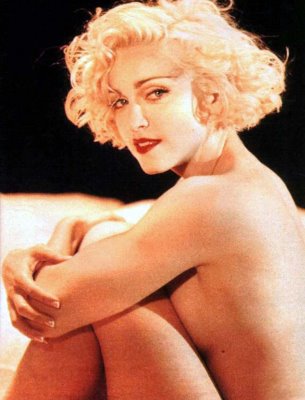
It is dodgy to use celebrities as exemplars, either positive or negative, precisely because we in the public are exposed to an image. We encounter an artifice, a carefully crafted public-relations product rather than a human being. When we see Madonna in a bustier singing to women to express themselves if they want their man, we are watching a commercial. When we hear Lady Gaga sing a song, using a card game as an innuendo for oral sex, we are listening to product placement. When we hear Britney Spears tittering in her breathy soprano, "Oops, I did it again," it is not phony intimacy we hear; it is much worse - the phony come-on of the coquette, made doubly false by its inherent illusory quality as well as the inherent refusal of the coquette.
When anyone uses persons in the entertainment industry as examples of moral turpitude, we are playing the game the industry wants us to play. Whether or not Madonna, or Stefanie, or Britney are or are not sluts is a question they want us to ask so that we will pay attention to them and, hopefully, buy their music. Of course, the persona they create is what we are really purchasing, with the music the soundtrack to our thoughts about them; pushing the boundaries of bourgeois sexual propriety is not only the method by which we are enticed to buy. It is what they are selling.
More than anything, calling these women sluts, bad examples young women should not emulate, is to accept the lie of the image. Even if you believe the constant barrage of carefully placed "rumors" and "stories" in the celebrity press, alleging bad behavior, you are still participating in the game. Here in the entertainment industry, its insistence on visibility and image, we have one of the best examples of capitalism eating itself. On the one hand we have bourgeois morality, with its tsking and tutting about what is and is not "proper" dress and behavior. On the other hand we have millions invested in ensuring these boundaries and mores are clear precisely because they are traduced so thoroughly and consistently.
Which is all the more reason I don't buy moral scolding. Morality has always been a product sold. Whether in ancient times, or feudalism, or in high or late capitalism, the ruling classes have always set out rules for proper conduct, including sexual conduct, which they have refused to apply to themselves. The best examples, of course, come from high and late Victorian England, when a whole striving middle and upper-middle class refused to use the word "breast" when talking about chicken, or covered the legs of tables because it might induce sexual thoughts; all the while the aristocracy was coupling like ferrets in spring time, the only rule being that none of this behavior actually be discussed.
When a group of young women insist that the police not hold them responsible for their possible sexual victimization by labeling their dress or conduct "slutty", this is not acceptable, either, because the word is as much a way of managing the conduct of others as it is a moral epithet. Celebrities can and do dress and act slutty for the public's enjoyment and their profit. A young college student, or a group of friends out on the town, however, are forbidden from imitating this behavior.
Rather than play the game, which is rigged from the get-go, isn't it far better to encourage people to ask uncomfortable questions, including questions regarding how moral epithets are applied? Dragging celebrities in to the mix not only confuses the matter. It also continues to play by the very rules that are being questioned.
Wednesday, December 26, 2007
My Anti-Year In Review
I don't like "Year In Review" things. For one thing, most of what passes through our consciousness is ephemeral, fleeting, replaced tomorrow by something equally if not more important, outrageous, beautiful, exciting, infuriating, hate-filled, loving, you name it. For another thing, there just seems to be few through-lines, or trend lines, or rising/falling fates-features of our public life (unless one takes the Britney Spears career implosion/Lindsay Lohan career implosion/Paris Hilton jail trauma narrative as important; of course, now we have Britney's sister getting pregnant, so it's like an even worse sequel to a really bad movie, straight to video). Finally, this year was, in many ways, prologue to next year - the up-coming Presidential campaign is, to put not too fine a point on it, and to say it for one of the few times that such words will actually mean something, the most important election since 1968, perhaps even since 1932. The Republicans look as if they might nominate no one; the Democratic race is looking tighter, but except for Sen. Clinton, any change at 1600 Pennsylvania Avenue, NW would be significant.
So, rather than look back at a year less than a week away from the history books, I would much rather look forward to 2008. I refuse to make predictions (I don't want to look like Bill Kristol, after all) except to say the year should be interesting, hard on many if not most working people (myself included), and include many surprises.
So, rather than look back at a year less than a week away from the history books, I would much rather look forward to 2008. I refuse to make predictions (I don't want to look like Bill Kristol, after all) except to say the year should be interesting, hard on many if not most working people (myself included), and include many surprises.
Wednesday, July 30, 2008
I'm John McCain And I Approved This Piece Of Racist Garbage
First, a video of the latest McCain ad against Obama. It seems so innocuous. In fact, I think part of it might hurt McCain, reminding people that Obama can get 200,000 people to come out and hear him speak, while McCain has a hard time filling a room without his advance people dragging in local supporters. Yet, it is the first few seconds of the ad that count. Watch, and I'll explain after:
I had seen a reference and commentary on this ad over at Talking Points Memo (to which I shall repair in a moment), but it was watching it in this post at Hullabaloo, in which dday points out that McCain has hired the guy responsible for the Harold Ford "Call me, Harold" ad, perhaps the most transparently racist ad since the Jesse Helms "white hands" ad in 1990, that I was gobsmacked.
Here's the thing. Those images of Britney Spears and Paris Hilton last barely a second, fading out as images fade in. The image of Ms. Hilton fades directly to a picture of Barack Obama smiling. Do I have to spell this out for you? I will be honest and say that, before I saw the ad, I thought this was a bit of a stretch. Indeed, textually, the ad seems to imply that Obama is an empty-headed celebrity, famous for being famous, with policies that don't quite jibe. That might even be a fair criticism to make. Seeing the ad, and the way those images fade out over one another, with the final shot of Obama smiling fading in over a photo of Paris with the only expression she ever wears - I just sat here in my empty house and said, "Wow!"
To be clear, I want to quote at a bit of length from digby's discussion of "racist dogwhistles":
Josh Marshall has a couple things to say about this particular bit of garbage as well.
Not only is he an empty-headed preener dazzled by all the attention he's getting, but he's a (nudge, nudge) black guy who likes (wink, wink) blonde white women (a nod's as good as a wink to a blind bat, eh?). Obviously, the McCain campaign and his supporters will cry foul - how dare they call Sen. Straight Talk a racist? I am not doing any such thing. What I am doing is calling out the subtle racist message encoded in this ad. It is one of those things you can take or leave. If you take it though, you were looking for it, and I mean that in both a positive - Yeah, he's an uppity Negro with a hankering for white meat! - and negative - What a bunch of racist claptrap! - way. Just because it's subtle doesn't mean it doesn't exist.
I had seen a reference and commentary on this ad over at Talking Points Memo (to which I shall repair in a moment), but it was watching it in this post at Hullabaloo, in which dday points out that McCain has hired the guy responsible for the Harold Ford "Call me, Harold" ad, perhaps the most transparently racist ad since the Jesse Helms "white hands" ad in 1990, that I was gobsmacked.
Here's the thing. Those images of Britney Spears and Paris Hilton last barely a second, fading out as images fade in. The image of Ms. Hilton fades directly to a picture of Barack Obama smiling. Do I have to spell this out for you? I will be honest and say that, before I saw the ad, I thought this was a bit of a stretch. Indeed, textually, the ad seems to imply that Obama is an empty-headed celebrity, famous for being famous, with policies that don't quite jibe. That might even be a fair criticism to make. Seeing the ad, and the way those images fade out over one another, with the final shot of Obama smiling fading in over a photo of Paris with the only expression she ever wears - I just sat here in my empty house and said, "Wow!"
To be clear, I want to quote at a bit of length from digby's discussion of "racist dogwhistles":
I think we need to have a little discussion of what "racist dogwhistle" means. It is a word or phrase that conjures up certain subliminal images in those who are predisposed to see things in racial terms. It doesn't mean that everyone who hears the word as a criticism sees it in that way --- only those who get "the code." So, when Karl Rove sends out McCain's minions to spread the word "presumptuous" all over the place, the idea is to signal to the racists among us that Obama is "uppity." It doesn't mean that if you think Obama is presumptuous that you are a racist. You might just think, "yeah, he's acting like it's in the bag already." But racists hear that Obama is an uppity black man.
See, it works on two levels. That's why it's called a dogwhistle --- only the racists can hear the racism in it.
This is a complicated mode of communication that's been developed on the right for many decades. It's not something I just made up. There are dozens of examples: "welfare queen" and "Willie Horton," the "Hands" ad by Jesse Helms and most recently, the Harold Ford "Call Me" ad in 2006. The most famous of all was Ronald Reagan slyly beginning his campaign in Philadelphia, Mississippi, where one of the worst atrocities of the civil rights movement happened. Over the years it's gotten more subtle as the nation becomes less tolerant of overt racism, but it's never completely gone.
Josh Marshall has a couple things to say about this particular bit of garbage as well.
[I]t is the norm that obvious campaign tactics that are treated as obvious after a campaign is over are nonetheless treated by most reporters as ambiguous or unclear during a campaign. But in this case it would be nice if that were not the case. Because here we have a candidate, John McCain, who is running on a record of straight talk and honorable campaigning running a campaign made up mainly of charges reporters are now more or less acknowledging are lies. But there's precious little drawing together of the contradiction. What's more, as everyone will acknowledge after the campaign, the McCain campaign is now pushing the caricature of Obama as a uppity young black man whose presumptuousness is displayed not only in taking on airs above his station but also in a taste for young white women.
Not only is he an empty-headed preener dazzled by all the attention he's getting, but he's a (nudge, nudge) black guy who likes (wink, wink) blonde white women (a nod's as good as a wink to a blind bat, eh?). Obviously, the McCain campaign and his supporters will cry foul - how dare they call Sen. Straight Talk a racist? I am not doing any such thing. What I am doing is calling out the subtle racist message encoded in this ad. It is one of those things you can take or leave. If you take it though, you were looking for it, and I mean that in both a positive - Yeah, he's an uppity Negro with a hankering for white meat! - and negative - What a bunch of racist claptrap! - way. Just because it's subtle doesn't mean it doesn't exist.
Monday, November 22, 2010
Woman Of Our Times
Sarah Palin is unpopular. Her activism on behalf of candidates in her home state, in Delaware, in Nevada backfired. She is an object of ridicule and scorn. Her ghost-written books wither on the shelves. Outside the tiny universe of some right-wing pundits, her continued presence in our national life is a source of a mixture of curiosity, fear, and laughter.
She now has a "reality TV" series on cable.
She is, in short, the perfect politician for our age of fake celebrity. She is the Snookie of politics, Paris Hilton without the cocaine bust, Lindsay Lohan out of rehab, Kim Kardashian in a sweater and muck-lucks. In other words, in a historical moment in which more Americans can identify "The Situation" than the future Speaker of the House of Representatives, Sarah Palin personifies almost to perfection the union of celebrity culture, tabloid journalism, and the destruction of our political sphere.
Her adumbrated tenure as governor of Alaska should not be accounted for by her excuses. Rather, she saw the main chance and grabbed it with both hands. Her record in public office is mixed, at best. The opportunity, however, to move out of the strictures and confines of public service offers action without accountability. No need to appear before those pesky voters with their preferences. No need to answer questions from a press corps that might not be charmed by her faux-folksiness or winning smile.
While I could be wrong (Lord knows I was wrong about the election!), I doubt very much she will run for office ever again. For one thing, despite press attention to her every word, and heavy-hitters in and out of the Republican establishment weighing in on the possibility, she has far more to lose by a run at the Presidency in two years than she could ever gain. She cannot win. I doubt she could win a single primary. Unlike, say, Secretary of State Hillary Clinton, whom most of the press has dubbed "divisive" for two decades, but who actually enjoys pretty broad popularity, Mrs. Palin's approval ratings are dismal. They actually are made worse when she appears in public.
Rather than evaluate her in traditional political terms, we need, rather, to consider her not as a politician at all. Consider the attention paid, for example, to the doings in the Pitt/Jolie household as far more relevant to our understanding of Palin agonistes than anything else. Paris Hilton, Lindsay Lohan, the Kardashian sisters are famous because . . . they are famous. One is the dysfunctional daughter of a hotel magnate. One is the seriously dysfunctional former child actress who has little future in front of her. The Kardashians are the daughters of a now-dead attorney who made his name fifteen years ago during the O J Simpson trial. Beyond these brief descriptions, there is little to attract our attention to them. They are followed, however, by photographers, the ups and downs of their personal lives, including purloined tapes of their private lives and photographs of their private parts displayed in public, because . . . they are famous! They do nothing, contribute nothing, and attract our attention for the same reason a bloody accident does. We all feel better knowing, "At least that isn't me."
Sarah Palin serves much the same function. She is the perfect politician for our historical moment, precisely because she does nothing, offers nothing, seeks only the affirmation of her own celebrity status through our continued attention, and wants nothing more than to continue to be before us, verifying and affirming her own existence for its own sake.
Understood this way, she is no more a threat to the Republic than would be another Britney Spears public meltdown. Entertaining, yes. Sad, too. Relieving because we can gaze upon the unnecessary overdramatization, the too-public nature of what should remain private, and remind ourselves how much better we are. Beyond any of this, she represents the final resting place for failed politicians in our society - to show up on heavy rotation on the cover of US magazine.
Saturday, June 28, 2008
Tabloid Culture, Tabloid Lives
Call this "Lessons I've Learned From Watching CDI, Part II.
I have written several times over the past year and a half on our exploitation of the personal foibles of various celebrities. My own take has changed from a pretty typical liberal "tut-tutting" to a far more open position. I no longer believe that we must make a choice between the Angie/Brad stories and Congressional hearings on torture; one can pay attention, at some level of attention, to both without being either a crude ignoramus or a "serious person". I do not think the increasing incursion of tabloid "journalism" spells the death of the Republic. This last is more the death of journalism as a profession.
At any rate, I think some perspective on tabloid-style reporting is in order, to put what we read in perspective. One of the complaints often lodged against the stories one reads in Us, Life & Style and other such fodder is that they rely on anonymous sources offering rumor and unfounded allegation. The narratives change from week to week as the editors switch from building an individual up to tearing them down.
One thing I think it is important to remember is that these stories focus exclusively on what is extraneous to our reasons for paying attention to these folks in the first place. The exceptions are the so-called "celebutants" like Paris Hilton, Kim Kardashian who have done nothing to warrant our attention and fascination other than keep themselves before the public eye. They are famous for being famous, in other words. Leaving aside the Nicole Richies of the world, we pay attention to the lives of Angelina Jolie and Brad Pitt, Jennifer Aniston and John Mayer, because they attract our attention. They present themselves publicly through their professions as actors, entertainers, musicians, and as such create an illusion of familiarity that is exploited by the tabloids, who attempt to lift the curtain, as it were, on the person behind the persona. Of course, the end result is, more often than not, as much a fiction as the image we see on our movie and television screens. Or, at the very least, only part of the story.
Watching CSI has forced me to think about this particular issue in an interesting light. While itself just a TV series, it nevertheless presents certain commonalities (and not-quite-commonalities) in a way that has forced me to ask a question the answer to which is quite disturbing: Could any of us have our private lives placed under a microscope, all the details spread before those outside, and not appear just as jaded, immoral, and small as some of our celebrities are presented via the tabloids? None of us live exemplary lives. All of us have secrets we prefer to keep hidden. All of us have a fact or event in our lives we would prefer no one know about. Yet, the tabloids offer us a glimpse of some of our most famous names and faces, without make-up, outside the carefully crafted personas of their publicity agents that do not differ all that much from our own foibles, failures, sins and transgressions. The difference, I think, is that we can at least have the satisfaction of seeing that those who present a certain face to the public have far more complicated lives than they wish us to know about. Sometimes, these secrets are so intimate, most of us would no longer show our faces should that aspect of our lives become public knowledge. Would any of my readers survive having our sexual exploits available to public inspection the way, say Pamela Anderson has done? I admire her strength of character precisely because having that most intimate and secretive part of one's life suddenly become so graphic a part of our common currency of images would most certainly destroy me.
The tabloids are successful for a variety of reasons, although I think mindlessness isn't one of them. Rather, they are successful because they remind us that those society determines are to become well known by wide swaths of the public are just human beings. No more, no less. Angelina Jolie is not to be considered some kind of freak because she desires to adopt children from poor countries, even as she continues her recovery from substance abuse. Britney Spears needs our prayers and good thoughts, rather than church-lady head shaking for her various public melt-downs. None of us are any better, and quite a few of us are far worse. In the end, the tabloids succeed because the lives they present are no different from our own. We are a tabloid society. The checkout-line magazine racks just highlight this obvious reality.
I have written several times over the past year and a half on our exploitation of the personal foibles of various celebrities. My own take has changed from a pretty typical liberal "tut-tutting" to a far more open position. I no longer believe that we must make a choice between the Angie/Brad stories and Congressional hearings on torture; one can pay attention, at some level of attention, to both without being either a crude ignoramus or a "serious person". I do not think the increasing incursion of tabloid "journalism" spells the death of the Republic. This last is more the death of journalism as a profession.
At any rate, I think some perspective on tabloid-style reporting is in order, to put what we read in perspective. One of the complaints often lodged against the stories one reads in Us, Life & Style and other such fodder is that they rely on anonymous sources offering rumor and unfounded allegation. The narratives change from week to week as the editors switch from building an individual up to tearing them down.
One thing I think it is important to remember is that these stories focus exclusively on what is extraneous to our reasons for paying attention to these folks in the first place. The exceptions are the so-called "celebutants" like Paris Hilton, Kim Kardashian who have done nothing to warrant our attention and fascination other than keep themselves before the public eye. They are famous for being famous, in other words. Leaving aside the Nicole Richies of the world, we pay attention to the lives of Angelina Jolie and Brad Pitt, Jennifer Aniston and John Mayer, because they attract our attention. They present themselves publicly through their professions as actors, entertainers, musicians, and as such create an illusion of familiarity that is exploited by the tabloids, who attempt to lift the curtain, as it were, on the person behind the persona. Of course, the end result is, more often than not, as much a fiction as the image we see on our movie and television screens. Or, at the very least, only part of the story.
Watching CSI has forced me to think about this particular issue in an interesting light. While itself just a TV series, it nevertheless presents certain commonalities (and not-quite-commonalities) in a way that has forced me to ask a question the answer to which is quite disturbing: Could any of us have our private lives placed under a microscope, all the details spread before those outside, and not appear just as jaded, immoral, and small as some of our celebrities are presented via the tabloids? None of us live exemplary lives. All of us have secrets we prefer to keep hidden. All of us have a fact or event in our lives we would prefer no one know about. Yet, the tabloids offer us a glimpse of some of our most famous names and faces, without make-up, outside the carefully crafted personas of their publicity agents that do not differ all that much from our own foibles, failures, sins and transgressions. The difference, I think, is that we can at least have the satisfaction of seeing that those who present a certain face to the public have far more complicated lives than they wish us to know about. Sometimes, these secrets are so intimate, most of us would no longer show our faces should that aspect of our lives become public knowledge. Would any of my readers survive having our sexual exploits available to public inspection the way, say Pamela Anderson has done? I admire her strength of character precisely because having that most intimate and secretive part of one's life suddenly become so graphic a part of our common currency of images would most certainly destroy me.
The tabloids are successful for a variety of reasons, although I think mindlessness isn't one of them. Rather, they are successful because they remind us that those society determines are to become well known by wide swaths of the public are just human beings. No more, no less. Angelina Jolie is not to be considered some kind of freak because she desires to adopt children from poor countries, even as she continues her recovery from substance abuse. Britney Spears needs our prayers and good thoughts, rather than church-lady head shaking for her various public melt-downs. None of us are any better, and quite a few of us are far worse. In the end, the tabloids succeed because the lives they present are no different from our own. We are a tabloid society. The checkout-line magazine racks just highlight this obvious reality.
Sunday, November 30, 2008
Another America-Hating Liberal Speaks Out
The only thing I tire of more than hearing Britney Spears' "Womanizer" is reading the folks at American Descent talk about how America doesn't torture. It's tiresome because it's demonstrably false, but no matter how much evidence piles up, no matter how many testimonies come out, not just from the victims but the perpetrators, it lands upon their ears like snow in the Sahara.
Think Progress notes another first-hand account.
I am quite sure that there will all sorts of verbal gymnastics and intellectual contortions employed to "prove" that the writer (a) isn't who he claims to be; (b) is overstating the use of various torture techniques; (c) admits there is no way to prove that torture has hurt the pursuit of our interests anyway, if it were used. Since folks who manage to employ each and every one of these arguments are impermeable to reason, I'll leave it to the rest of you to make of it what is obviously there:
It is obvious that this soldier is an enemy of the state and should be shot immediately.
Think Progress notes another first-hand account.
I am quite sure that there will all sorts of verbal gymnastics and intellectual contortions employed to "prove" that the writer (a) isn't who he claims to be; (b) is overstating the use of various torture techniques; (c) admits there is no way to prove that torture has hurt the pursuit of our interests anyway, if it were used. Since folks who manage to employ each and every one of these arguments are impermeable to reason, I'll leave it to the rest of you to make of it what is obviously there:
I learned in Iraq that the No. 1 reason foreign fighters flocked there to fight were the abuses carried out at Abu Ghraib and Guantanamo. Our policy of torture was directly and swiftly recruiting fighters for al-Qaeda in Iraq. … It’s no exaggeration to say that at least half of our losses and casualties in that country have come at the hands of foreigners who joined the fray because of our program of detainee abuse. The number of U.S. soldiers who have died because of our torture policy will never be definitively known, but it is fair to say that it is close to the number of lives lost on Sept. 11, 2001. How anyone can say that torture keeps Americans safe is beyond me — unless you don’t count American soldiers as Americans.
It is obvious that this soldier is an enemy of the state and should be shot immediately.
Sunday, February 04, 2007
I Guess I'm un-American
I couldn't care less about the Super Bowl today. Not if Dick Cheney and Condoleeza Rice threatened to come to my house and explain to me what victory in Iraq would look like; not if Ted Haggard would explain how he is being cured of being a gay man by a bunch of closeted homosexuals; not if the Britney Spears/Paris Hilton sex video were played at half-time - if any of these things occurred, the amount of emotional and other energy I would put into the game would still be less than zero. That's right, I actually am working at not caring.
I do wish I didn't sound tedious, or earnest, or sophomoric, or humorless, but I just can't seem to get excited about what is, after all, less a football game than it is a media event when things are the way they are - here at home, in Washington, in Iraq, and maybe, just horribly maybe, in the Persian Gult as we race towards an apocalypse with Iran. The whole thing is about as fake as it gets, and the worst thing is that people get sucked into it - they feel they have to go to parties, or hold parties, or root for one team or another, or bet in office pools, or whatever. Just because everyone else is.
No, you don't.
I wish you all a football-free, hype-free, care-free Sunday. Spend the time watching a good movie, having special time with a significant other, shopping at your favorite store (everyone else will be somewhere watching the game, so even malls will be empty), or listening to your favorite music and reading a book. Anything but switching on the idiot box and watching a game that really, really, doesn't mean a thing, listening to imbeciles prattle on as if anyone cared ot listen to them. Commentators are a hold-over from the days of radio, a hold-over that should be discarded. I think we can watch the game without being told what is happening.
DO I sound like your typical humorless liberal yet? Good. The whole thing is making me so grumpy, I think I need to go listen to some Tom Waits to cheer me up. Enjoy the rest of your day.
I do wish I didn't sound tedious, or earnest, or sophomoric, or humorless, but I just can't seem to get excited about what is, after all, less a football game than it is a media event when things are the way they are - here at home, in Washington, in Iraq, and maybe, just horribly maybe, in the Persian Gult as we race towards an apocalypse with Iran. The whole thing is about as fake as it gets, and the worst thing is that people get sucked into it - they feel they have to go to parties, or hold parties, or root for one team or another, or bet in office pools, or whatever. Just because everyone else is.
No, you don't.
I wish you all a football-free, hype-free, care-free Sunday. Spend the time watching a good movie, having special time with a significant other, shopping at your favorite store (everyone else will be somewhere watching the game, so even malls will be empty), or listening to your favorite music and reading a book. Anything but switching on the idiot box and watching a game that really, really, doesn't mean a thing, listening to imbeciles prattle on as if anyone cared ot listen to them. Commentators are a hold-over from the days of radio, a hold-over that should be discarded. I think we can watch the game without being told what is happening.
DO I sound like your typical humorless liberal yet? Good. The whole thing is making me so grumpy, I think I need to go listen to some Tom Waits to cheer me up. Enjoy the rest of your day.
Wednesday, March 16, 2011
Killing The Record Industry One Song At A Time
My friend Greg, who is also the guy for whom I work as a DJ, turned me on to the documentary, Before the Music Dies. It's available free, as you may have discovered if you clicked the link, at Hulu.com. A look at the hazards and potential of our current historic moment as regards music - the depredations of the music industry, corporate consolidation in commercial radio, and the MTV effect on the one hand; the availability of inexpensive recording tools and distribution networks from social media to small labels to other internet sources - the film is a definite must-see for any music fan.
With the advent of Justin Bieber over the past year, and the threat of a new Britney Spears record on the horizon, this film reminds us that while the destruction of both commercial radio and the record industry in the name of profit is an opportunity for musicians to get their music heard, and for fans of music - any kind of music - to hear incredible, strange, marvelous, wonderful stuff.
The film opens with the following clip, leaving this viewer with the dreadful thought that, as the record industry has existed for the past twenty years or so, nothing like this could have been produced. Thankfully, technology and a desire for hearing something new, really new, is keeping the door open for all sorts of people who might otherwise never get a chance to be heard. So, hear are Ray and Billy, ladies and gentlemen.
Oh, yeah, here are ten random songs, just because randomness is a threat.
Two Lovers - Mary Wells
Southern Point - Grizzly Bear
Runaway - The National
Up for the Downstroke - Parliament/Funkadelic
Larks Tongue in Aspic, Part III (Live) - King Crimson
Ommie Wise - G. B. Grayson (Anthology of American Folk Music)
Ben - Michael Jackson
Harold The Barrel - Genesis
Kneel and Disconnect - Porcupine Tree
I Ka Barra - Habib Koite and Bamada
This song just missed my random list, literally. All the same, it may well be my favorite song of all time. If I were stranded on a desert island, and didn't have this song, I'm not sure how I would survive. I think God put Marvin Gaye on this earth to record the album What's Going On, and this title track is just about perfect in every way.
With the advent of Justin Bieber over the past year, and the threat of a new Britney Spears record on the horizon, this film reminds us that while the destruction of both commercial radio and the record industry in the name of profit is an opportunity for musicians to get their music heard, and for fans of music - any kind of music - to hear incredible, strange, marvelous, wonderful stuff.
The film opens with the following clip, leaving this viewer with the dreadful thought that, as the record industry has existed for the past twenty years or so, nothing like this could have been produced. Thankfully, technology and a desire for hearing something new, really new, is keeping the door open for all sorts of people who might otherwise never get a chance to be heard. So, hear are Ray and Billy, ladies and gentlemen.
Oh, yeah, here are ten random songs, just because randomness is a threat.
Two Lovers - Mary Wells
Southern Point - Grizzly Bear
Runaway - The National
Up for the Downstroke - Parliament/Funkadelic
Larks Tongue in Aspic, Part III (Live) - King Crimson
Ommie Wise - G. B. Grayson (Anthology of American Folk Music)
Ben - Michael Jackson
Harold The Barrel - Genesis
Kneel and Disconnect - Porcupine Tree
I Ka Barra - Habib Koite and Bamada
This song just missed my random list, literally. All the same, it may well be my favorite song of all time. If I were stranded on a desert island, and didn't have this song, I'm not sure how I would survive. I think God put Marvin Gaye on this earth to record the album What's Going On, and this title track is just about perfect in every way.
Sunday, January 28, 2007
Elitism
I used to be a proud elitist. I admit it with only the embarrassment that comes from revealing some other non-dangerous vice. I used to be quite proud of myself, of the books I read, the music to which I listened, to my education status. I used to think it was important to make distinctions between what was just mediocre or popular or otherwise middle- to low-brow and what was truly excellent and good and true. I was most proud of the fact that I recognized this distinction and counted myself above those benighted masses who could not.
Life and experience have made me completely reject the very idea of elitism as anything other than an epithet tossed about by those who feel inadepquate when confronted by others who may know something they do not, or who may feel intimidated by those who are better educated, or better looking, or whatever. Conversely, there are elitists who truly believe the nonsense that most Americans are knuckle-draggin morons who prefer "American Idol" to discussing politics, art, music, or whatever. They disdain such fools, granting to themselves the privilege of being among those who understand quality. I know such people, and politely detest them, because they are usually smug, ignorant, small-minded, and as locked within their own world-views as those benighted, bedraggled masses they wish to elevate themselves from.
When I recognized that, far from making myself better, I was just making myself different from others because of what I choose to read, listen to, view, etc., I was suddenly free from the burden of being among an anointed minority staving off a new Dark Age in the wake of FOX TV, Paris Hilton, and a new CD from Britney Spears. I no longer judge other people for the choices they make - or do not make - concerning a whole host of things cultural, educational, intellectual, or otherwise, because, quite frankly, one man's meat is another man's poison, and I refuse to poison anyone in the belief that it is steak for all.
Another thing that forced me to rethink the whole elitism thing was actually listening to what other people said, whether it was about politics, about music, about religion, or whatever. Once I had completely absorbed my father's oft stated dictum that I "don't know every goddamn thing", I realized - lo, and behold! - there is an abundance of wisdom and understanding out there, and it is free for the taking as long as one is open to it. While still trapped within my own skull, as are we all, I no longer limit myself to seeing through my own eyes, but imaginatively live with and see with other lives and through other eyes. I engage others as equally befuddled stumblers through the world, trying, sometimes successfully, sometimes not, but never surrendering. Once I realized that disagreeing with me did not make another person wrong - that is, absolutely wrong in some final epistemological and ontological sense - I was free to engage in lively debate, holding firmly to my positions, but listening to others and finding myself changing my mind once in a while.
One of the biggest challenging the liberal/progressive movement today is a pervasive elitism, manifest often by those who find that disagreement means fundamental error. As time has not ended, history continues, and entropy unfolds around us, we progressives may currently have the better arguments, the preponderance of the evidence, and many of those same benighted masses behind us; this does not make us "right" in some ultimate sense. It only makes us, to steal a quote, right now. A bit of humility is in order, a bit of listening, a bit less schadenfreude (no matter how good it feels!).
Life and experience have made me completely reject the very idea of elitism as anything other than an epithet tossed about by those who feel inadepquate when confronted by others who may know something they do not, or who may feel intimidated by those who are better educated, or better looking, or whatever. Conversely, there are elitists who truly believe the nonsense that most Americans are knuckle-draggin morons who prefer "American Idol" to discussing politics, art, music, or whatever. They disdain such fools, granting to themselves the privilege of being among those who understand quality. I know such people, and politely detest them, because they are usually smug, ignorant, small-minded, and as locked within their own world-views as those benighted, bedraggled masses they wish to elevate themselves from.
When I recognized that, far from making myself better, I was just making myself different from others because of what I choose to read, listen to, view, etc., I was suddenly free from the burden of being among an anointed minority staving off a new Dark Age in the wake of FOX TV, Paris Hilton, and a new CD from Britney Spears. I no longer judge other people for the choices they make - or do not make - concerning a whole host of things cultural, educational, intellectual, or otherwise, because, quite frankly, one man's meat is another man's poison, and I refuse to poison anyone in the belief that it is steak for all.
Another thing that forced me to rethink the whole elitism thing was actually listening to what other people said, whether it was about politics, about music, about religion, or whatever. Once I had completely absorbed my father's oft stated dictum that I "don't know every goddamn thing", I realized - lo, and behold! - there is an abundance of wisdom and understanding out there, and it is free for the taking as long as one is open to it. While still trapped within my own skull, as are we all, I no longer limit myself to seeing through my own eyes, but imaginatively live with and see with other lives and through other eyes. I engage others as equally befuddled stumblers through the world, trying, sometimes successfully, sometimes not, but never surrendering. Once I realized that disagreeing with me did not make another person wrong - that is, absolutely wrong in some final epistemological and ontological sense - I was free to engage in lively debate, holding firmly to my positions, but listening to others and finding myself changing my mind once in a while.
One of the biggest challenging the liberal/progressive movement today is a pervasive elitism, manifest often by those who find that disagreement means fundamental error. As time has not ended, history continues, and entropy unfolds around us, we progressives may currently have the better arguments, the preponderance of the evidence, and many of those same benighted masses behind us; this does not make us "right" in some ultimate sense. It only makes us, to steal a quote, right now. A bit of humility is in order, a bit of listening, a bit less schadenfreude (no matter how good it feels!).
Saturday, April 27, 2013
Entitlement
Words get bandied about in our national conversations without too much thought. Social Security, for example, is often called an "entitlement" program in a way that sounds disparaging. In fact, recipients of Social Security benefits - not just retirement benefits, but the Supplemental Security Income program and other benefits Social Security pays - are, indeed, entitled to them. Because they've paid in to the system. It's their money, after all, and so it isn't exactly something people are receiving for no reason.
According to the Merriam-Webster Online Dictionary and Thesaurus, the word entitlement has three distinct definitions. It is the third on which I prefer to focus attention at the moment: belief that one is deserving of or entitled to certain privileges. With all the discussion recently about rape, one thing emerges quite clearly. Too many men, young and old, feel a sense of entitlement when it comes to women. If they've taken a woman out on a date, they are entitled to something in return. If a woman has had sex with other men, then they are entitled to have sex with her. If a woman begins an intimate encounter with a man, the man is entitled to full consummation.
If a young man, or young men, are accused of raping a woman, the man is entitled to defend himself, this is true. Too often, that defense assumes a certain air of entitlement. Consider the young men in the Stuebenville rape case. The assumption was the town would rally to their defense; their coach, their parents, the teachers and school administration, all would come to defend them. The victim in this case, however, was entitled to no such presumption of social care and concern. She was attacked online and in the press. She received death threats, threats of further sexual assault, her reputation was attacked. When the young men were convicted, the best they could come up with as an apology was an admission that passing around photos of the young woman's violated body wasn't a good idea. Not that forcing a young woman to drink to unconsciousness, then raping her, then putting her in a car and taking her elsewhere to do it all again, sharing the event with friends; not that any of this was wrong.
Or consider some concern-trolling Beyonce has received.
We swim in a sea of male entitlement, and fighting back against it takes a lot of work. The first thing we need to do is get men to understand that we do not deserve anything from anyone just because our genitals are different. If we really want a different world, a better world, the first thing we need to do is give up the idea that we are entitled to dictate the terms of that change.
*And could we please just dispense with the idea that public figures are role models? This on-going, desperate search for idols to worship is really quite troubling. Most young people are intelligent enough to know their role models are their parents; that's who they rebel against, after all. Celebrities, athletes, politicians are NOT role models.
**When Beth Spencer highlighted this comment at Lawyers, Guns, & Money, there was a whole lot of manspalinin' in the comment section. At a liberal blog. Which, again, shows how far we still have to go.
According to the Merriam-Webster Online Dictionary and Thesaurus, the word entitlement has three distinct definitions. It is the third on which I prefer to focus attention at the moment: belief that one is deserving of or entitled to certain privileges. With all the discussion recently about rape, one thing emerges quite clearly. Too many men, young and old, feel a sense of entitlement when it comes to women. If they've taken a woman out on a date, they are entitled to something in return. If a woman has had sex with other men, then they are entitled to have sex with her. If a woman begins an intimate encounter with a man, the man is entitled to full consummation.
If a young man, or young men, are accused of raping a woman, the man is entitled to defend himself, this is true. Too often, that defense assumes a certain air of entitlement. Consider the young men in the Stuebenville rape case. The assumption was the town would rally to their defense; their coach, their parents, the teachers and school administration, all would come to defend them. The victim in this case, however, was entitled to no such presumption of social care and concern. She was attacked online and in the press. She received death threats, threats of further sexual assault, her reputation was attacked. When the young men were convicted, the best they could come up with as an apology was an admission that passing around photos of the young woman's violated body wasn't a good idea. Not that forcing a young woman to drink to unconsciousness, then raping her, then putting her in a car and taking her elsewhere to do it all again, sharing the event with friends; not that any of this was wrong.
Or consider some concern-trolling Beyonce has received.
She has been the target of a lot of discussion, beginning in February with her performance at the Super Bowl halftime show. There was this near-universal shriek of horror at a woman daring, among other things, to display her body and include her sexuality as an attribute not for delectation but of inherent power. Consider for example, Madonna, who's decades-long metamorphoses have always seemed rooted in an assurance that she will be yours; unlike, to take another example, Britney Spears, who was offered up as fodder for older men to ogle a too-young girl, insisting she wasn't "that innocent" in a way that came far too close to the edge of child pornography; and like a contemporary of Ms. Knowles, Lady Gaga, whose sexuality is simultaneously on display and downplayed precisely because it is part and parcel of a far larger set of attributes she wishes to show the world; like these - and so many other female performing artists - Beyonce always stands on the thin blade of a very sharp sword. Regardless of what she does or how she presents herself, there will be those who either insist she overplays her sexuality; or, conversely, that by not emphasizing her sexuality enough, she is losing an opportunity, variously, to be a "role model"* for young women, or be a bad "role model" for young women. Through all this, there is the assumption that women's sexuality is not their own but rather a thing to be used and manipulated by and for men. As one commenter wrote at Raw Story:When Beyonce kicked off her Mrs. Carter Show World Tour two nights ago, wearing her sheer bodysuit with nipples showing, to me she performed the final degradation of her talent; a retrogressive transformation that has taken someone stellar and otherworldly, and made them into something dreadfully familiar and sad.Variations of Beyonce's body suit can be found in brothels, strip clubs and red light districts across the world - where sex is for sale and it happens to be dispensed through a woman's body. That she is a human being with feelings and dreams, perhaps a sister, a mother, a leader, a teacher, a student - ALWAYS - a daughter - all of this can be forgotten. In those surroundings a suit like Beyonce's would look far from glamorous. Maybe just downright heartbreaking as a woman somewhere becomes an object, available for the gratification of a desire - at a price dictated by her 'managers'.
Women are like a beautiful work of art, they should never be hidden behind a curtain (burka) - Iranians are making their country less beautiful by covering women.Women are not people, who can choose how to live their lives, including the manner, time, and place during which they may or may not display their sexuality among their other attributes. Rather, women are a thing, a product to be seen gazing through a store window or museum, to be judged not by whatever merits they might possess, but rather on how they add to the beauty of the world.** The point is not the integrity of the women, their agency in the world, or the freedom to live their lives as they see fit. Rather, the point is that men are entitled to enjoy women as they see fit. Women step out of line by displaying their sexuality in a way men disapprove? They get slut shamed, like Beyonce was at Huffington Post, and all around Twitter and Facebook after the Super Bowl halftime show. Women in positions of power and authority who dare to act like the boss? Obviously, they're bitchy, unapproachable harridans who just aren't feminine enough. Because, you know, men know what it is to be "feminine" and any woman who isn't "feminine" needs a stern talking-to.
We swim in a sea of male entitlement, and fighting back against it takes a lot of work. The first thing we need to do is get men to understand that we do not deserve anything from anyone just because our genitals are different. If we really want a different world, a better world, the first thing we need to do is give up the idea that we are entitled to dictate the terms of that change.
*And could we please just dispense with the idea that public figures are role models? This on-going, desperate search for idols to worship is really quite troubling. Most young people are intelligent enough to know their role models are their parents; that's who they rebel against, after all. Celebrities, athletes, politicians are NOT role models.
**When Beth Spencer highlighted this comment at Lawyers, Guns, & Money, there was a whole lot of manspalinin' in the comment section. At a liberal blog. Which, again, shows how far we still have to go.
Sunday, December 30, 2007
I've Been Tagged By The GOM
I just discovered that I have been meme-tagged by none other than William Gladstone, the great nineteenth century British statesman who continues to live and prosper and offer his vision for his upcoming (in 2009) 200th birthday. Eight "aspirations" (predictions) for the coming year (I have to say that I am only doing this because I have been tagged by a personage of Gladstone's greatness; otherwise, I would not do so):
- I predict that a brokered Republican convention will settle on Newt Gingrich as the nominee; he will lose 49 states and the District of Columbia;
- I predict that, after Clinton and Obama destroy one another in the early primaries, John Edwards emerges as the Democratic front-runner, especially after winning several southern primaries, including Florida and South Carolina;
- I predict that David Broder will die of a brain aneurysm when it becomes clear that Edwards will be the Democratic nominee;
- I predict that George Will will quote everyone from Ignatius of Antioch to Wittgenstein to prove that Edwards is outside the mainstream of western thought;
- I predict that Edwards' running mate will be Dennis Kucinich;
- I predict that most of the music played on commercial radio will suck;
- I predict that Lindsay Lohan and Britney Spears will both go in to rehab, and fall off the wagon (OK, so that was an easy one);
- I predict that Focus on the Family will proclaim the end of Christianity in America when Edwards/Kucinich are elected, even as Edwards celebrates his election in his home church in North Carolina, thus providing the final nail in the coffin to the sanity of Focus on the Family.
Some of the predictions are serious. Some are not. I'll leave it to the reader to decide which is which.
- I predict that a brokered Republican convention will settle on Newt Gingrich as the nominee; he will lose 49 states and the District of Columbia;
- I predict that, after Clinton and Obama destroy one another in the early primaries, John Edwards emerges as the Democratic front-runner, especially after winning several southern primaries, including Florida and South Carolina;
- I predict that David Broder will die of a brain aneurysm when it becomes clear that Edwards will be the Democratic nominee;
- I predict that George Will will quote everyone from Ignatius of Antioch to Wittgenstein to prove that Edwards is outside the mainstream of western thought;
- I predict that Edwards' running mate will be Dennis Kucinich;
- I predict that most of the music played on commercial radio will suck;
- I predict that Lindsay Lohan and Britney Spears will both go in to rehab, and fall off the wagon (OK, so that was an easy one);
- I predict that Focus on the Family will proclaim the end of Christianity in America when Edwards/Kucinich are elected, even as Edwards celebrates his election in his home church in North Carolina, thus providing the final nail in the coffin to the sanity of Focus on the Family.
Some of the predictions are serious. Some are not. I'll leave it to the reader to decide which is which.
Tuesday, December 18, 2007
James Lipton's Last Questions
Via Hapa Theology, discovered via Erudite Redneck, comes the following questions, which are standard fare on James Lipton's From The Actor's Studio on Bravo:
What is your favorite word?
"Flabbergasted". It seems like a nonsense word to me, but it has such a nice sound. One does not need it defined when one hears it, because its meaning seems to obvious.
What is your least favorite word?
"Fiduciary". It sounds like a social disease.
What turns you on creatively, spiritually or emotionally?
Creatively - a good melody; spiritually - openness and a lack of fear; emotionally - the same as spiritually.
What turns you off?
Following rules that don't make any sense. Also, anti-intellectualism. Anyone who thinks that another person thinks too much, writes too much, or shows off how much they know drives me nuts (probably because I've had that tossed at me quite a bit).
What is your favorite curse word?
"Horseshit". I liked the way my parents used it. The flow from the "s" to the "sh" can be either smooth or not, but it does seem to be not a natural move in English. Once you get it nailed with this word - sounding both within a single flow - it works far better that the far more common exclamation of bovine excrement.
What sound or noise do you love?
My children's laughter. My wife's sighs. My church singing. The bank teller saying, "Here's your money, sir."
What sound or noise do you hate?
Britney Spears singing.
What profession other than your own would you like to attempt?
Since I don't have a profession, any would do.
What profession would you not like to do?
Accountant.
If Heaven exists, what would you like to hear God say when you arrive at the Pearly Gates?
"Here's what you got right" and shows me a pad from a pocket notebook with the word "Loved his family" on it. "Here's what you got wrong" and unrolls a computer printout seven and a half feet wrong - all blank.
What is your favorite word?
"Flabbergasted". It seems like a nonsense word to me, but it has such a nice sound. One does not need it defined when one hears it, because its meaning seems to obvious.
What is your least favorite word?
"Fiduciary". It sounds like a social disease.
What turns you on creatively, spiritually or emotionally?
Creatively - a good melody; spiritually - openness and a lack of fear; emotionally - the same as spiritually.
What turns you off?
Following rules that don't make any sense. Also, anti-intellectualism. Anyone who thinks that another person thinks too much, writes too much, or shows off how much they know drives me nuts (probably because I've had that tossed at me quite a bit).
What is your favorite curse word?
"Horseshit". I liked the way my parents used it. The flow from the "s" to the "sh" can be either smooth or not, but it does seem to be not a natural move in English. Once you get it nailed with this word - sounding both within a single flow - it works far better that the far more common exclamation of bovine excrement.
What sound or noise do you love?
My children's laughter. My wife's sighs. My church singing. The bank teller saying, "Here's your money, sir."
What sound or noise do you hate?
Britney Spears singing.
What profession other than your own would you like to attempt?
Since I don't have a profession, any would do.
What profession would you not like to do?
Accountant.
If Heaven exists, what would you like to hear God say when you arrive at the Pearly Gates?
"Here's what you got right" and shows me a pad from a pocket notebook with the word "Loved his family" on it. "Here's what you got wrong" and unrolls a computer printout seven and a half feet wrong - all blank.
Monday, September 10, 2007
This Magic Moment
So Gen. Petraeus and Amabassador Crocker are before two Congressional Committees today in the premiere of The September Report. One would be more enthusiastic about this if there were some indication that either one of them would do anything other than toe the Administration line, plead for more time, more money, and more patience. As all the independent, thoughtful Generals have either been fired or quit in disgust, we are left with this toadying sycophant and his mindless civilian counterpart mouthing words we have heard so many times before.
The worst part about it is that it is, and was specifically, so predicted and predictable. What are we left with? Nothing, of course, except a "defense" of the status quo, with the Democrats mouthing meaningless protests and the entire Republican political and media establishment are praising the greatness and purity of Petraeus, and the Absolute Truth of Every Word that flows from his mouth. Meanwhile, in the real world, Iraqis and Americans continue to die, with no strategy on one side and political chaos on the other. All during the 1990's, we kept hearing from Republicans that the Washington Establishment was irrelevant to the lives of Real Americans. Now, we are seeing that it is irrelevant even to the conduct of the war. They have at least managed to make their complaints reality, at the cost of only a few thousand ordinary lives.
Of course, the real news is Britney Spears' abysmal performance at the VMAs last night.
The worst part about it is that it is, and was specifically, so predicted and predictable. What are we left with? Nothing, of course, except a "defense" of the status quo, with the Democrats mouthing meaningless protests and the entire Republican political and media establishment are praising the greatness and purity of Petraeus, and the Absolute Truth of Every Word that flows from his mouth. Meanwhile, in the real world, Iraqis and Americans continue to die, with no strategy on one side and political chaos on the other. All during the 1990's, we kept hearing from Republicans that the Washington Establishment was irrelevant to the lives of Real Americans. Now, we are seeing that it is irrelevant even to the conduct of the war. They have at least managed to make their complaints reality, at the cost of only a few thousand ordinary lives.
Of course, the real news is Britney Spears' abysmal performance at the VMAs last night.
Sunday, March 11, 2012
Nothing Matters And What If It Did?
When I was a graduate student at The Catholic University of America, I took what I thought would be a seminar on Aristotle's Politics. The professor was one of the most popular, well-respected scholars teaching in the School of Philosophy. I'd taken a course on moral philosophy from him and the seminar was to be the first of two parts, the second being a seminar on Hobbes' Leviathan. The problem, however, was that there were almost thirty people signed up for a graduate seminar. It turned from an intimate discussion of issues within a classic text to a long, tedious line-by-line exegesis. About half way through the semester, a student interrupted the monotone presentation of yet another ridiculously boring read-through with a simple question: "Who was Aristotle writing for?"
The professor paused and said, "Why, he was writing for the ages."
At that point, I realized I would get nothing out of the rest of the class.
No one, certainly not Aristotle, ever does anything for the ages. Aristotle didn't because the very concept would have been unintelligible to him. The Greeks had no such concept. We, who supposedly have some kind of historical consciousness, are led to believe that if our lives are to have meaning, we are to make a mark that lasts. Even an ahistorical hyper-romantic like Richard Rorty wrote in Contingency, Irony, and Solidarity that the best any of us can do is add a line or two to the poem of the world.
Neil Strauss's Everyone Loves You When You're Dead: Journeys Into Fame And Madness has an "Epilogue" that, if anyone had been paying attention, was redundant. Setting out eleven "lessons" that shaped the structure and narrative framework of the sprawling set of interviews - bits and pieces that span two decades, 228 in all - they all return to what Strauss says was the impetus behind the formation of the book: Does what we do have any meaning?
A long-time rock journalist and critic, working with publications as various as The New York Times, Spin, Esquire, Maxim, and The Village Voice, Strauss has also published works written in co-operation with Motley Crue and Marilyn Manson, Dave Navarro, and porn/pop phenom Jenna Jameson. The subjects span from Chuck Berry, Jerry Lee Lewis, and Bo Diddley through Led Zeppelin, Pink Floyd, and Eric Clapton, and Bruce Sprinsteen to Snoop Dogg, Wu-Tang Clan, The Backstreet Boys, Lady Gaga, and The White Stripes. Some of the subjects, like Trent Reznor, Clapton, Springsteen, and Snoop Dogg, and Marilyn Manson, seem held-together (except, of course, Reznor was in the midst of a years-long heroin addiction; even for that, the parts of his interview seem the most honest even if self-deprecating). Others, such as Jonathan Davis from Korn, Julian Casblancas from The Strokes, Twiggy Ramirez from Marilyn Manson, Question Mark from Question Mark and the Mysterians, rapper The Game, and Christina Aguilera are, variously, neurotic, drunk, coked up, schizophrenic, and too self-absorbed to comprehend how much of a flash-in-the-pan he is. The end result is not so much an exploration of the single meta-question that drove this work as a series of quick-cut presentations that, while interesting in and for themselves, accumulate weight over time. The question of meaning, makes itself clear from page one, where a drunken Julian Casablancas dodges an interview by getting so stupidly drunk, the interview becomes a lesson in and of itself of the dangers and threat posed by fame.
In our capitalist society, the question of meaning is usually relegated to an interesting non-sequitur. For the people whose interviews are within the pages of this book, however, the question of the meaning of their work is paramount. One story Strauss catalogs, the loss and recovery of a set of costumes from a Country Music Wax Museum that closed in the 1980's; the costumes were all original sets of clothing donated by various figures from Jimmie Rogers and Johnny Cash to Barbara Mandrell and Minnie Pearl. Quite apart from the monetary value, the historical significance of sets of clothing can be debated.
Or can it?
Reading the back story to the search and discovery of the clothing, I couldn't help but think, "Wow, all those old costumes. First they were gone, now they're back." I think most anyone, even someone not particularly interested in country music, or pop culture more broadly, would agree this is an issue of significant importance. It's a connection, a very real connection, between people. The black shirts Johnny Cash would wear; the hair and bell-bottoms Barbara Mandrell was famous for; Minnie Pearl's hats - these are symbols that tell us who these people were as performers. They signify what they meant to us and for us.
Some of the people whose interviews Strauss includes got lost somewhere along the way. Either through drugs or fragile psyches or chronic, untreated mental illness or (as in the case, say, of Brian Wilson) some combination of all three, what made them who they once were is destroyed. Like everything else in our capitalist society, the producers of our popular culture have become disposable commodities; planned obsolescence isn't just about a new car model every year. No one expected Chuck Berry to continue performing in to the first decade of the 21st century. No one thought The Beach Boys were creating a template for pop music writing and production that would continue even as the technology for music production exploded. No one thought Trent Reznor would make it through his years of rage and heroin to win multiple Academy Awards for soundtrack composition.
No one thought an illiterate share-cropper from Mississippi named Otha Turner would, at the age of 91, be one of the last in a legacy of fife-and-drum performers who would be able to continue his legacy of a dying, marginal musical form that has roots to African fife-and-drum rituals because a few enterprising, interested journalists and musical ethnographers would insist listening to him was important.
Yet all these things, and so much more, are indeed important. They have meaning because, despite the totalitarian insistence of capitalism that meaning is irrelevant, a question best left to drunk college students or stoned-out bohemians who have nothing of substance to contribute, all these - and so much more - tell us who we are.
Nothing makes that more clear than the chapter entitled "Cannibalism Is The Answer". Holding a mirror up to America over the past couple decades, we see an ugliness of racism, idiotic superficiality, and triumphant over-coming that boggles the mind. Whether its the Skullbones Amphitheater in Tennessee, with its booths selling racist paraphernalia, Paris Hilton being Paris Hilton, or the failing and triumphal national tour of Iceland's only indigenous country western band, we see the many contradictory realities of who and what we are shining back at us. Perhaps Sacha Baron Cohen's Borat shows this most clearly. Crossing the many lines of performance art, entertainment, and social commentary, we see and hear who we are and the result is both hilariously funny and incredibly sad. In a rare interview as himself (until that time, Cohen only interviewed as his characters Ali G and Borat; Strauss got a glimpse at the man behind the curtain and discovered, as he did with Stephen Colbert, the sanity behind the madness) Cohen shows Strauss that the keys to unlocking the many doors we would prefer remain closed lie in being able to make us laugh even as we are disgusted at what we are seeing. In a short snippet of an interview with Hanson, we see a rare moment when a group of teenagers display more wisdom than far too many adults; rather than discuss their personal religious beliefs as a way of labeling and pigeon-holing themselves, they only want to talk about the music they make (the fact they had both more musical merit and talent, and displayed this singular maturity also tells us something about who we are; we would far rather label a group of musicians as a way of restricting them, even dismissing them, than hearing what they have to say as musicians).
Strauss's book is a monument, despite its pedantic epilogue, to the importance of popular culture even as it quickly becomes more historical product than lasting statement of historical significance. Whether it's a lost free-jazz artist living on the streets of New York City, Britney Spears being astounded at a con-job, or the nine-year saga of the writing and production of Cher's last number one song, it's all important because we see who we are in the midst of what is both best and worst about ourselves. The things that will last, the things that are popular, the things that define us at any given time become touchstones, signifiers of the panorama of American (and, more broadly, western) culture.
The professor paused and said, "Why, he was writing for the ages."
At that point, I realized I would get nothing out of the rest of the class.
No one, certainly not Aristotle, ever does anything for the ages. Aristotle didn't because the very concept would have been unintelligible to him. The Greeks had no such concept. We, who supposedly have some kind of historical consciousness, are led to believe that if our lives are to have meaning, we are to make a mark that lasts. Even an ahistorical hyper-romantic like Richard Rorty wrote in Contingency, Irony, and Solidarity that the best any of us can do is add a line or two to the poem of the world.
Neil Strauss's Everyone Loves You When You're Dead: Journeys Into Fame And Madness has an "Epilogue" that, if anyone had been paying attention, was redundant. Setting out eleven "lessons" that shaped the structure and narrative framework of the sprawling set of interviews - bits and pieces that span two decades, 228 in all - they all return to what Strauss says was the impetus behind the formation of the book: Does what we do have any meaning?
A long-time rock journalist and critic, working with publications as various as The New York Times, Spin, Esquire, Maxim, and The Village Voice, Strauss has also published works written in co-operation with Motley Crue and Marilyn Manson, Dave Navarro, and porn/pop phenom Jenna Jameson. The subjects span from Chuck Berry, Jerry Lee Lewis, and Bo Diddley through Led Zeppelin, Pink Floyd, and Eric Clapton, and Bruce Sprinsteen to Snoop Dogg, Wu-Tang Clan, The Backstreet Boys, Lady Gaga, and The White Stripes. Some of the subjects, like Trent Reznor, Clapton, Springsteen, and Snoop Dogg, and Marilyn Manson, seem held-together (except, of course, Reznor was in the midst of a years-long heroin addiction; even for that, the parts of his interview seem the most honest even if self-deprecating). Others, such as Jonathan Davis from Korn, Julian Casblancas from The Strokes, Twiggy Ramirez from Marilyn Manson, Question Mark from Question Mark and the Mysterians, rapper The Game, and Christina Aguilera are, variously, neurotic, drunk, coked up, schizophrenic, and too self-absorbed to comprehend how much of a flash-in-the-pan he is. The end result is not so much an exploration of the single meta-question that drove this work as a series of quick-cut presentations that, while interesting in and for themselves, accumulate weight over time. The question of meaning, makes itself clear from page one, where a drunken Julian Casablancas dodges an interview by getting so stupidly drunk, the interview becomes a lesson in and of itself of the dangers and threat posed by fame.
In our capitalist society, the question of meaning is usually relegated to an interesting non-sequitur. For the people whose interviews are within the pages of this book, however, the question of the meaning of their work is paramount. One story Strauss catalogs, the loss and recovery of a set of costumes from a Country Music Wax Museum that closed in the 1980's; the costumes were all original sets of clothing donated by various figures from Jimmie Rogers and Johnny Cash to Barbara Mandrell and Minnie Pearl. Quite apart from the monetary value, the historical significance of sets of clothing can be debated.
Or can it?
Reading the back story to the search and discovery of the clothing, I couldn't help but think, "Wow, all those old costumes. First they were gone, now they're back." I think most anyone, even someone not particularly interested in country music, or pop culture more broadly, would agree this is an issue of significant importance. It's a connection, a very real connection, between people. The black shirts Johnny Cash would wear; the hair and bell-bottoms Barbara Mandrell was famous for; Minnie Pearl's hats - these are symbols that tell us who these people were as performers. They signify what they meant to us and for us.
Some of the people whose interviews Strauss includes got lost somewhere along the way. Either through drugs or fragile psyches or chronic, untreated mental illness or (as in the case, say, of Brian Wilson) some combination of all three, what made them who they once were is destroyed. Like everything else in our capitalist society, the producers of our popular culture have become disposable commodities; planned obsolescence isn't just about a new car model every year. No one expected Chuck Berry to continue performing in to the first decade of the 21st century. No one thought The Beach Boys were creating a template for pop music writing and production that would continue even as the technology for music production exploded. No one thought Trent Reznor would make it through his years of rage and heroin to win multiple Academy Awards for soundtrack composition.
No one thought an illiterate share-cropper from Mississippi named Otha Turner would, at the age of 91, be one of the last in a legacy of fife-and-drum performers who would be able to continue his legacy of a dying, marginal musical form that has roots to African fife-and-drum rituals because a few enterprising, interested journalists and musical ethnographers would insist listening to him was important.
Yet all these things, and so much more, are indeed important. They have meaning because, despite the totalitarian insistence of capitalism that meaning is irrelevant, a question best left to drunk college students or stoned-out bohemians who have nothing of substance to contribute, all these - and so much more - tell us who we are.
Nothing makes that more clear than the chapter entitled "Cannibalism Is The Answer". Holding a mirror up to America over the past couple decades, we see an ugliness of racism, idiotic superficiality, and triumphant over-coming that boggles the mind. Whether its the Skullbones Amphitheater in Tennessee, with its booths selling racist paraphernalia, Paris Hilton being Paris Hilton, or the failing and triumphal national tour of Iceland's only indigenous country western band, we see the many contradictory realities of who and what we are shining back at us. Perhaps Sacha Baron Cohen's Borat shows this most clearly. Crossing the many lines of performance art, entertainment, and social commentary, we see and hear who we are and the result is both hilariously funny and incredibly sad. In a rare interview as himself (until that time, Cohen only interviewed as his characters Ali G and Borat; Strauss got a glimpse at the man behind the curtain and discovered, as he did with Stephen Colbert, the sanity behind the madness) Cohen shows Strauss that the keys to unlocking the many doors we would prefer remain closed lie in being able to make us laugh even as we are disgusted at what we are seeing. In a short snippet of an interview with Hanson, we see a rare moment when a group of teenagers display more wisdom than far too many adults; rather than discuss their personal religious beliefs as a way of labeling and pigeon-holing themselves, they only want to talk about the music they make (the fact they had both more musical merit and talent, and displayed this singular maturity also tells us something about who we are; we would far rather label a group of musicians as a way of restricting them, even dismissing them, than hearing what they have to say as musicians).
Strauss's book is a monument, despite its pedantic epilogue, to the importance of popular culture even as it quickly becomes more historical product than lasting statement of historical significance. Whether it's a lost free-jazz artist living on the streets of New York City, Britney Spears being astounded at a con-job, or the nine-year saga of the writing and production of Cher's last number one song, it's all important because we see who we are in the midst of what is both best and worst about ourselves. The things that will last, the things that are popular, the things that define us at any given time become touchstones, signifiers of the panorama of American (and, more broadly, western) culture.
Subscribe to:
Posts (Atom)
Virtual Tin Cup
