Monday, July 04, 2011

Frack, Baby, Frack!

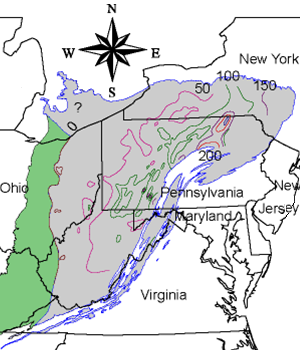
In my emotional response to certain immediate matters regarding the development of natural gas resources in and around the area of the country where I grew up, I have been negligent in making clear exactly what it is I'm talking about, where, and what the potential stakes - economic, environmental, political - may prove to be. For right now, I'm going to take a moment, step back, and talk about what the Marcellus Shale is, and what the potential natural gas reserves buried deep underneath the ground may mean.


This mas shows where, precisely, the Marcellus Shale formation is. It all started 400 million years ago when what is now the eastern United States was (a) in the southern hemisphere, and (b) the bottom of a narrow, but relatively deep small ocean. Like the oceans today, it was filled with all sorts of life, the bulk of which was small to microscopic. Like all life, it ended, floating gently down to depth of over a kilometer and more that, lacking oxygen, impeded decay of the organic material. Layer upon layer upon layer of dead plankton and microfauna piled up until, over the course of time, and pressure, and heat, and the drifting of continental plates, a relatively thick and broad layer of black shale developed. The organic components, under tremendous pressure, were changed in to various forms of fossil fuels, although the pressure from the overlying layers eventually cracked much of the oil to natural gas. Originally named for an outcropping in the central New York town of Marcellus during the first systematic geological survey of the state in the 1830's, the extent of the shale has been documented by geologists, who also understood that, along with various ores - pyrite and gypsum and, perhaps, sulfur blooms - was the possibility of fossil fuels.

There have been natural gas wells throughout the Marcellus deposits for decades, low yield, yet ultimately profitable because of their longevity. Major development of the region as a natural gas repository, however, was not deemed feasible as most estimates were that any large reserves were both too deep and variable, trapped within small pockets within the shale, to be viable. According to this article at Geology.com, as recently as 2002, the USGS didn't see any potential for exploiting the reserves.
As recently as 2002 the United States Geological Survey in its Assessment of Undiscovered Oil and Gas Resources of the Appalachian Basin Province, calculated that the Marcellus Shale contained an estimated undiscovered resource of about 1.9 trillion cubic feet of gas. [1] That's a lot of gas but spread over the enormous geographic extent of the Marcellus it was not that much per acre.

--snip--

In early 2008, Terry Englander, a geoscience professor at Pennsylvania State University, and Gary Lash, a geology professor at the State University of New York at Fredonia, surprised everyone with estimates that the Marcellus might contain more than 500 trillion cubic feet of natural gas. Using some of the same horizontal drilling and hydraulic fracturing methods that had previously been applied in the Barnett Shale of Texas, perhaps 10% of that gas (50 trillion cubic feet) might be recoverable. That volume of natural gas would be enough to supply the entire United States for about two years and have a wellhead value of about one trillion dollars! [5]
It is important to put some kind of perspective on the potential for developing the region as a source for fossil fuels. The best way to do that is to compare the Marcellus region with the well-known, and much debated, oil reserves buried beneath the Arctic National Wildlife Refuge (ANWR).
In 1998, the USGS estimated that between 5.7 and 16.0 billion barrels (2.54×10⁹ m3) of technically recoverable crude oil and natural gas liquids are in the coastal plain area of ANWR, with a mean estimate of 10.4 billion barrels (1.65×10⁹ m3), of which 7.7 billion barrels (1.22×10⁹ m3) lie within the Federal portion of the ANWR 1002 Area.[17] In comparison, the estimated volume of undiscovered, technically recoverable oil in the rest of the United States is about 120 billion barrels (1.9×10¹⁰ m3).[24] The ANWR and undiscovered estimates are categorized as prospective resources and therefore, not proved. The United States Department of Energy (DOE) reports US proved reserves are roughly 29 billion barrels (4.6×10⁹ m3) of crude and natural gas liquids, of which 21 billion barrels (3.3×10⁹ m3) are crude.[25] A variety of sources compiled by the DOE estimate world proved oil and gas condensate reserves to range from 1.1 to 1.3 trillion barrels (210 km3).[26]

The DOE reports there is uncertainty about the underlying resource base in ANWR. “The USGS oil resource estimates are based largely on the oil productivity of geologic formations that exist in the neighboring State lands and which continue into ANWR. Consequently, there is considerable uncertainty regarding both the size and quality of the oil resources that exist in ANWR. Thus, the potential ultimate oil recovery and potential yearly production are highly uncertain.” [24]

In 2010, the USGS revised an estimate of the oil in the National Petroleum Reserve–Alaska (NPRA), concluding that it contained approximately "896 million barrels of conventional, undiscovered oil".[27] The NPRA is west of ANWR. The reason for the decrease is because of new exploratory drilling, which showed that many areas that were believed to hold oil actually hold natural gas.
According to revised estimates on the total amount of natural gas contained, and the use of hydraulic fracturing techniques increasing the recovery rate, Terry Engelder of Penn State revised earlier estimates and claimed as much as 1300 trillion cubic feet of natural gas was, potentially, recoverable. That translates into 4800 cubic kilometers. By contrast, ANWR contains 210 cubic kilometers of recoverable oil reserves by the revised estimates of 2010 USGS survey. All the attention paid to empty lands along the Arctic Ocean, and right there on the doorstep of the nation's capital, within driving distance of the eastern seaboard, is a monumental amount of potentially exploitable fossil fuels.

With this comparison, it is easy enough to understand why, after 2008, there was a tremendous increase in interest in tapping the reserves. Many companies - among them Chesapeake Energy, based in Oklahoma City, and Chief Oil & Gas, based in Dallas - have rushed in. Right now, Pennsylvania is the hot spot of activity. With New York's governor Andrew Cuomo signalling his intent to lift the ban on fracking within certain guidelines and under what he says are "strict controls", however, New York may soon join Pennsylvania as a hotbed of natural gas exploration and drilling.

During the 2008 Presidential campaign, one phrase one heard repeated far too often was "Drill, Baby, Drill!", the demand to open public lands in Alaska to petroleum production. It may well be that a stealth campaign issue for next year will be the exploitation of the Marcellus Shale, with the revised restrain that is the title of this post heard around much of the country.

Saturday, July 02, 2011

Paying For A Boom (UPDATE)

I realize a holiday weekend when most people will be busy doing all sorts of other things than read blogs is an odd time to write a complicated, link-heavy post. All the same, it is what is on my mind, which is the usual impetus for doing this. Plus, I get it out of the way early and can enjoy the rest of what will be a hot, muggy day.

Yesterday I read two reports, very different in framing and tone, on a single act of New York's governor, Andrew Cuomo. Let's start with Our Paper Of Record:
The Cuomo administration is seeking to lift what has effectively been a moratorium in New York State on hydraulic fracturing, a controversial technique used to extract natural gas from shale, state environmental regulators said on Thursday.
That's the act subject to two, very different articles. The Times piece continues:
The process would be allowed on private lands, opening New York to one of the fastest-growing — critics would say reckless — areas of the energy industry. It would be banned inside New York City’s sprawling upstate watershed, as well as inside a watershed used by Syracuse, and in underground water sources used by other cities and towns. It would also be banned on state lands, like parks and wildlife preserves.

--snip--

Hydrofracking has prompted intense protests from some environmental activists, who say it threatens the cleanliness of groundwater. The process involves injecting large volumes of water, mixed with sand and chemicals, deep into the ground to break up rock formations and release natural gas. It is legal in a number of other states, including Pennsylvania.

A primary concern among environmental groups has been the leftover wastewater that can be contaminated with toxic materials buried underground, including naturally occurring radioactive elements, or carcinogens like benzene. Proponents, on the other hand, focus on the potential benefits. Drilling for natural gas has been promoted because it burns more cleanly than coal and can reduce dependence on imported energy sources, and it can also bring jobs to economically battered regions of the state.

--snip--

The governor telegraphed his position about hydrofracking in a campaign document on energy policy he released last year. It referred to the potential development of the Marcellus Shale, a rock formation that stretches from southern New York State to Ohio and West Virginia.

“The economic potential from the Marcellus Shale could provide a badly needed boost to the economy of the Southern Tier and even many environmentalists agree we want to produce more domestic natural gas that reduces the need for environmentally damaging fuel sources such as coal,” his campaign statement said, while adding, “Existing watersheds are sacrosanct, and Andrew Cuomo would not support any drilling that would threaten the state’s major sources of drinking water.”(italics added)
My hometown newspaper covered the same facts - Cuomo's desire to lift the ban of hydraulic fracturing (fracking) - with a headline that seemed to signal a preference for a far more lenient oversight of natural gas exploration:
State may ban gas drilling in watersheds, state land
The story continues in the same vein:
New York environmental officials have proposed a ban on drilling for natural gas with hydraulic fracturing in the New York City and Syracuse watersheds and on all state-owned lands while permitting it on private land only under “rigorous and effective controls” codified into state law.
Rather than discuss opening the possibility for fracking on private lands, the story begins by discussing the limits Cuomo and the state DEC plan to place on the practice.

The "Southern Tier" candidate Cuomo's position paper referred to is the long stretch of rural counties and communities from the NY-PA border just east of Erie, PA to Binghamton, NY and Broome County in the east, where the state border turns southeast along the Delaware River and the descent to New York City. Never hugely economically prosperous, the Southern Tier does have the advantages of gorgeous rolling hills, lakes like Chatauqua, small college towns like Alfred and Olean, and the small cities of Elmira and Corning. The eastern half of the region is the gateway to the Finger Lakes, with its tourist attractions and wineries.

In the middle of this stretch is my hometown, Waverly, NY. It has the unusual distinction for being a pivot point both for the NY-PA border - its existence has always been a bone of contention for the cluster of towns squeezed between the confluence of the Chemung and Susquehanna Rivers - and for the boom that has resulted in the exploitation of the Marcellus Shale for its natural gas reserves. Lifting the ban in New York will open the floodgates in Tioga County and areas to its east and north to the gas companies just as its immediate southern neighbor, Bradford County, PA, has become home to an economic boom the area hasn't known since the days of the railroads.

Back in April, I noted that all the promises of how safe and clean natural gas is, how strict and safe fracking is, ran up against the reality of a huge spill of toxic chemicals outside Canton, PA. At the heart of my own fear regarding Cuomo's proposed ending of a fracking moratorium lies exactly this - the procedure known as fracking involves pumping water filled with a variety of things, including toxic chemicals, deep under ground to break up the shale and release the natural gas trapped in a variety of tiny pockets inside the formations. The problem is, the details regarding the contents of "other stuff" used is considered proprietary information. We don't know exactly what is being pumped underground, until it finds its way in to ground water, and we discover such things as benzene, xylene, and toluene poisoning ground water.

The gas companies understand how the game is played, to be sure. In Bradford County, among other rural counties in northeastern PA, Chief Oil and Gas paid for improvements and repairs on 45 miles of rural roads, buckling under the pressure of the constant flow of heavy equipment. On their website, Chief insists "[s]ocial responsibility is a core value at Chief Oil & Gas", without ever mentioning pouring tons of known carcinogens, neuro-toxins, and other poisons in to the ground. This kind of thing, which should be understood as bribery rather than some corporate do-gooderism, is meant to head off any attempt at user fees and road taxes specifically targeted at the gas companies. Yesterday, an attempt by Democrats in the Pennsylvania State Senate to include impact fees died in Harrisburg. While this may have died, the gas companies know that regulation and taxation will continue to dog them; paying up-front for road repair is good PR, keeps their trucks from needing maintenance, and offers more land in relatively inaccessible areas to gas exploration.

This kind of public pay-off isn't the only thing the gas companies promise. The influx of money and interest from the gas companies, the promised payouts to land owners holding leases, many of which include not just land use and rental fees but also royalties, in an area of the country where "Depression" has defined much of its history seems an obvious way to keep voices of dissent from raising themselves too high.

Then there are jobs. Jobs at the rigs. Jobs in maintenance. Jobs in the front offices of local branches of out-of-state gas companies (many from Texas and Oklahoma and Colorado). And not just those jobs. All the new industry will need all sorts of support services, physical and economic infrastructure from hotels and gyms to restaurants and stores that will cater to new-found money and needs and desires.

Except most of the current jobs directly linked to the gas drilling are going to imported workers, experienced roughnecks from the gas and oil regions of Oklahoma and the Rockies, skilled trades people from home offices, geologists, hydrologists from home offices. . . Even diesel mechanics and truck repair personnel are imported. Why? It takes too long, apparently, to give the necessary training in the skills needed to get the wells up and producing to wait for locals. Much better, much cheaper, much more necessary to use people who know what they're doing.

Yesterday, I had a brief chat with Professor Jordan Kleiman on a mutual Facebook friend's status, and he mentioned an article (.pdf) by Cornell geologist Robert Howarth. Howarth was investigating the claims made by the natural gas industry that it is a "clean" energy, with a far smaller greenhouse gas footprint than coal when used for energy. In fact, even taking methane leakage in coal mining and production in to account, and considering hydraulic fracturing as the main means of natural gas extraction, there is little difference in the alleged "cleanliness" between coal mining (in particular, mountaintop-removal mining) and fracking for natural gas.

There is a problem with Howarth's study, however. The data available to researchers is scant at best. He admits up front that there may well be more comprehensive data available to the industry. If so, they aren't sharing. The gas industry jumped on this admitted limitation - any scientific study with more data is better, more precise, and more reliable - in a statement repudiating Howarth's study.

My own sense is that Howarth may well be correct, but more and better data, more and better and more thorough investigation of the overall impact of natural gas - from extraction through consumption - is needed to get a clearer picture. One thing Howarth's study does, however, is focus attention on the entire process of extracting natural resources and their overall impact on the environment, rather than the focus on the radical differences between burning coal and natural gas.

I have been paying attention to these matters in a somewhat desultory way, from a distance, ever since I learned of the gas boom and what it was doing, and the "more" it was promising to do for the area in which I grew up, where I still have families, and where I have very deep roots. Now that Gov. Cuomo is signalling lifting the ban on fracking in the name of economic benefit, it is important to ask serious questions of the gas industry, as well as local, county, and state officials who see dollar signs in the midst of economic malaise in the rest of the country. Not the least of these questions is what, exactly, is in the water pumped deep underground, beyond what we know from leakages at other sites around the country? Have there been hydrological surveys of underground water movements to judge where chemicals, once introduced, may move and how long such movements may take? Do we know what breaking up the deep substructure underlying such a large region of the country - the Marcellus Shale runs from my old neck of the woods down through Middle Appalachia - will do to the physical stability of the region?

What happens when the gas runs out and the companies and all their employees pack it up for the next hot spot? Will Tioga County and Tompkins County in New York, Bradford and Susquehanna Counties in Pennsylvania resemble parts of Nevada, Arizona, and Colorado that boomed during silver, copper, and iron mining, then died once the minerals disappeared, with tons of toxic waste poisoning the soil and water?

These are the questions. These are my fears. I have nothing against economic development, in particular for a place I love so much. The price, however, seems so steep, and the negative impacts - to the water and soil, to the local and county and state politics, to the global environment - have yet to be studied and understood in any thoroughgoing manner.

UPDATE: Is it possible for hydrofracking to undermine the stability of the surface? Well, it at seems possible, given this story out of Arkansas via Syracuse:
LITTLE ROCK, Ark. (AP) — Two natural gas companies agreed Friday to temporarily cease operations of injection wells in an area of central Arkansas that has seen more than 800 earthquakes during the past six months.

Oklahoma City-based Chesapeake Energy and Clarita Operating of Little Rock said they would comply with the Arkansas Oil and Gas Commission’s emergency request to stop all injection activities in Greenbrier- and Guy-area wells used to dispose of wastewater from production. The panel’s next regular meeting is March 29.

Geologists are studying a swarm of recent area quakes, most tiny, in an attempt to determine whether there is a connection between the seismic activity and gas-drilling companies’ work in the Fayetteville Shale formation. A 4.7-magnitude earthquake, the most powerful reported in the state in 35 years, struck near Greenbrier on Sunday night.

Friday, July 01, 2011

A Farewell Salute

I would be remiss if I did not note that yesterday marked the end of Robert Gates' service as Secretary of Defense. He has served every President since Jimmy Carter, when he was hired to work on the National Security Staff by Zbigniew Brzezinski. Non-partisan in a good sense, Gates exemplifies rare virtues in public servants - honesty, a refusal to truckle to his paymasters, and a willingness to perform tasks and carry out policies with competence and without a great deal of public attention-seeking - that are far too rare. Compared to other Cabinet-level appointees from Robert McNamara and Henry Kissinger to Alexander Haig and Donald Rumsfeld, his virtues seem so obvious they almost escape notice.

No NPR the other day, I heard a tape from a Congressional hearing at which Gates was a witness back in 2006. He was asked a direct question by Sen. Carl Levin (D-MI) and he gave a direct, one word answer. When asked if he believed we were "winning" in Iraq (a concept I still find difficult to understand because it has never been defined), Gates said, "No." That right there should have endeared him to the hearts of so many critics of the Bush Administration. Not the answer itself. Rather, in an Administration constructed around misdirection and obfuscation, Gates offered a direct, transparent honesty that should have made people sit up and take notice. Bush-fatigue, however, being the widespread phenomenon it was by then, few (including me) were willing to notice this fundamental difference with the rest of Bush's national security team.

Obama's record on foreign affairs seems, to me at least, a mixture of continuity with some of the worst tendencies of the Bush Administration and a curious tendency to improvise, with the occasional word from on high in speeches such as his Nobel acceptance speech, pronouncements on Israel/Palestine, and his Egypt speeches. As counterpoint, Gates has been a quiet, thoughtful, and serious adviser, skeptical both on Obama's decision regarding the pace of troop withdrawal from Afghanistan and the recent military action in Libya, as well as urging and supportive in Obama's decision to draw down (although not remove) troops from Iraq.

As Secretary of Defense, his biggest virtue has been the attention he lavishes on the troops. He has visited them frequently, spoken to them one-on-one, shaken their hands, and expressed, repeatedly using the same phrases over and over, the way decisions he has made that effect their lives weight on him because he considers them not just our soldiers, sailors, airmen, and Marines, but our fellow citizens. Being able to combine this kind of personal approach as well an intelligence and insight on matters of policy is rare enough; doing so serving different Presidents of different parties is even more rare.

His replacement across the river, Leon Panetta, is an example of the kind of Washington creature best described as courtier. Best known as Clinton's late-term Chief of Staff and currently head of the CIA, one thing Panetta does not bring to the office is the kind of resume that would lend credibility to his advice on defense matters. He is a toady, not a public servant. I shall worry over the course of his tenure about the kind of advice Obama will receive, and if he will be willing to do the unthinkable - insist that the President might well be making mistakes.

Thank you, Robert Gates, for your service to our country, to our military, and for the example you have set. I do not know if you are the best of our Secretaries of Defense, as the President said, but you have been quite good, and we as a country owe you a debt of gratitude.

Thursday, June 30, 2011

How We Got Here (UPDATE UPDATE II)

You seem to be inventing monsters so you can fight them.
Edwin Drood

So I was reading today's Daily Howler, and Somerby noted a piece in the Outlook section of June 4's Washington Post that purports to explain "How We Got Here", with reference to the current fiscal situation we face. The failure, in this instance, was the author's curious position, admitted up front, that the particular issues at which she looks - the Bush-era tax cuts, the wars in Iraq and Afghanistan, and the stimulus package in 2009 - only account for one-third of the total current fiscal shortfall. What about the rest of it? As Somerby makes clear for readers who may not have noticed, 67% of the problem remains "unexplained", at least according to the categories set forth in a piece of journalism purporting to explain the situation. A bit like explaining football by talking about special teams only. You know, all that offense, defense is kind of important, too.

Funny enough, the current fiscal situation is easy enough to understand if you have been paying attention. Of course, not everyone has been, which is why the kind of journalistic malpractice Somerby highlights is so important. While the tax cuts enacted in 2001 and 2003, the wars in Asia, and the stimulus have, indeed, contributed to the budget shortfall, the elephant in the room is the subject no one wants to talk about - persistent high unemployment, brought on, initially, by the financial sector crisis, then industrial sector crisis in the fall of 2008, and the resulting Great Recession that just doesn't seem to want to go away.

There is a great deal of information out there on all sorts of specifics concerning the collapse of the financial sector, most clearly and cogently the Financial Crisis Inquiry Commission Report (and its bizzaro-world minority reports), about which I wrote this past January.

No one has been better at making clear the choices we have faced over the past two-and-a-half years than Paul Krugman. While occasionally venturing forth in to the waters of splenetic venting about how stupid and/or venal our elected officials can be, by and large his columns in the New York Times have been both simple and consistent: We know, if we wish to accept it, what needs to be done - fiscal stimulus both larger and more diverse than was initially used in 2009, over a longer period of time.

Other facts, more tangential, yet important nevertheless, include the behavior of the large banks who would, without the federal government stepping in through the TARP legislation passed in the autumn of 2008 no longer exist. Rather than say, "Thank you," the way my parents taught me, they cry and whine and moan about how mean the Obama Administration has been, how terrible the Democratic Congress was in daring to pass legislation regulating parts of their behavior. After all, they proved they are trustworthy, right?

Oh, wait. . .

They continue to restrict borrowing in what might be considered a rational response to recent events. Except, of course, as the FCIC report details, their behavior over the period of the housing bubble was anything but either normal, or even in many cases legal. Using their own irrational behavior as an excuse, they continue to use TARP and other funds to pursue high-risk, high-yield investment opportunities, rather than return to a kind fiduciary responsibility and financial probity one hears ad nauseum is the thing banks really do.

There is no mystery why we are in the situation we currently enjoy. It isn't something I made up, nor is it the vague ramblings of some weird liberal types. We can dicker over details - more or less stimulus, more or less oversight of the financial industry - yet recent history should be clear enough: If we had the will to make our way out, we would. Too many stakeholders have too much to lose if the changes needed to fix the problems were enacted. Thus, we have the dog-and-pony show of legislative gridlock and sideshow freaks like Eric Cantor pretending to act on principle when, really, we know he just dances to the tune of them what called it in the first place.

UPDATE: It is serendipity, or synchronicity, or perhaps just coincidence that I came across this article today.
In a well-covered exchange, Jamie Dimon, JPMorgan Chase’s chief executive, challenged Ben S. Bernanke, the Federal Reserve chairman, about the costs and benefits of the Dodd-Frank rules. More attention has been paid to the banker’s audacity, but the response of the world’s most powerful banking regulator was more troubling. Mr. Bernanke scraped and bowed in apology without mentioning the staggering costs of the crisis the banks led us into.

So this is a good occasion to step way back to understand just how good the banks have it today.

The federal government, in ways explicit and implicit, profoundly subsidizes and shelters the banking industry. True since the 1930s, it is much more so today. And that makes Mr. Dimon no capitalist colossus astride the Isle of Manhattan, but one of the great welfare queens in America.

--snip--

This bailout never ended. “In effect, we nationalized the biggest banks years ago,” Mr. Allison said. “We implicitly guaranteed them. The taxpayers are still the ultimate owners of the risk in those banks — they just don’t get equity returns for that ownership.”

So when taxpayers hear a bank chief, like Jamie Dimon, complaining, it’s worth keeping in mind that his 10-figure paycheck is largely coming courtesy of us.
As they say, read the whole thing.

UPDATE II: Apparently, there's nothing new under the sun:
Suppose we describe the following situation: major US financial institutions have badly overreached. They created and sold new financial instruments without understanding the risk. They poured money into dubious loans in pursuit of short-term profits, dismissing clear warnings that the borrowers might not be able to repay those loans. When things went bad, they turned to the government for help, relying on emergency aid and federal guarantees—thereby putting large amounts of taxpayer money at risk—in order to get by. And then, once the crisis was past, they went right back to denouncing big government, and resumed the very practices that created the crisis.

What year are we talking about?

We could, of course, be talking about 2008–2009, when Citigroup, Bank of America, and other institutions teetered on the brink of collapse, and were saved only by huge infusions of taxpayer cash. The bankers have repaid that support by declaring piously that it’s time to stop “banker-bashing,” and complaining that President Obama’s (very) occasional mentions of Wall Street’s role in the crisis are hurting their feelings.

But we could also be talking about 1991, when the consequences of vast, loan-financed overbuilding of commercial real estate in the 1980s came home to roost, helping to cause the collapse of the junk-bond market and putting many banks—Citibank, in particular—at risk. Only the fact that bank deposits were federally insured averted a major crisis. Or we could be talking about 1982–1983, when reckless lending to Latin America ended in a severe debt crisis that put major banks such as, well, Citibank at risk, and only huge official lending to Mexico, Brazil, and other debtors held an even deeper crisis at bay. Or we could be talking about the near crisis caused by the bankruptcy of Penn Central in 1970, which put its lead banker, First National City—later renamed Citibank—on the edge; only emergency lending from the Federal Reserve averted disaster.

You get the picture. The great financial crisis of 2008–2009, whose consequences still blight our economy, is sometimes portrayed as a “black swan” or a “100-year flood”—that is, as an extraordinary event that nobody could have predicted. But it was, in fact, just the most recent installment in a recurrent pattern of financial overreach, taxpayer bailout, and subsequent Wall Street ingratitude. And all indications are that the pattern is set to continue.
History adds perspective, including the perspective that the banksters are free-wheeling precisely because they know we will pull their chestnuts out of the fires they set, and never ask anything of them.

Wednesday, June 29, 2011

We Need Better Books, Better Music, Better Randomness


With thanks to Feodor via Facebook comes this review, purporting to show links between the events and the popular musical choices of 1970. The review makes several interesting points, and a boner. The boner is that CSN&Y were one of the reasons punk came along. Actually, as a British phenomenon, punk was reacting against the music of Pink Floyd, Led Zeppelin, Yes, and ELP; in America, The Ramones were taking on Captain & Tenille, Billy Joel, Barry Manilow, and the hyper-produced, slick sounds emanating from LA's studios (think The Eagles, Fleetwood Mac, Steely Dan, that kind of thing).

More interesting for me is the choice of James Taylor. Taylor, a son of privilege with a variety of issues including a tendency toward mental instability and drug indulgence, spent a couple years in the late 1960's in The Beatles' orbit before landing with both feet as a singer-songwriter, the tunes being largely of the navel-gazing variety (although his covers of various tunes from Motown to the Brill Building were interesting, to say the least). No mention is made of Carole King's groundbreaking Tapestries, perhaps the most important pop recording of the year. Nor, as the reviewer notes, is mention made of Led Zeppelin II, or Captain Beefheart, or The Yes Album, and their subsequent US tour that brought them fame, money, and a new audience.

Reducing a year, a time, an era to a handful of artists is a dangerous game. Today's popular choices are tomorrow's trivia contest footnotes. A serious journalist, looking to do more than reflect on childhood memories, might well take a few moments to consider the huge variety of ways various musics emerge and how they reflect, or don't reflect, a time.

That being said, yesterday and today are both picture-perfect summer days pushing me to indulge some rare nostalgia for summer days of my youth spent running hither and yon. Normally, I try to remain clear-eyed about my childhood and youth but the days have been far too good not to take a few moments to remember those hazy, lazy, crazy days of summers gone by.

Here's a soundtrack, in part:


And now, something no one was expecting, the Spanish Inquisition without the confy chairs:
Dark Time - October Project
Present Joys - Alabama Sacred Harp Singers (Anthology of American Folk Music)
Swingtime in the Rockies - Benny Goodman (Live at Carnegie Hall, 1938)
Sysyphus, Part III - Pink Floyd
El Greco, Movement III - Vangelis
Telephone Calls From Istanbul - Tom Waits
Down The Road - Kansas
Only Child - Steven Wilson
Low-Spark of High-Heeled Boys - Traffic
Pretender - James LaBrie

Tuesday, June 28, 2011

Go Team!

When I first arrived on the internet five years ago, I discovered a most interesting phenomenon. Most people discussing various topics act like they are still in high school.

For example, I used to spend quite a bit of my internet time hanging out over at Huffington Post. One of the folks who posted frequently over there wrote on the topic of evolution. Along the way would come the occasional observation, stated axiomatically, that no one could be a real Christian and accept the theory of evolution by means of natural selection. Since this was the moment in the sun for people like Sam Harris, who insisted the religion had never, ever, in any society at any place or time, done any positive thing for humanity, and Richard Dawkins, who rewrote, rather poorly, Bertrand Russell's Why I Am Not A Christian, and Christopher Hitchens, whose atheism is both broad and deep, yet allows him to side with some of the most narrow-minded religious bigots in contemporary American politics, this was a common enough observation.

After reading this line several times, repeated without any reasons or arguments, merely stated as fact, I offered that, as a Christian who also accepts (I do not like "believes in" as a way of describing my adherence to any scientific theory; science is not a matter of belief) biological evolution, his statement as a categorical axiom was wrong. What I got in response was, in its shortest version, that I didn't know what I was talking about.

Along the way, I encountered other sentiments. For example, the idea that religious education was child abuse. Not religious education in some weird cult where kids are taught weird things like sexual precocity and the like. No, just run-of-the-mill religious instruction. The usual case was, again, the dispute between scientists and creationists. Parents who would prefer their children not learn the theory of evolution were, it was reasoned, creating a situation where their children would be deprived of information and understanding that would, in the long run, be detrimental to them. The state has to step in and insist that such practices had to stop, in the name of protecting both the children from harm and promoting the value of scientific education.

Then, of course, there are the various iterations of complaints against the Tea Party - in particular, that it is a political movement akin to fascism, rooted in racism. I dealt with this particular matter a couple weeks ago. It seems, however, that other variations of a kind of disdain for conservatives exist, which include but are not limited to the screeching, "They're gonna put us all in concentration camps!!!" Essentially, it rewards liberals for being so much more intelligent, thoughtful, able to use critical reason than our conservative brothers and sisters. Those who make this claim seem to have some scientific evidence on their side. My guess is the studies linked here are what Jeanine Garofalo refer to in the discussion noted by Bob Somerby.

Please note I say "seem" in the above paragraph. I find many troubling things with the presentation of the studies. The British study does have an abstract available online, which reads in part:
Recent work has shown a correlation between liberalism and conflict-related activity measured by event-related potentials originating in the anterior cingulate cortex [4]. Here we show that this functional correlate of political attitudes has a counterpart in brain structure. In a large sample of young adults, we related self-reported political attitudes to gray matter volume using structural MRI. We found that greater liberalism was associated with increased gray matter volume in the anterior cingulate cortex, whereas greater conservatism was associated with increased volume of the right amygdala. These results were replicated in an independent sample of additional participants. Our findings extend previous observations that political attitudes reflect differences in self-regulatory conflict monitoring [4] and recognition of emotional faces [5] by showing that such attitudes are reflected in human brain structure. Although our data do not determine whether these regions play a causal role in the formation of political attitudes, they converge with previous work [4,6] to suggest a possible link between brain structure and psychological mechanisms that mediate political attitudes. (italics added)
In other words, there's different stuff going on the brains of self-identified liberals and self-identified conservatives. That's all they found. Hardly definitive, at least to me.

Here's the thing - I refuse to reward myself, or others who hold views similar to mine, with any virtue. We liberals aren't better human beings. Conservatives aren't stupid. All this Manichaeism with a scientific veneer is repugnant to me for a variety of reasons. Not the least of these reasons is the simple one that there just isn't one simple, correct answer to the conundrum of human existence. While I certainly have a set of conditions and responses rooted in my life-experience and reflection, I would hardly insist it is, let alone should be, normative. Furthermore, promoting any notion that there is scientific evidence for disparate political ideologies veers far to close to phrenology, which proved that Africans were inferior to Caucasians; to any ideology that purports to show, definitively, that one group of human beings is inherently superior to another.

If we are to find our way out of our duldrums, the first thing we need to surrender is ego - the need to be right. This does not mean pointing out all sorts of errors, either of fact or reason, when we encounter them. It just means not making general observations out of specific instances of inanity and stupidity. Sarah Palin is not representative of conservatives any more than Teddy Kennedy - with his various romps with a variety of women - is representative of liberals.

I don't play for any team, so don't expect me to cheer-lead. The times call for sacrificing adherence to the preference for being right.

Monday, June 27, 2011

Hidden Histories

My Uncle David Johnston is my mother's younger brother. A big man in his mid-80's, David's many health problems are catching up with him. Garrulous and loud - like most members of the Johnston clan - intelligent and witty, David can regale visitors for hours, without a visitor getting a word in edgewise.

Some of those stories would surprise anyone looking at the aged, sickly old man might surprise you. Others would shock you. See, when David joined the Marine Corps right out of high school, his aptitude tests were off the charts. After boot camp he went to Special Intelligence School.

See, David was a spook.

In the mid-1950's, newly married, David and his lovely bride Billie lived in Columbus, OH where David worked while attending Ohio State University. He returned home one day to find a strange car parked catty-corner from his house, a man slumped down in the front seat. David snuck around the corner, entering his house from the backdoor and told Billie to call the police. He left the way he entered, only this time he was armed. He came up behind the car, making sure the driver wasn't looking in the mirror, then yanked the door open and dragged out the man sitting behind the wheel, pinning him to the ground and putting his sidearm in the guy's face just as the police pulled up.

David had managed to wrangle a police detective staking out a possible house of ill-repute up the street from where David and Billie lived (must have been a great neighborhood). David told the police officers that they needed to move their stakeout.

Why did he react this way?

Because he was a spook.

There are so many stories out there, far too many we will never hear first-hand, because those involved, while living, were ordered never to speak. Then, long past the point when silence made little difference, they took their secrets to the grace with them. One was David's (and my mother's) oldest brother, Eugene Johnston. Junior entered the Navy on December 8, 1941, then after boot camp at Great Lakes, disappeared. His wartime service was a blank slate until he, like David, became elderly and the pressure of all that forgetting became too much. He and David shared their stories with one another (including Junior revealing that he knew about David's secret marriage because he lost his security clearance over it; long story) until, a couple years ago, Junior passed away. Lost with him are so many stories that fill in the details not so much of his life, but of our understanding of how we Americans conducted the war.

I got thinking about all these lost stories after reading this story in today's Washington Post. One huge takeaway from this story, as well as David's and Junior's, is thinking carefully about those elderly folks we see, and often complain about. They drive slow. They walk slow. They seem to need so much more, which confronts us with our own mortality and the price we may pay for getting older.

Yet, so many of them hold secrets that might shock us. Or scare us. Or leave us in awe. We need to remember, as Tom Brokaw's "Greatest Generation" passes from this earth that so many of them carry around stories of horror and heroism, of duty fulfilled and cost paid, that many of us younger folks can barely imagine. We need to remember that the next time grumble about some old guy driving too slow down the road, or tottering in front of us in the Mall, slowing us down in our dire need to get to Aeropostale. We owe our roads and malls, the very fact of our on-going life as a nation, to folks who did all sorts of things about which we will never know.

Sunday, June 26, 2011

On Marriage - Gay, Straight, In The Past, In The Future . . . And Mine

Kudos to New York, in particular Gov. Andrew Cuomo for working so hard to get marriage equality passed in my home state. All the same, there have always been voices of dissent that question the value of the institution. What follows is little more than some thoughts to spark interest, perhaps thoughts of your own.
I saw this over at Eschaton yesterday, and it sums up what I've said, too many times, about marriage.
It shouldn't be too hard to understand that there is, effectively, a secular state aspect to what we call marriage - mostly a property contract - and then there's the part that's between you, your mate, and, if you care, your church/religion and they ultimately don't have all that much to do with each other.
Checking out the summer issue of New Politics, there is an article entitled "A Young Radical's View of Marriage". It was nice to read the view I put forth on marriage as rooted in property rights (including the legitimacy of children) was also held by Friedrich Engels. Nice company.

An important point she raises, with which I neither agree nor disagree, is that, in contemporary American society, not only a favorable view of the institution but the practical use made of it is determined by race and class distinctions that render so many of the voices defending what they call "traditional marriage" suspect on a variety of grounds. Both survey data of attitudes as well as trends in marriage over time show pretty definitively that, if you are white and upper-middle class or higher, you are far more likely both to have a positive view of the institution and actually get married than if you are poor, African-American, or Latino. With particular emphasis on African-Americans and the history of attempts to destroy the slave family ties, it seems to me a radical view such as this faces serious questions. All the same the reality of the lack of attractiveness of the institution in certain groups, and its lack of practice, certainly raise questions that have not been addressed by the shouting over the matter.

After setting out various arguments against marriage, from both political radicals and feminists from Emma Goldman (who was both) to Betty Friedan, the author admits her own misgivings about the state-recognized institution while desiring the kind of communal celebration of long-term commitment that we usually associate with a wedding:
Personally, I like the idea of having a public ceremony — minus the religious trappings — where I declare my love for my partner in front of those I care about, and then we eat cake. I even like the idea of both of us being dressed up when we do this. But, particularly with the divorce rate as high as it is, I don’t feel eager to enter an institution that I associate with social inequality and housework. In my foggy vision of the future, my partner and I stand before a gathering of family and friends and recite love poems or self-made vows, then share a meal with people we love. At some point, maybe, there is dancing, which, unlike marriage, Emma Goldman might have appreciated. Then we move on with our equal and independent lives, with some commitment to togetherness and chore-sharing. It’s a simple idea, and one more ancient than the origin of property rights.
In the course of the article was a link to a Boston Review article by a historian that debunks the idea put forth by opponents of marriage equality that marriage has always been the same (at least in the west; I rarely see evidence or discussion of non-western marital practices).
Opponents of equal marriage rights for same-sex couples say that marriage has always been between a man and a woman and must remain so. They argue from “tradition.” Counter to their claims is an argument from history—a history of change over time.

Many features of marriage that were once considered essential have been remade, often in the face of strong resistance, by courts and legislatures. Economic and social changes have led to increasing legal equality for the marriage partners, gender-neutrality of spousal roles, and control of marital role-definition by spouses themselves rather than by state prescription. Yet marriage itself has lasted, despite these dramatic changes. Not only that: it retains vast appeal.
One particular point needs to be emphasized here: The history of marriage in America, from colonial times to the present, emphasizes the legal, contractual, secular institution over any religious principle.
Seventeenth-century English colonists in North America created marriage laws almost immediately upon settling. In England the established Anglican Church ruled marriages, but rather than replicate that arrangement or treat marriage as a sacrament (as Catholics do), colonial legislators asserted that marriage was a “civil thing” because it dealt with matters of property. Although the great majority of colonists believed in the basic tenets of Christian monogamy, colonial legislators explicitly rejected religious authority over marriage. Thus even before the American Revolution, marriage was deemed a civil institution, regulated by government to promote the common good.

After the founding of the United States, state after state maintained this principle. State laws allowed religious authorities to perform marriage ceremonies and to recognize only marriages adhering to the requirements of their own faith, but not to determine which marriages would be considered valid by the public. For example, California’s first state Constitution stipulated, “No contract of marriage, if otherwise duly made, shall be invalidated for want of conformity to the requirements of any religious sect,” a provision now retained in the state’s Family Code. To be sure, many people, then as now, invested marriage with religious significance, but that had no bearing on any marriage’s legality.
With the arrival of same-sex marriage, civil unions (such as here in Illinois), and the general trend toward acceptance of marriage equality across the country, time, history, and sentiment seem to be on the side of changing, yet again, our understanding of marriage.

I would like to add some thoughts from my own 18 years of marriage to the mix. First of all, neither Lisa nor I got married for reasons of legal or financial expedience. On the contrary, when we got married, we were so poor, I can't imagine any of that stuff being anywhere in our thoughts. We married for what most would call old-fashioned reasons: we loved one another, wanted to spend our lives together. We didn't talk about children at all, other than to agree we did not want children right away. For a bit of time, six months or so, we even talked seriously about remaining childless.

Most of all, when we first talked about getting married, I insisted that I did not want Lisa taking my name. I did not like the implications of it, that she was a piece of property that changed hands, the name-change signifying a change of ownership from her father to me. After some discussion, we decided that we would both hyphenate. We went to the DC Social Security office the week after we got married and when time came, we changed our names on both our Social Security numbers. The clerk behind the desk looked at me like I was from Mars and said, "You don't have to do this. Only she does."

I smiled and said, "I'm changing my name, too."

He looked at me, then looked at Lisa and said, "Lady, he must really love you," then handed over the form for me to fill out.

The name change is important. Getting married changed both of us. I'm not who I was before I got married. The change wrought by marriage affects us both. If I sat around with the same name, what would that tell anyone? Taking Lisa's last name and adding it to my own - not just conventionally but legally - tells the world that we are in this together. We are partners, equals.

In that sense, then, Lisa and I do not have a "traditional" marriage, for which I am thankful. We are hardly a conventional, traditional couple. Our example, I think, makes the simple (but largely unnoticed) point that each and every actual marriage adds its own distinctive color to our collective understanding of the institution. Non-traditional marriages, in whatever form they may take, accumulate change over time that leads to changing legal understandings. It usually begins, however, with couples making choices about their lives, just as Lisa Kruse and I did all those years ago.

Marriage is not some ideal "thing", but a mixture of legal definitions and actual marriages between real human beings, all of which change over time. As we move toward marriage equality in more and more states, our understanding of what marriage "is", or what it might be, will continue to change and grow, or perhaps shrink and fade. Whatever happens, it is an institution that changes each and every time a judge or priest or minister or rabbi or imam or some other officiant says, "I now pronounce you husband and wife."

Saturday, June 25, 2011

A Case Study

Could it be that competing in the global market place has gotten a lot harder since the 70's, so chief executives who have to deal with that are getting paid more?

At the same time it's gotten easier to pump milk so the wage for that has decreased.
Edwin Drood
Of the multitude of things I know absolutely nothing about, the dairy wholesaler's market is one I really haven't thought anything about. An article this past weekend in The Washington Post on the growth in executive compensation at Dean Foods, comparing it to the stagnant wages of workers at the same company, prompted the above reply. I thought rather than dismiss out of hand the contention that the differences in the trajectory of pay between the CEO and workers were understandable and morally and socially acceptable, I would investigate the case in particular to see if it were, in fact, true. Edwin offered a falsifiable set of conditions by which understanding the question is possible. I thought, why not use those as a way of seeing if he was right or wrong.

The initial source is the Post piece itself. It begins by outlining the compensation for the chief executive at a precursor of Dean Foods.
It was the 1970s, and the chief executive of a leading U.S. dairy company, Kenneth J. Douglas, lived the good life. He earned the equivalent of about $1 million today. He and his family moved from a three-bedroom home to a four-bedroom home, about a half-mile away, in River Forest, Ill., an upscale Chicago suburb. He joined a country club. The company gave him a Cadillac. The money was good enough, in fact, that he sometimes turned down raises.
So, this is the set of initial conditions posited - the wholesaler in question was the nation's largest; the executive in question lived a more-than-modest life of the upper-middle-class rather than the truly wealthy. This description is contrasted as follows:
Forty years later, the trappings at the top of Dean Foods, as at most U.S. big companies, are more lavish. The current chief executive, Gregg L. Engles, averages 10 times as much in compensation as Douglas did, or about $10 million in a typical year. He owns a $6 million home in an elite suburb of Dallas and 64 acres near Vail, Colo., an area he frequently visits. He belongs to as many as four golf clubs at a time — two in Texas and two in Colorado. While Douglas’s office sat on the second floor of a milk distribution center, Engles’s stylish new headquarters occupies the top nine floors of a 41-story Dallas office tower. When Engles leaves town, he takes the company’s $10 million Challenger 604 jet, which is largely dedicated to his needs, both business and personal.
This is the set of current conditions. Getting from then to now is the matter at hand.

The article posits another set of conditions that is part of the story:
Over the period from the ’70s until today, while pay for Dean Foods chief executives was rising 10 times over, wages for the unionized workers actually declined slightly. The hourly wage rate for the people who process, pasteurize and package the milk at the company’s dairies declined by 9 percent in real terms, according to union contract records. It is now about $23 an hour.

The Dean Foods website, linked above, does not include a history of the company. While not necessarily reliable, Wikipedia does have the advantage of footnotes with links in order to check the information presented. Dean Foods has a Wiki page, that skips over the beginnings of Deans in my neck of the woods as a small dairy distribution company to 2001 when Suiza Foods, a Dallas-based conglomerate, purchased it and changed the name from Suiza to Deans. The list of product names it either names or licenses is long:
Dean Foods produces soy milk in the United States under the name Dean Foods and (Sun Soy). organic milk is marketed under the brand Horizon Organic.

White Wave Foods is the distributor for Silk soy milk, Horizon Organic dairy products, International Delight creamer, some Land O'Lakes dairy products, Hershey's milk products,[citation needed] and Stōk espresso shots.

The company's TofuTown brand and its various tofu products were acquired by the Hain Celestial Group in June 2007.

Dean Foods owns many other brand names, such as Alta Dena, Barbe's, Barber's, Berkeley Farms, Borden, Broughton Foods Company, Brown's Dairy, Country Fresh, Creamland, Dairy Ease, Gandy's, Garelick Farms, Jilbert's Dairy, Lehigh Valley Dairy Farms, Liberty Dairy, Louis Trauth, Mayfield Dairy, McArthur Dairy, Meadow Brook, Meadow Gold, Model Dairy, Oak Farms, PET Dairy, Price's, Purity, Reiter, Robinson Dairy, Schenkel's, Schepps, Swiss Farms (formerly Wengert's Dairy of Lebanon, Pennsylvania), T.G. Lee, and Tuscan Dairy Farms.[citation needed]

Dean Foods licenses the Land O'Lakes brand, which markets creamers and fluid dairy products.[12]
Not included in this list is the Wal-Mart name-brand, Great Value milk. As someone who unloads pallets of GV milk off a Deans delivery truck, take my word for it - even if they don't own the license for the name, they distribute it, probably from plants in which different labels are slapped on different milk jugs.

According to Wikinvest, Deans Foods "is the largest processor and distributor of milk and other dairy products in the U.S., with products sold under more than 50 familiar local and regional brands and a wide array of private labels.[1]" They were so described in the late 1970's, so the question still remains - is "competition in our contemporary market" more difficult? Even when Deans was a regional operation, it was the largest dairy wholesaler in the country. Now that it is an international conglomerate with plants and distribution networks in both the United States and the United Kingdom, not only distributing dairy products but selling in-house and licensed brands of dairy and associated products, has its market share been the result of executive business sense or the purchase of a variety of brands?

If you click on the "BRANDS" at the top of the Deans Foods homepage, you will find a list of national brands it owns or licenses - from Horizon and Silk and International Delight and Land-o'-Lakes - to the regional brands it either distributes or owns. The only regions of the country it doesn't seem to have control of regional brands is the lower Midwest (Missouri, Arkansas) and the Pacific Northwest. With control over leading national brands (we love Land-o'-Lakes salted creamery butter in our house), however, this lack of local and regional control is not as big an issue as it might otherwise be.

According to Wikinvest, Deans "is the largest processor and distributor of milk and other dairy products in the U.S., with products sold under more than 50 familiar local and regional brands and a wide array of private labels.[1]"
Dean Foods manufactures and distributes dairy food products to retailers, distributors, foodservice outlets, schools and governmental entities across the United States. Both the Dairy Group and WhiteWave Foods are heavily dependent on its main customer, Wal-Mart Stores (WMT), which accounted for 21% of the Dairy Group’s 2009 net sales.[2]

Both the Dairy Group and WhiteWave Foods use Dean’s extensive direct store delivery system, or DSD, which transports products from processing facility to customers’ stores via refrigerated trucks. Dean’s ownership of such an expansive DSD system has made it the only national dairy beverage company in the U.S.
If they are "the only national dairy beverage company in the U.S.", where is the competition?

In March of this year, Deans Foods and Justice Department reached a settlement in an anti-trust action brought when Deans planned to purchase a Wisconsin dairy. According to The Wall Street Journal:
The Dean Foods case was part of the effort by the Justice Department, under the Obama administration, to step-up antitrust enforcements in the agriculture sector, which has undergone rapid consolidation in recent years.

The deal was too small to be reportable to the government. However, the Justice Department moved to block it anyway after deciding it would eliminate competition between the two companies in the sale of milk to schools and stores in Illinois, Michigan and Wisconsin.

"The proposed settlements restore competition so that school children and consumers in Illinois, Wisconsin and Michigan, will pay lower prices for their milk," said Christine Varney, the head of the Justice Department's antitrust division.

Dallas-based Dean Foods said it agreed to settle the cases— which were also brought by the attorneys general of Wisconsin, Illinois and Michigan— to avoid the time and expense of fighting them.

"We continue to believe that our acquisition of the Foremost Farms assets in Wisconsin supported competition and benefitted consumers," the company said. "However, because ongoing litigation is expensive, distracting and brings uncertainty to our business, we believe that this resolution is in the best interest" of employees, shareholders and consumers.

Dean Foods bought the Foremost unit in April 2009, including its dairy processing plants in Waukesha and De Pere, Wis. The company said the proposed settlement, which must still be approved by a judge, allowed it to keep the De Pere plant.
Rather than concentrate on product improvement, Deans Foods has dealt with competition in the time-honored fashion of high- and late capitalism: eliminate it by buying it. From the days of Rockefeller buying out other oil refineries in the Cleavland, OH, area, then buying controlling interests in various railroads in order to control the shipping prices for distributing its products, the best way to ensure continued high market share has not been competition, as the theory of capitalism claims, but to get rid of competition as inefficient, reducing not only marketing and R&D costs, but creating broader efficiencies in what was once known as vertical market control (like Deans fleet of trucks or Standard Oil's fleet of railroads from the Lehigh Valley RR, for which my grandfather worked his entire adult life to the Pennsylvania, B&O, and other larger national rail lines).

So, does the current CEO of Deans Foods "deserve" a salary and benefits that dwarf his predecessor from a generation ago? In the first place, the name "Deans Foods" and its regional visibility in the Upper Midwest is all that remains of the former regional, but still largest in the nation, wholesaler of dairy and related products. Having been purchased by another company, who changed their name for reasons of market recognition, Deans Foods no longer exists in the same way it did in 1979. As CEO of a multi-national with huge market share through purchase and license of a variety of products and the largest DSD network of any wholesaler, one could argue that a larger compensation package is called for.

What about those stagnant wages for workers? In the first instance, these aren't dairy farmers, now a pretty high-tech industry, although also still labor intensive. Rather, the workers in question are the folks who work in Deans plants (including one just up the road in Harvard, IL) who have not seen a concomitant rise in pay with the rise in market penetration by Dean Foods.

Why is that?

According to this USAToday story from April - one of many I could cite:
At a time most employees can barely remember their last substantial raise, median CEO pay jumped 27% in 2010 as the executives’ compensation started working its way back to prerecession levels, a USA TODAY analysis of data from GovernanceMetrics International found. Workers in private industry, meanwhile, saw their compensation grow just 2.1% in the 12 months ended December 2010, says the Bureau of Labor Statistics.
So, it isn't just Deans Foods. Trends across business show modest (at best) increases in worker pay even as executive pay rises rapidly.

The reasons for this disparity seem to escape analysis. The trend crosses industry barriers, matters of competitiveness, and even shareholder return. Considering the bonuses and salaries awarded to the large banks that brought the entire world economy teetering on the edge of collapse, there is no link between performance and compensation. High rates of pay for executives and senior management have entered the realm of entitlement, rather than linked to any measurable results.

This glance - and it has only been a glance, blogs being the medium they are - at Deans Foods as a way of asking whether or not higher compensation has yielded, in this case, at least a couple tentative answers. First, it is not a matter of the CEO "working harder", nor of the demands of competition. Considering the CEO's sole desire seems to be purchasing rival dairies, including regional dairies and distributors, while both successful and a commonplace in business, it is hardly akin to any theory of capitalism with which I am familiar (monopoly does have its advantages, but folks usually support competition rather than its elimination when touting the virtues of the market). Furthermore, since the case of Dean's reflect national trends in the differences between executive pay and worker pay, one cannot set it to the specifics of Deans Foods, the market in dairy production and distribution, or the vagaries of milk production. The question, still unanswered, is the source of the disparity, and whether or not it creates sustainable socio-economic conditions.

According the the CIA's Gini Index in its World Factbook, the United States income distribution levels are slightly better than those of Jamaica, Uganda, and The Philippines, and slightly worse than Cameroon, Cote D'Ivoire, and Iran. We are thirty-ninth overall, with number one, Namibia, being the country with the greatest disparity in wealth. Considering Cote D'Ivoire is undergoing a civil war, this isn't exactly a good sign; considering our levels of maldistribution of wealth rival most of the developing world, that poses a challenge to any who defend the continued efficacy of untrammeled capitalism and a free political system.

Friday, June 24, 2011

Not Here For An Argument

I saw the link to this article this past Sunday, but with a crazy week, it has only been right now I've turned my attention to it. In sum, just read it, because it says everything I have tried to say on the subject, only better. It pretty much reflects where I stand on the whole issue of "argument". Rather than convince anyone of anything, I just state what I believe to be the case, with whatever facts I can dredge up along the way that convict me of my views. You can take it or leave it, but by and large I really don't care.

The whole goal is to present an alternative way of viewing the world, and consequently of living in it. You don't like it? Well, it's no skin off my nose, and the door is always open if you change your mind. Don't believe for one moment that the stuff you say to me is going to alter my own course, however. Not being interested in argument includes not being interested in the arguments of others. Since it isn't about being right, but living for others; since it isn't about me in any manner, fashion, or form, but about God and neighbor, that is where my heart lies, and that is the goal.

We all have a lot of work to do to make the world more livable. Rather than figure out who's right and who's wrong, I am far more interested in finding ways of doing that, and presenting them as possibilities. Anyone who wishes to join along, the more the merrier. I have no interest any more in using labels - conservative, liberal, fundamentalist, what-have-you. I am far more interested in seeking ways all of us, together, can get together and work together to get out of the hole in to which we have dug ourselves. Standing around arguing over whose fault it is we are in this particular hole, listening to those who insist if we only keep digging we'll get out of it, choosing sides, calling names - those are all games. I'm not interested in games.

God loves this world, and we are to reflect that love in our life and work in this world. For other people. For the planet God has given us for safekeeping, and which we are trashing at a horrendous rate. If you believe those things, and really don't care about being right or wrong, moral or immoral, just serving God and loving others, this is the place to be.

Thursday, June 23, 2011

Choices We Face

One of the remarkable insights provided by Christopher Lasch's The Culture of Narcissism was the prevalence in the mid- to late-1970's of what Lasch called "survival literature". The category "survival" permeated every aspect of American life - from cooking to politics to business. The apocalyptic sentiment was rampant at a time of declining wages, stagnant economic growth, and the beginning of the decline of American post-WWII international political hegemony. The choices, it seemed, were no longer accommodation to a new set of realities. Instead, the choices were either ignore the reality and pretend we were a powerful nation still growing, still full of possibility or surrender to the inevitable collapse, eking out whatever meager remnants could be salvaged from the wreckage.

I wonder what Lasch would have made of our times? With our economy in a shambles, shuffling through stagnation to the edge of collapse; our political system deadlocked on trivia and irrelevancies; entrenched yet already irrelevant power structures demanding the maintenance of the political and economic and social status quo or risk the threat of the collapse that always seems to be around the next corner. Unlike forty years ago, when the problems we currently face were still either nascent or perhaps even theoretical, the challenges we currently face are, in fact, quite dire, limiting our choices should be desire to continue to exist, even if in a different form.

Among the many pieces of the puzzle challenging us to decide to act or not for our common survival is the release a few days ago from a group called the International Program on the State of the Oceans (IPSO). The summary of a recent workshop held at Oxford University, the IPSO report is dire, indeed.
The 3 day workshop, co-sponsored by the International Union for Conservation of Nature (IUCN), looked at the latest science across different disciplines.

The 27 participants from 18 organisations in 6 countries produced a grave assessment of current threats — and a stark conclusion about future risks to marine and human life if the current trajectory of damage continues: that the world's ocean is at high risk of entering a phase of extinction of marine species unprecedented in human history.

Delegates called for urgent and unequivocal action to halt further declines in ocean health.
The report summary is available as a .pdf document, but the main findings include the effect of human activity upon warming, acidification, and anoxia. Further, while the changes the scientific literature tracks are consistent with the IPCC findings, some are actually more rapid than predicted, presenting a grave threat, including mass extinction.

Cheery thought, that.

So, as with so much else, we are presented with evidence that is forcing us to make serious choices. Yet we do not have any structures in place - not politically, not socially - to deal responsibly with the choices with which we are confronted. At some point, when the worst does begin to occur, someone, somewhere, will insist, "How could we have known?" Well, we did know. It is up to us, the people, to lead on this, if we care anything at all about all life on this planet doing more than just surviving.

Wednesday, June 22, 2011

Clarence Clemons, R.I.P.


I was saddened to hear that Bruce Springsteen's longtime saxophone player, Clarence Clemons, passed away from complications from a stroke.

I was even more sad to hear he was 69 years old.

Sixty-nine.

Good God, we really are getting old. All of us.

Rest in peace, Big Man. Something tells me you were greeted by someone yelling, "It's the Master of DisASter!" If you blow the solo in "Jungleland", remember it helped a little kid understand what a good rock-and-roll sax solo could be.

Oh, and Clemons didn't just play with Bruce. He also toured with Jerry.


Some randomness, what do you say?

Tears in My Eyes - Uriah Heep
Brokedown Palace - The Dead (Allstate Arena, 5/5/09)
El Becko - Jeff Beck
Die Young - Black Sabbath
Feuer Frei - Rammstein
Stinkfist - Tool
Orbits - Miles Davis Quintet
Lift Me Up - Yes
Frame by Frame - King Crimson
Mint Car - The Cure


Thanks to David Dye and The World Cafe for turning me on to Elbow. A little bit of Peter Gabriel, but a whole lot of Elbow.

Tuesday, June 21, 2011

The Wages Of Sin

Why don't I care about gay marriage as a "moral issue"? Because of stuff like this:
The largest single chunk of the highest-income earners, it turns out, are executives and other managers in firms, according to a landmark analysis of tax returns by economists Jon Bakija, Adam Cole and Bradley T. Heim. These are not just executives from Wall Street, either, but from companies in even relatively mundane fields such as the milk business.

--snip--

Over the period from the ’70s until today, while pay for Dean Foods chief executives was rising 10 times over, wages for the unionized workers actually declined slightly. The hourly wage rate for the people who process, pasteurize and package the milk at the company’s dairies declined by 9 percent in real terms, according to union contract records. It is now about $23 an hour.
This is what is tearing apart our country. Not two men wanting to be called spouses because they live together, wanting that relationship legally recognized by the state as a social good from which both corporate parties - the state and the couple - can benefit. It is the simple reality of stagnant worker wages, grossly overcompensated corporate senior management, and no social or legal mechanisms in place to check either trend. That is why we are on the brink of economic collapse.

There are solutions, and they are actually known. Support for unionization of the workplace, with a legal infrastructure to support organization and collective bargaining. Higher corporate taxes, as well as higher marginal tax rates for the wealthy. Reinstituting the estate tax as well as the capital gains taxes at the levels they were at in the 1970's and early 1980's, encouraging charitable giving as well as less risky investment behavior.

For some reason, however, the disgusting disparity in wealth and its gaudy display are not seen as social evils to be battled, but rather social goods to be pursued. We are told, ad nauseum, that any time we point out the disparity and its corrosive effects on the social contract we are engaged in "class warfare". People who have much to gain from joining the ranks of such a conflict say stuff like this, repeating words they heard somewhere else, thoughtless automatons in our nation's downfall.

Gay marriage? It's becoming the law of the land, and it is only showing that we as a people are both smarter and more open than we used to be. Checking corporate extravagance and the underlying greed that drives it? That's not a sin!

That's the American way.

Questions That Interest Me

I will admit that my interests tend to wander from specific matters related to being a Christian in our contemporary world. At least, to others, that may seem to be the case. Since all the ways we divide up our world in to little compartments are largely fake, however, I tend to see continuities where others raise their eyebrows and wonder, "What in the world are you talking about?"

Fellow blogger Dan Trabue has one of those posts designed to drag the homo-haters out of their holes. It is working, too. The same tired arguments. The same sentences, typed for the thousandth time by the same people playing their appointed roles. It isn't even necessary to read specific comments to know beforehand how different people are going to respond. Which is not to say that Dan's question is unimportant, although I believe it is so for reasons other than one's he may entertain. Rather, the internet and blogging is a medium not designed for careful, thoughtful analysis of important matters. Rather, it allows people who do not know one another to play verbal games. For all I know, the folks taking up various positions at Dan's do not believe a word they are typing; they may just be enjoying the game.

Let them play.

I am currently reading Medieval Cosmology, selections from Pierre Duhem's massive, multi-volume history of western scientific thought from the patristics to the Renaissance. The subjects are arranged topically - infinity, place, time, the void, the plurality of world - and cover the period, roughly speaking, from St. Thomas and the condemnations of 1277 through the early Renaissance. Writing during the First World War (and never fully completed because Duhem was not a well man and died before he could finish it), Duhem's thesis was simple enough. Rather than view the various scientific discoveries of the sixteenth and seventeenth centuries as revolutions in thought, we need to see them as events on in intellectual continuum. Physics didn't begin with Newton, but Aristotle. Astronomy did not begin with Copernicus, but Aristotle. It was the rediscovery of Aristotle, and the adaptation of his thought to the neo-Platonism of the middle years of the Christian era that created the intellectual milieu that led, in steps variously large and small, to the discoveries of what we call "the scientific revolution".

In order to make his case, however, Duhem had to place in evidence huge amounts of material that was unknown outside the narrow precincts of Scholastic studies and those folks interested in the 14th century arguments known as the conflict between the ancients (those who followed in Aquinas' footsteps and stuck close to Aristotle) and the moderns (the nominalists and their students, from Ockham through Peter of Spain and Albert of Saxony). Many of the people reviewed by Duhem were virtually unknown except to a few specialists - Robert Grosseteste and Jean Buridan, Albert of Saxony and a 14th century Merton College Fellow named Swineshead - and their views on these matters largely unexplored until Duhem put the pieces together.

Do I agree with Duhem's thesis? I cannot say one way or another. What I do think is important, however, is understanding what people used to believe and think and teach. First of all, learning stuff like this is its own reward. More knowledge, no matter how seemingly trivial or irrelevant to many people, is always preferable to less. Second, considering the intensity of the debates, the fact that so much of late Scholasticism flowed from a series of condemnations of various pieces of Thomistic thought in 1277, it gives contemporary readers a perspective on our own controversies. Finally, how can we understand who we are if we have no idea of our roots?

These are the questions that interest me. This is why I'm wading through the dense sophistry and dialectic of late Scholasticism, rather than engaging in a shouting match over gay marriage (which is not to say I haven't posted a couple comments; rather, I have tried to change the subject). I have limited time and resources as it is, and I think it would be far better used exploring matters of interest to me, than playing a part in an internet set-piece whose structure and content I am already familiar with.

Sunday, June 19, 2011

Name Dropping

In February, 1983, my brother was in an automobile accident. He spent close to three weeks in a hospital in Ithaca, NY. Of the many trips we made to Ithaca in that time, one was just my father and me. Dad could always fill the quiet of a forty-minute car ride with questions about classmates, talk of books, what-have-you. We reached a cross roads outside Ithaca and he broke in to a rare moment of nostalgia (unlike my mother, Dad really didn't talk a whole lot about his childhood, at least when I was under the age of 18; apparently he decided it was rated "R" or something . . .). "I remember hitchhiking down this road when I was in college," he said.

"Really," I said, being at that point in my life incapable of picturing a younger version of my father doing anything as remotely un-Dad-like as hitchhiking.

"A couple friends and I decided to go to Binghamton for a party. One of my friends had a friend there who lived with his parents, and they were away."

It was getting more interesting by the minute. A couple years later, having experienced a few college-age parties myself, I would understand even more what he was talking about.

The next question was more in the way of chatter on my part. "Do you remember who they were?"

"Well, the friend was Richard Deacon. We were hitching to Binghamton to go to Rod Serling's house for a party."

For the first, but not the last time in my life, I was quite literally speechless.

For those who may not remember the name, Richard Deacon played Dick Van Dyke's boss on his eponymous show. Rod Serling, well, if you don't know the name, you can stop reading now.

When my father graduated from Waverly High School in 1939, he received some money to study violin at an institute affiliated with Carnegie Hall in New York. When I started college - a bare few months after the aforementioned conversation - he told me that his father wanted him to go to Syracuse University and study journalism. He mentioned this because we had met one of the music performance professors at Alfred University, and Dad confessed to me that he had wanted me to study piano, then recounted his own struggles with his parents as a way of reminding both of us that being a parent includes letting our children make their own choices.

When he arrived in New York City, he ditched his fiddle and took up classes in theater. Since it was all paid for, it didn't really matter all that much, although it probably didn't please either George or Grace (he always referred to his parents by their first names). A tiny bit of his story from that time came to my attention several years later.

I was back at the homestead for a visit at some point in the early 1990's, and saw Dad was reading Kirk Douglas' memoir, Ragpicker's Son. He had a page toward the front of the book marked and since it wasn't hidden away somewhere, I checked out what it might be. Douglas was recounting his early time learning theater, and how cold his first year was. Being poor, he couldn't afford a proper jacket, and he writes in the book that another classmate of his, "Betty", gave him one. Betty would change her name in a couple years, impressing millions of American men when she says to Humphrey Bogart, "You know how to whistle, don't you? You put your lips together and blow." Apparently, Bogart was impressed, too, because he married her, only her name then was Lauren.

I asked Dad why he had marked that particular passage, and he gave me a funny look - angry? frustrated? ironic? - and said, "That was my coat." See, Dad's roommate at the time he was studying theater and acting was this really dirt-poor son of Russian immigrants. He decided to call himself Kirk. The only reason "Betty" spoke to this poor rag-picker's son at all was because he was friends with my father, with whom she was friendly (although he would tell me later that she was, well, let's just say an unpleasant person, highly ambitious, quite willing to discard some and latch on to others whom she felt might help her get what she wanted; when I told him that I thought she was among the more beautiful women in Hollywood from that era, he said she was even more beautiful in person).

At that point, I had known about my father's associations with all sorts of folks whose names were well-known. I had even known that he and the actor who would become Kirk Douglas had roomed together in New York during his first stretch of time living there. When my grandmother died in July, 1984, she left behind 95 years of collected mementos through which her three surviving children had to spend years sifting. Among them were more photos than you could shake a stick at. At home for Christmas break later that year, one night Dad was sitting in his usual chair, photos scattered about the living room in various piles. I asked if I could look at some of them - you always asked in my house before you touched anything - and he said, "Of course." I was glancing through some that appeared to be a group of young people sitting at a restaurant. One made me stop short, because in the picture was my grandmother - much younger, of course - sitting next to a young man with chiseled good looks, his dimpled chin recognizable immediately. It was then I learned about Dad's friendship with Kirk Douglas.

My grandparents suffered much less than many families during the Great Depression because my grandfather never lost his job. In 1931, when many people were abandoning the land, he bought a hundred acres and a house in Lockwood, NY, about seven miles north of Waverly. I think he did it because living in the big red house on Waverly Street had become intolerable to his wife, inconsolable after the death of their oldest son three years previously. My father's family was hardly wealthy, but having a job, farm hands, extra cash was a rare thing for far too many people at the time. Douglas, coming from extreme poverty and looking it, aroused a bit of pity on the part of my grandmother, who told my father to give him his, Dad's, old coat and she would buy him a new one. Thus the source of the coat which Douglas either misremembered coming from Lauren Bacall, or perhaps simply erased by father, who had not become a household name, from the record of his life.

The picture was from a party thrown by some of Dad's theater friends after he got out of the Army in 1946. He was struggling with the decision of either going back to New York or returning to Ithaca College and finishing his degree. He told our English class that his early experience in theater taught him how important education was; so many of the other young hopefuls around him had college degrees. He realized that he wouldn't make it unless he got some education, for the simple reason they got the better parts. He had hopped back and forth between New York and Ithaca between 1939 and 1945 when he entered the Army, with an autumn in Hollywood trying to get a studio contract. He ended up going to Ithaca, putting him on a road to that hitchhiking trip to Rod Serling's. Before then, though, he had a little party thrown for him, and someone took some pictures, including one of my grandmother sitting and laughing at a table with, among others Kirk Douglas.

In the late 1940's, after college but before he settled in to his decision to teach, he was back in New York City, the hub of early television. He did some work on Playhouse One and some of those other anthology shows. I remember him telling me about an appearance with Boris Karloff. Karloff was a Capt. Bligh type, with my father an equally unpleasant leader of a gang of mutineers. He told me he had to do the entire thing shirtless, his skin oiled and dirty to look tanned. The set was a cutaway of an old sailing ship, cramped, and extremely hot, he said.

He was in a summer company in Rhode Island in the 1950's that featured Eva Gabor (let's just say she was not well-liked by the company), Claude Rains ("Hark, I hear the Assyrians!"; my father missed his cue, having fallen asleep standing up backstage waiting for it, and Rains had to scream the line three time before he dashed on stage; he apologized to Rains after the performance, to which Capt. Renault replied, "That's OK, Dan. The show is a piece of shit, anyway.") It was there my father worked with an aging, but still vital, Mae West, laughing about the young "bodyguard" she dragged behind her on an invisible leash.


While I was growing up, my father did community theater work, summer stock at Bristol Valley Playhouse in Naples. In the early 1990's he landed the role of Sam Clemens' father-in-law at the Mark Twain musical drama in Elmira. Later he would work at Cider Mill Playhouse in Endicott, finally landing a part in the Caucasian Chalk Circle in Ithaca, probably the late-life role of which he was most proud (I remember hearing that he kissed another man full on the mouth in that show, not something light but a good old-fashioned snog, and thinking that his acting skills had to be top-notch; there are just some things I cannot picture my father doing, and that's four of them).

Both my parents led the most interesting lives before they met, married, and settled down to the impossible task of raising a family, and I had always wanted to live that same kind of life - living in all sorts of places, meeting interesting people - and now, looking back, I think I did. There is a part of me that has always been a little in awe of the life my father led before he ended up settling down, marrying my mother, spending the bulk of his working years teaching - the old Van Etten school, Sayre High School, Tioga Center High School, then Waverly High School, from 1964 until he retired in 1988 - with his summers spent in various locations doing odd jobs (mowing at a Christmas Tree farm outside Athens,PA has always been one my favorite jobs he did), working at a local furniture store, a hardware/automotive store. On this Father's Day, I just wanted to honor the life Daniel Safford led in the real passion of his life. Whether he ever was frustrated by not achieving the kind of recognition, not to mention financial independence, some of his acquaintances achieved I cannot answer; that's one of those questions I have always been afraid to ask him. All the same, more than anything else he did, I know Dad was always happiest under the lights, a crowd in front of him. I want to remember him that way.

Happy Father's Day, Dad. Love you.

Virtual Tin Cup

Amazon Honor System Click Here to Pay Learn More