Monday, May 17, 2010

Political Tourette's

They just can't help the hate.
– Conservative radio host Debbie Schlussel blamed Fakih’s win on a supposed “politically correct, Islamo-pandering climate” in America and labeled her a “Lebanese Muslim Hezbollah supporter with relatives who are top terrorists.” [5/16/10]

– Right wing pundit and Fox contributor Michelle Malkin ranted that “Fakih’s cheerleaders are too busy tooting the identity politics horn to care what comes out of her mouth” and that “the Miss USA pageant didn’t want to risk the wrath of the open-borders mob.” [5/16/10]

– Conservative author Daniel Pipes, who was briefly appointed by former President George W. Bush to the U.S. Institute of Peace, opined that “this surprising frequency of Muslims winning beauty pageants makes me suspect an odd form of affirmative action.” [5/16/10]

– Fox News’s Gretchen Carlson complained that Woolard’s “informed opinion” may have cost her the crown, and said that Fakih may have won because we live in a “PC society.” [5/17/10]

Obviously, giving the title Miss USA to a Muslim is a sign that, soon, we shall all live under Sharia. Except, instead of burkhas, the women will wear evening gowns and bikinis.

When I heard this morning on my drive home from work that an Arab American had won, I just knew folks on the right would start crap like this. They are all subjects in a Skinner experiment, it seems. . .

Sunday, May 16, 2010

Sermon Thoughts I

Since I'm preaching next weekend, I have been mulling some ideas I want to include, and how much of them. These are more in the nature of thematic content, rather than the way I want my sermon structured. Help in the form of feedback would be gratefully appreciated.

My wife and I were talking about the subject, and wondered aloud, "What is it about music, anyway?"

Music is a way to order chaos. Before there were the rules of literature - theme, plot, character development, and so forth - there are the far more basic, elemental structural rules of music - rhythm, harmony, and melody. They impose a most basic structural rigidity upon how we wish to go about telling a story. The earliest stories, in any case, were sung before they were spoken, and the imposition of the structure of song creates a framework which forces the narrative to flow this way and not that, to move forward orderly, rather than flip, flop, and meander. Other elements of musical composition - dynamics and meter, for example - have to serve the far more basic demands of the rhythm, the harmony, and melody.

As such, music is primarily a social art form, more so than, say, painting or sculpture. While the products of the plastic arts are certainly meant to be shared with a wider audience, and to so to communicate, even to tell a story (consider the cave paintings in Lescaux, in France, as an example). Yet, we don't sit around and paint together in worship. Instead, we sit and sing together, expressing our faith and praise, praying and confessing within the ordered rules of song.

With those rare exceptions of Free Jazz and experiments in group improvisation in both jazz and rock music, music of necessity follows these strict rules. Even in other cultural settings, where musical development can be strikingly different. For example, the diatonic scale of the west is not the only musical scale. A friend of mine in Virginia, enjoying the sitar music of Ravi Shankar, tried to learn to play it, and discovered, much to his chagrin, there is actually a different note, say, between F# and G-flat! This is one of many reasons music from India sounds so discordant to our ears - it utilizes sounds that are not utilized in western music.

This idea - discord - is another that has fluctuated in meaning over the centuries, even in the west. For all the years music in the west was dominated by the monastery, there were certain harmonic structures - both well known such as the Dorian mode - and less well-known that have become commonplace in musical composition. The most famous is the use, by jazz musicians after the Second World War, of what was called "the devil's harmony" - the flatted fifth. This discord in particular, precisely because it sounds not so much "wrong" as sinister, was actually anathematized by the Roman Catholic Church.

Discord is often in the ear of the hearer, too. There are many people who quite simply cannot listen, say, to the composer Schoenberg, or avante-garde pianist Cecil Taylor, or post-bop jazz pianist Thelonius Monk because of their use of what sounds like discord. Stravinksy became enamored of non-western music and incorporated it in to his suite, "The Rite Of Spring"; at its debut in Paris, the audience quite literally rioted because the sounds were so strange. Because what often sounds discordant is not resolved by some composers and performers, but used as a platform for expanding our ideas of harmonic structure as well as melody, there seems to be less structure to such compositions. Whether it's "Pharoah's Dance" by Miles Davis, or the long, free-form group improvisations of King Crimson or Phish, by violating harmonic rules, we tend to think of them as not so much "making music" as playing, pure and simple. The accusation, in turn, is usually accompanied by that most feared of critical epithets - self-indulgence. Musical onanism certainly shares with its sexual cousin the reality that it doesn't create anything other than a mess. Yet, in the same way that sexual onanism serves as a way for us to learn about ourselves, so, too, musical self-indulgence allows the individual to push his or her limits, perhaps clear up questions and offer the opportunity to explore what might otherwise not be explored.

OK, I probably won't use the whole masturbation thing in my sermon . . .

Identity & The Internet

There are a couple posts at Crooked Timber on the question of identity in the age of the Internet that tie in, in a strange way, with an odd discussion I've been having here. Since "Know Thyself" is perhaps the hardest philosophical dictum with which to come to terms, and in any case is something that is always in process, one that can never be accomplished fully, it is almost futile to consider the question as a serious one.

Along with this site, I am on Facebook (FB), along with 400,000,000 other people. The idea that FB creates a space on the internet transparent enough to reveal something about ourselves to others is kind of silly. For all anyone knows, even the most intimate details on FB can be fabricated. Whether its the family photos, the expression events in one's day, clicking "like" or "dislike" on this or that subject-matter, song, group, whatever - it can all be a construct. Shoot, I could be making up pretty much everything about me, including multiple identities so that it appears I have close friends and family who know me. To complain about a lack of privacy, of threats to our identity to the point where the personae we don in various settings in our lives - as parents, spouses, workers, siblings, what-have-you - become superfluous is nonsense on the face of it.

Everything we know about others, even those most closely related to us, who share the most intimate relations with us, rests upon a certain amount of trust. There are always gaps, always hidden, secret places in the lives of those even of those to whom we are closest. For example, last weekend, my wife and I celebrated our seventeenth wedding anniversary, and I can say, with all confidence and a great deal of joy, that I still do not know everything about her. The reason I can say this is simple - I recognize and grant her own particularity, her individuality, and allow her the space to be Lisa as pastor, ministerial colleague, church leader, youth leader, in ways that do not impact my own interactions with her. Which is not to say I do not consider her, along with being my wife, my own pastor also. It is just that the mixing of identities, at that point, creates a muddle at times. Also, since I look forward to a lifetime of discovery with her, I know there are all sorts of things coming up that we will share, but have not shared, and I have no idea how we will be in the midst of it all. Our children's adolescence, special moments such as proms, graduations, weddings, our retirement together - just to name a few. These are very real possibilities in our combined future, things we talk about, think about, plan for, to be sure, but things that we cannot, now, not having lived through them, have any notion of how we shall be in the midst of them.

I am always amused by the reactions some people have on the internet to people they have yet to meet. Quite apart from our knowledge of these others limited by two things - what they choose to reveal of their own lives, and how trustworthy those reports actually are - we could very possibly be having discussion and even budding friendships with people who are not at all who they claim to be.

The idea that FB, or anyplace else on the Internet, creates dangers to our identity in some deep sense - not our legal identity, as in stealing our name or some other part of our legal identity for nefarious purposes - is to grant far more power to the internet while simultaneously buying in to the idea that there is some kind of scrupulous honesty on the internet. I don't. While I trust that those with whom I've interacted over the years are, at the very least, who they say they are, I also would never think that I know who they are. In some cases I anticipate meeting them with joy; in other cases, maybe not so much, but at least these responses are based on my own sense that these people, by turns and respectively, would be fun to be around, or not.

Yet, far too often, people make noises that they may "know" something about me, or others may claim to "know" something about someone that transcends any revelations we may make about ourselves on the internet. In most cases, these "knowings" are quite wrong, almost laughably so. I used to feel the need to correct these intuitive leaps; anymore, I just laugh at folks who think they have any idea who I am apart from what I choose to make plain in our interactions.

So, I don't worry about threats to my identity in the age (or perhaps moment) of Facebook, because I would never presume that even those closest to me ever reveal anything close to their real identities there, or anywhere else.

Just Curious

I know this will not be the last time this question is asked, either by me or someone else.

Who cares what Newt Gingrich thinks about anything? So, he's published a book. Wow.

Here's a guy whose history of just making stuff up is so long that repeating it would be tiresome. He's intellectually dishonest, almost pathologically incapable of keeping his mouth closed, disliked by the American people, was booted from office by his own party for multiple failures of leadership. He is, quite simply, nobody. On his third wife (who, if she had any sense, would make sure all of her husband's staff was male, considering Newt's history . . .), talking about how wonderfully inviolable the institution is.

He doesn't even provide comic relief any more. I'm just tired of seeing and hearing him.

Friday, May 14, 2010

Book Reviewing As High Comedy

Lee Siegel's review of Paul Berman's The Flight of the Intellectuals is a marvelously funny piece of criticism (and thank you, Scott, for the link). While I can appreciate Scott's comment on the review (which is also quite funny), the end of Siegel's review captures an attitude I have found far too frequently, and not just on the internet:
When I read Mr. Berman, I don't think romantically of those dreadful old Partisan Review "smackdowns." Instead, I recall this line spoken by Dostoevsky's Father Zossima in The Brothers Karamazov: "Suffering is the inability to love." The problem with that kind of suffering is that it blinds you to everyone else's. You become a hero in your own mind, the rest of the world be damned.

That brave soul, standing athwart the tide - whether it be left or right, intellectual elitism or anti-intellectual buffoonery, the theocratic threat or the secular humanist threat - is the creation of those individuals' own grand sense of their own place in history.

Me, I'm happy with a small blog that about three people read with any regularity.

Of course, this doesn't detract from the fact that a bit of score-settling may be taking place here. Moral rectitude is a pose I dislike in any case; vengeance disguised as moral rectitude is particularly nasty.

But, it can also be funny.

Good For The Soul

I mention no names or places here, to protect myself from any chance legal liability. On the other hand, I hope the point is clear that the only person who comes out of this looking bad is me.

The best supervisors at a place of business are those who not only support those under them positively, but those who are quite willing to hand them their ass when necessary. The other night, I had my ass handed to me, on a silver platter. I want to take a moment to thank my supervisor for doing this. It is significant that this was the last chance this person had to do this for me, and it was done clearly, professionally, and even thoughtfully. My only regret is I won't have the opportunity to prove that I can, indeed, change for the better.

I've worked at the same place for about three and a half years. While hardly a world-changing, life-changing job, it is a job. The past two years, however, the job has become progressively more physically demanding. Always physically stressful, the changes I have gone through moving from just-turn-41 to 44 are taking their toll. Because of that, I have, over time, cut little corners here, there, and elsewhere in the performance of my duties, always with one eye on some parts of my job, but another eye - far more jaundiced - turned askance at it.

Suffice it to say I was called out on my performance the other night. The accumulation of grievances became the subject of a heated exchange between me and my supervisor. While not granting every single accusation made as accurate, suffice it to say that, in sum, the diagnosis of the issue was spot on. Significantly, it was toward the end of a dressing down both long-needed and much deserved, in what seemed like a throw-away line at the time, that I realized where my error lay. I was told, "Sure, you aren't a surgeon or a lawyer, but you should still do your job as best you can," or words to that effect.

In other words, I was getting a lecture in work-place ethics in which it was being made clear that mine were found wanting. And for precisely the reasons set out, too. Because the work isn't "significant", or "important", or some other socially-acceptable bit of employment, I consoled my own decreasing lack of performance over time in the understanding that it didn't really matter all that much.

Except, of course, it does. It's a matter of character. A matter of ensuring that, no matter the job or task, is done with dedication and thoroughness. What I feel most ashamed of is not the details of my failure which are, in fact, relatively easily remediable. A bit of a slower pace, a bit more attention to detail, a bit of thought and concentration on the task at hand - that's all that is required. It is the ethical failure, the realization that on an issue as important as how one views and conducts oneself as a worker - regardless of the work in question - I had been found wanting, that troubles me. For this, I am heartily sorry; I hope that I can show others, in the near future, that this is a situation I understand, and will change.

I have been fortunate in my time at this particular place because I have been surrounded by people who, working under all kinds of stresses and limitations, manage to do incredible amounts of work - physically taxing if not precisely intellectually stimulating - not only with dedication, but with a sense of fun. All of that flowed down from a one particular person who will no longer have the position of supervisor come our next work week, through no fault of this person's own. I guess I want to take a moment to say, "Thank you," because I really have learned so much from this person. I'm just sorry it took so long, that I was too thick to allow the lesson to penetrate until the last possible moment.

A little confession is good for the soul, so they say (hence the title). A little penitence, at least in this case in the form of a conscious effort to make some ever-so-slight adjustments in my own work habits, will also do me good. I hope, for my own sake, that the words have not come too late. I also hope this person understands how grateful I am and have been to be able to work with someone who understands far better than I do what it means to work ethically.

Ignorance & American Representative Democracy

N.B.: This is just one of what will be at least two posts on this paper (.pdf) linked via a comment at Crooked Timber.
The citizens of a modern democracy are trying to be well informed about social-science questions that confound even social-science professionals - because of the difficulty of using controlled experimentation to answer them. . . . When public-opinion researchers enumerate the shocking levels of factual ignorance displayed by members of the public, they are really catalouging the haphazard and often incoherent theorizing in which we, the people engage in our capacity as amateur social scientists.
Jeffrey Bernstein

Taking one's cue on social theory from Karl Popper might seem to be the height of intellectual honesty. Featuring most prominently an admission of the limits of human understanding and knowledge, and the fallibility of even the most cherished ideas about the way the world works, Popper's theory of science and theory change, as well as his more directly relevant writings on politics and social thought (The Open Society and Its Enemies (2 vol.) and The Poverty of Historicism in particular) certainly offer to a budding social theorist the opportunity to make the case for the limits of any social theory, let alone the potential success or failure of the intellectual project of the social sciences.

While it is certainly true, as Jeffrey Bernstein makes explicit, that the salient feature of our social life is the complexity of contemporary social and political phenomena and the impossibility of grasping it in toto, he misconstrues Popper's (and natural scientist's generally) understanding of the structure and role of theory. Furthermore, and more explicitly in reference to the question of ignorance and self-governance, he ignores certain salient features of social and political life that even a non-professional recognizes. Most important, his insistence on his own understanding of what he calls "rational-choice theory" as operative in political decision-making is hardly very rigorous. It seems to me that these two points invalidate any idea that operational ignorance of what even Bernstein calls "trivia" (although ignorance of some more significant facets of our social life certainly give one pause) bears any relationship to questions of the success or failure of governance.

First, as to the question of Popper's fallibilism and the role of theory formation, it is important to remember that Popper was swimming against the rushing current of logical positivism when he offered the notion that scientific theories are not and can never be verified, but rather are only significant and operationally important to the extent that they have, as yet, to be falsified. In the limited case of the natural sciences, this theory offers a view of the openness of the scientific enterprise to the reality that even the best theories are no more than organizational structures for what we know so far.

It is important to remember a significant feature of Popper's approach to scientific theories that goes unmentioned by Bernstein (and, for that matter, by Popper in his writing on social and political philosophy). Theories, for Popper, are nothing more than a series of what he calls "basic statements", which are themselves nothing more than singular instances of facts. Again, we have to understand what Popper was doing here. In the first place, he was contrasting "basic statements" with the "protocol sentences" of the logical positivists. These latter were intended to be a logically coherent structure by which theories were operationally affective. Basic statements, on the other hand, were simply reports of experimental results; "facts" in this case were nothing more or less than points plotted on a graph. A series of basic statements related to one another operationally, i.e., because they consisted of reports from experiments on particular related phenomena, are what make up a theory. Precisely for this reason, then, one can understand how fallibilism worked for Popper; there would always be another experiment, another report, another basic statement to be added to a theory. The accumulation of factual data, over time, refined and more than occasionally falsified not just particular theories, but whole research programs (to borrow a phrase from Popper's colleague, Imre Lakatos).

On an epistemological level, theories, for Popper, were an attempt to end-run modernist objections to philosophical realism. In a collection of essays entitled Objective Knowledge, Popper pronounced himself a "realist", insofar as scientific theories were actual descriptions of the way the world really is constructed without reference to human agency. He went on, at one point, to posit the possibility of the accumulation, at some point, of enough basic statement to have the least chance of falsifying our understanding of the world. Be that as it may, this dedication to a certain kind of what can be called, for the moment, naive realism, raises as many questions as it solves (which is the way any important philosophical notion operates, I suppose).

His objection to much of social science, at least as was practiced at the time he was criticizing it, was the presence of explicit theories, announced by researchers beforehand, that governed the way data was not only interpreted, but gathered, delimited, organized, and thus organized as social theories. Yet he never understood that his own naive realism operated in much the same way in the natural sciences. Operating from either an explicit or implicit philosophical predisposition is not, by itself, the mark of a lack of intellectual integrity, nor should be thought to render irrelevant or incomprehensible or incoherent what results. Even the most naive positivist in the social sciences would hardly disagree that gathering and interpreting data, governed by the limits and rules of any social theory, hardly qualifies as either surprising or even a significant observation. Whether one is a dedicated Marxist, or Friedmanite, while this may determine which data may be considered important or unimportant for reasons of statistical comparison, it is the results of the statistical analysis that are important for understanding whether the issue at hand has in any way been clarified.

In other words, theories are no more than collections of data that are, themselves, governed by principles as to significance and importance.

Now, this relates to the question of ignorance and social and political life precisely because Bernstein ignores the structure of "theory" as put forth by Popper, as well as his own philosophical commitment to a kind of realism that dictated his own approach to how theories are to be understood. Fallibilism, while certainly clarifying the way the scientific enterprise operates in a way the positivism and its dedication to verification did not, is only part of a far larger whole, which includes a principled understanding of theories as really representing, in a philosophical sense, the way the world can be understood without any reference to human agency. Yet, on this very point there is a certain philosophical incoherence precisely because, as "statements", Popper admits that a "statement" can only be falsified by another statement. No experiment or observation can make false the statement, "All swans are white" (to use the example used by Lakatos in a long paper defending and clarifying Popper's fallibilism). In other words, Popper's claim of realism cannot be made coherent precisely because he understands a disjunction to exist between "the world" and our theorizing about the world.

Whether it is the phenomena of the physical sciences (Popper is relatively silent on biology, except to say that Darwin's Theory of Natural Selection isn't science, a point creationists have latched on to far too often), or social life, then, our understanding is always limited by our commitments to certain principles that dictate how we understand such things as "data", "significance", and how scientists go about their business of interpreting this stuff. Without a full report of Popper's fallibilism, Bernstein presents a truncated view of Popper's fallibilism that seems to indicate that Popper's objection to the social sciences is rooted in a principled grasp of the limit of human understanding. In fact, Popper's objection is that the social sciences are not philosophically and theoretically coherent; there are abundant approaches and definitions of what the social sciences are and how they should operate that are mutually exclusive. This meta-theoretical muddle creates the situation where there is no way, a priori, to judge whether or not this or that social researcher grasps the way his or her work is theory- and mistake-laden.

Now, as far as I know, there aren't too many practicing social and political scientists who would argue the contrary opinion, viz., that their findings approach the level of explanatory power of the physical sciences. Indeed, statistical significance in the social sciences is far lower than the physical sciences precisely because even the most broad theoretical understanding and statement about social behavior is understood to grasp and explain such a small part of our social life. To put this in far simpler terms, most practicing social scientists understand the complexity of our social and political life; even the most dedicated ideologue of one sort or another would insist on the explanatory limits of his or her pet theories (if he or she were intellectually honest).

All of this - the miscontrual of Popper's understanding of theory and the limiting case of the social sciences - is important to grasp precisely because Bernstein wants to argue, pace Popper, that the level of basic factual ignorance on matters of social and political significance preclude any kind of successful government action in a representative republic. Our institutions are laden with far too much information for any individual to grasp in any kind of totality; our mediating institutions are not up to the challenge of providing any kind of framework for understanding. Levels of either trivial or significant ignorance are too often apparent to be ignored by researchers. This should lead even the most dedicated proponent of the positive possibilities of state action to pause before insisting that our institutions can operate at even some minimal level of success, let alone efficiency, precisely because it is impossible to have all the information available to make these kinds of judgments with anything like scientific rigor.

This is wrong, pure and simple, because whatever a particular social scientist's theoretical predilections, he or she would certainly admit that we always operate from a limited, whether practical or theoretical, knowledge base. For me, the two national elections in 2006 and 2008, and the social change represented by public opinion surveys, are good test cases for an understanding of social phenomena that takes both trivial and significant ignorance in to account, while still showing that the public does, indeed, act in what it considers its own best interest.

In the aftermath of the terrorist attacks in 2001, the public rallied around Pres. Bush and continued to support his Administration, even as questions arose as to the factual basis, for instance, of his accusations of the collusion of the Iraqi government and those who planned and carried out the attacks on New York and Washington. In the face of those events, Bush's decision to act against those who had attacked the US, regardless at the time of their truth or falsity, gave the public the confidence that he was, in fact, acting to protect our most basic national interest.

He won re-election in 2004 precisely because he reminded the public over and over again that, in the face of a concerted effort to attack and kill Americans on their own soil, he had moved to retaliate in order to prevent similar events from occurring in the future. Then, in the fall of 2005, Hurricane Katrina roared across the Gulf of Mexico and destroyed much of the City of New Orleans as well as the marshy coasts of southern Louisiana and the tourist spots on the coast of the state of Mississippi. The Bush Administration's failure to act with both the resources and a sense of the significance of the devastation in this case caused his support among the American people to plummet precipitously, from which they never recovered. That members of his party in Congress supported this lack of action in the face of a natural disaster as destructive in its own way as the terror attacks four years previously caused support for them to crash as well.

In the wake of this, the Republicans lost control of Congress in 2006. While particular races in particular states were driven as much by local and state-wide concerns as anything, the general sense - without reference to particular points of fact or other issues that supporters of either party could point to - that the Republican Party had failed to act adequately to help the American people who faced destruction from natural forces indicated they were not the party to lead. This simple equation - failure to act means failure of leadership means the withdrawal of electoral support - is enough to account, for me, for the results of the 2006 mid-term elections. The on-going disfavor of the Bush Administration led to Pres. Obama's election in much the same way.

While close watchers of political events can certainly point to counter-factuals to this particular view of events, my own sense is that this explanation is at least as theoretically powerful as any other. More important, it does not rest on a prior commitment to a moral or intellectual dedication to issues of general social knowledge or ignorance. The folks who made this simple equation in their heads may or may not have been able to name the nine Supreme Court Justices, or the Secretary of Labor or Interior or the head of FEMA under President Bush. What they did grasp, however, was that, unlike after an attack by a terrorist group, a similarly destructive event was not met with the same kind of resolve, let alone commitment to resources. This failure is enough to account for the ill fortunes of the Republican Party the past four years.

Now, does this test case account in a more generalizable way, making the case that the amount of trivial or significant ignorance on the part of the American people is less relevant to the success or failure of representative democracy? I think it does precisely if one considers how the public view the role of certain actions of the state, as opposed to the details of public policy reviewed by analysts. Whether or not voters in Bend, OR or Pawtucket, RI know whether the fourth or fifth amendment to the US Constitution protects them from self-incrimination is less important than whether or not those voters understand that their elected officials have succeeded or not in the most basic function of any government - the protection from harm, and assistance when those protections break down (as they are wont to do).

Our representative institutions operate as they always have, with limited resources, including information. Insisting that this lack of information indicates some kind of practical limit to state action precisely because of the theoretical and practical ignorance is based on a faulty grasp of Popper's thought, as well as a reliance on a view of rational-choice theory that ignores other ways this may operate in regard to social and political action.

. . . and this is far longer than I intended. My apologies to your attention span.

Thursday, May 13, 2010

Oh Those Pesky People Who Just Can't Be Governed

Synchronicity? Or perhaps a careful watch placed on the walls at any given moment? For whatever reason, there is a more-than-curious appearance of this seemingly off-the-cuff comment by Henry at Crooked Timber:
First: ungovernability. Or, rather, “ungovernability.” Chris got a lot of flak in comments for suggesting that centrists and center-right people in the media were going to come out with suggestions that a bit of dictatorship might not be a bad idea.

He goes on to give his opinion that, in fact, such talk really isn't going to rear its ugly head. Never mind that, just a few short years ago, Thomas Sowell, apropos of nothing in particular offered the opinion that a military dictatorship would be good for America. In any event, the question of "governability" or its lack is one that addresses itself from China and India to Africa to our own country. In the 1970's, one heard it about the city of New York as it faced fiscal collapse; one sees it in criticisms of the United States Senate and its odd tradition of necessary super-majorities to act on some pieces of legislation.

Lo and behold, the New York Review of Books features an article my Mark Lilla, entitled "The Tea Party Jacobins", which has this as a closing note:
Representative democracy is a tricky system; it must first give citizens voice as individuals, and then echo their collective voice back to them in policies they approve of. That is getting harder today because the mediating ideas and institutions we have traditionally relied on to make this work are collapsing.

Are technologies that eclipse previous institutions that governed civic life rendering large democratic practices impossible? Are nations as large and diverse as China, India, the United States, Nigeria, and others unable to manage their public affairs via emerging institutions? Is the insistence that the emergence of hostility to state action a sign of ungovernability correct? Or is it, perhaps, that our state actors, both personal and institutional, have not grasped the variety of changes through which we all have lived over the past two decades?

I lean toward the latter general explanation, but otherwise am more curious about responses to these questions from others than setting out my own views (for the moment).

The Satan


The above image, a still from The Exorcist, has become iconic. It is this view of "evil" that, much more for worse rather than better, seems to pop in to people's brains when talk turns to the Prince of Darkness (whose angelic name, "Lucifer", means "Light Bearer"; no irony there . . .). For reasons that should be obvious, this kind of Classic-Comics nonsense doesn't impress me much; even the make-up, and the voice-over by an aged British character actress, is kind of campy.

Dealing with questions of evil are serious, life-and-death questions. Simply demanding a Biblical verse to support this or that position means nothing to me. As I have said on many occasions, one can use all sorts of verses, whole books even, from the Bible to support pretty much any theological position one wants. I would be far more impressed if my interlocutor - quite apart from calling me a moron - had expanded a bit more than citing the number of time the English word "Satan" had appeared in the Bible.

"The Satan" is actually a title (I do hope I'm not boring anyone with this business) and appears in the earliest-written bit of Biblical literature, the long poem Job as an advocate in the Divine Court. By the time of the Gospel's - as much as 1500 years later! - this title has morphed in to an interchangeable proper name, along with "the devil" and "Lucifer" to refer to the leader of a band of spiritual beings who sole purpose seems to be keeping people from living their lives according to God's will.

This, of course, explains nothing more than the literary function of a character in a story. Examining what this means for we who believe is certainly important; for one thing, it doesn't mean little girls puking split-pea soup on priests or masturbating with crucifixes. "Evil" is hardly captured by these images; even the most dedicated traditional Christian, shivering in his theater seat during the first run of The Exorcist would have to admit that, as an examination of the question of evil, both the book and film fall short in any number of ways.

Historian Jeffrey Burton Russell has done a four-part study of "diabology". Titled, in order, The Devil, Satan, Lucifer, and Mephistopheles, the study considers the emergence, growth, and development of the western understanding of evil, personified in the character of a supernatural being variously given these titles and names (I read the second for an undergraduate history seminar; I own the fourth, but look forward to getting all four, plus some other of his books). At the heart of these books, as Burton Russell makes clear in the preface of each, is his understanding of the reality of radical human evil, usually presented by a newspaper clipping of some horrendous event.

To me, addressing the question of evil by restating a two-thousand-year-old persona of ambiguous origin and traceable intellectual development across time, space, language, culture, even religion doesn't really mean all that much. Burton Russell's work shows that, even those in the West who take the Bible seriously and addressed the question of evil via an examination of the Devil and his minions changed radically over time. One can address the fact of evil without recourse to a supernatural being. Indeed, repeating "Satan" only restates the problem.

So, I guess I'm a moron because I find the problem of evil to be something to take seriously. While considering scriptural understanding of a particular supernatural entity is a good place to start, one needs to do so within the context of the larger theological structure one uses to interpret not just the Bible as a whole, but particular passages. Far too often, giving the name (or title; whichever . . .) "Satan" as an answer seems to preclude any thought or notion of the efficacy of Divine grace, the power of the death and resurrection in the life of the Church, and reduce human agency to not quite nothing.

This is why, for the most part, I just can't get behind the whole idea that Satan, or the Devil, or Lucifer, or whomever, rules legions of similarly fallen angels as the source of human misery. Sin? Salvation? Grace? Divine power? Once one falls back on some anti-God as the source of human misery, these notions become irrelevant.

Adult Conversation

Here's my question:
"Is Mark suggesting that it is actually impossible to form a deep emotional bond with another person of the same gender in the same way, say, I have with my wife?"

Here's the reply:
I have a hard time imagining any woman could have a sexual desire for you, Geoffrey, but it's a strange world we live in. I suppose anything is possible.

I'm so humiliated . . .

OK, not really.

Wednesday, May 12, 2010

Concern-Trolling For The Sake Of Atheists

Kevin Drum's reply in an exchange on the social costs and benefits of atheism versus religion offers an interesting point-of-view, one encountered far too often on the Internet. While I have issues with the so-called "New Atheists", they are, for the most part, intellectual rather than "spiritual" or "religious". That is to say, I have no worries one way or another that they pose a danger to my own or any one else's faith (precisely because the big three - Dawkins, Harris, Hitchens - are all recycling the same arguments that atheists have been touting for centuries, adding in a kind of nonsensical, barely-veiled hostility that is kind of frightening).

When "defenders of the faith" read Drum, say, or some other person who offers the personal view that, not only does religion not play any part in his or her life, but this individual really feels nothing lacking because of it, for some reason they take to their keyboards to point out that there is, indeed, an ache, a hollow place in their lives they aren't even aware of. I might take issue with this or that point in a discussion with Drum on the net social benefits of Christianity in the west; I would never insist, however, that his life is hollow and meaningless without him even understanding it to be so.

Part of this stems from my own sense of the give-and-take on the Internet, and my own sense of my beliefs. As I have said on numerous occasions, I am not interested in arguing with people. I explain, to be sure, why I believe or live the way I do; I cannot for the life of me imagine anything I have to say is so convincing to others that they would immediately change their whole lives, shouting, "Yes! Yes!". If someone out there reads my words and thinks, "Hmmm . . .", that's enough for me. On the other hand, I'm not interested in apologetics or proselytizing. I figure if someone has no personal, psychological yearning for specific religious beliefs, that's their business, and it certainly isn't mine to show them how empty their lives are.

Which does not mean that my own participation in the larger life of faith is meaningless for me. On the contrary. I just take it for granted that, like everything from liking wax beans to modern art, religious belief is for some and not for others.

At the heart of so much Christian-concern-trolling when atheists explain themselves stems, I am convinced, from what theologian Jurgen Moltmann calls "a pusillanimous faith". Too cowardly to admit its own weaknesses, it compensates by being belligerent and triumphal. Me, I figure even if no one on planet earth or the rest of the Universe believed in God has no bearing whatsoever on whether or not God exists. Or has anything to do with salvation, or Divine Providence, or anything else. The human race will go the way of the dodo, the passenger pigeon, and about 100 species a day at some point, either through our own stupidity or the ravages of time and biology; that does not mean that God will cease to exist, that the death and resurrection of Jesus has no efficacy for the eternal Divine plan.

So, if Drum is living a happy, fulfilled life, who am I to insist there is a hollow place in his life where God should sit? As far as I'm concerned, God really isn't hurt by Drum's lack of belief, and Drum might just be living the life set out for him by God precisely as someone insouciant about religious belief in general, and for himself in particular. There are far more things to worry about than whether or not someone believes in God.

"I'm Not Gay, But The Prostitute I Hired For My Vacation Is"

Even as the closet door has swung open, Rekers' crawls to a back corner and cowers.
"With the assistance of a defamation attorney, I will fight these false reports because I have not engaged in any homosexual behavior whatsoever. I am not gay and never have been."

That guy who went to Europe with him? Held his bag. The whole trip. I swear.

Come on, Rekers, come for me with a defamation suit.

Darwin's Law Passes In Virginia

So, McDonnell signed a bill in to law in the Commonwealth of Virginia allowing people to take loaded, concealed guns in bard. Back in the 90's, right after George Allen was elected governor, the legislature tried this and failed (it was part of an omnibus "gun rights" bill that would have also permitted loaded concealed weapons in Commonwealth courtrooms; the State Police opposed this provision and so the bill died). Tennessee, it seems, is about to traverse the same dark and bloody road.

Apparently, neither supporters nor opponents of this bill understand what is really behind all this. The Republicans and the NRA actually want to thin out their numbers, and this seems an expedient way to do it. After all, what better way to see Darwin's Theory in action than a bar full of drunk guys packing?

I have no beef, really, with an individual's right to carry a weapon. But specifically permitting individuals to carry a concealed weapon in to a bar - and, of course, these folks won't be drinking because they're law-abiding gun owners! - is a recipe for keeping coroners, the police, and funeral directors busy at the beginning of every week. My brother, who fancies himself a libertarian, tried to argue with me on this one back in the day, and I told him, knowing some of the folks who frequent various watering holes, nothing more deadly than plastic sporks should be allowed in their hands at any given time; in bars, even straws should be considered lethal weapons, and kept away from them after the third or fourth round.

In all seriousness for a moment, I have to wonder what these people are thinking. Were I a resident of the Commonwealth who worked in a bar, I would have already quit my job unless I was given a raise so I could buy body armor.

Tuesday, May 11, 2010

Stupid Democrats, Yet Again

I have no opinion on the nomination of Solicitor General Elena Kagan to be on the Supreme Court. She is the President's choice, and I'm guessing this was done with more thought than, say, John McCain putting Joe the Plumber in to our national consciousness. Tbogg kind of has the same vibe I do.
Obama came into office promising change and people clutched that to their breasts and ran off in every direction thinking that their pet liberal/progressive cause finally had a champion who would make everything all better overnight. But sometimes change is gradual and, now sixteen months later, he is unacceptable. Quite frankly the country Obama inherited is a fucking mess and, while I’m not entirely thrilled with everything that has gone down under him, I’m willing to cut him some slack.

So, have a little faith. This is not the end of the world. Pick your battles wisely and, seriously: chill the fuck out.

The idea that Barack Obama would (a) nominate Robert Bork in drag; (b) is no better, indeed worse, than George W. Bush; (c) our entire country is going down the toilet not because of the may years of "creative destruction" we suffered under Republican Congresses and George W. Bush but because Pres. Obama didn't wave his magic wand and make it all better immediately, related as they are in the inevitable disappointments that come when our "heroes" are revealed to be less than Divinely gifted, has led many on the left to as complete a break with reality as those on the right.

Now, this is not to say there are not good arguments against Solicitor General Kagan sitting on the Supreme Court. It is only to insist that far too much anti-Obama nuttiness on the left is as agnotological as that on the right. While I am sympathetic with atrios' view of the matter generally, in this case the rhetoric is, quite simply, quite outside the bounds of reason and evidence.

I should add that, since I have no view at present, should serious evidence arise that she is unfit to sit on the Court, I will accept that. I guess all I'm suggesting is that people need to breathe a bit.

It's Not Me, But Christ In Me

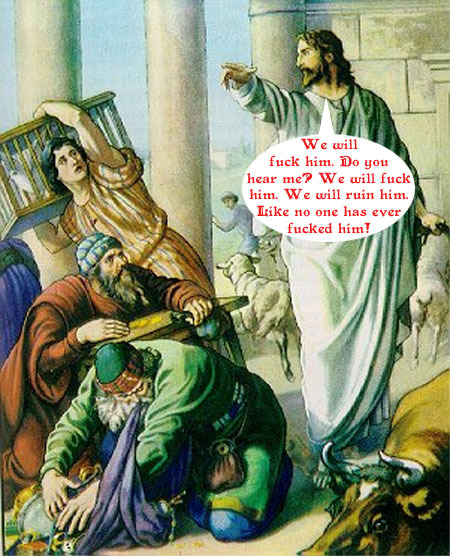
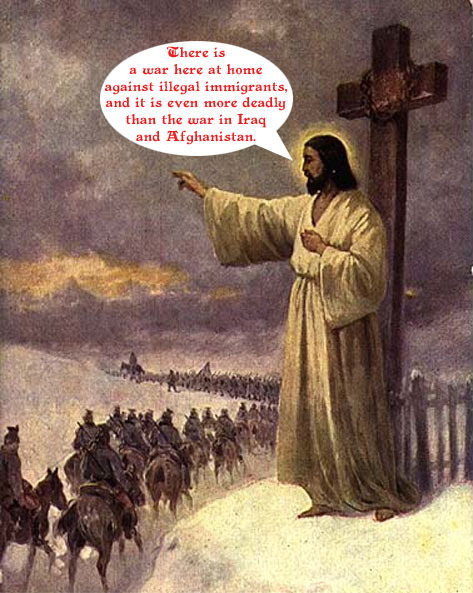
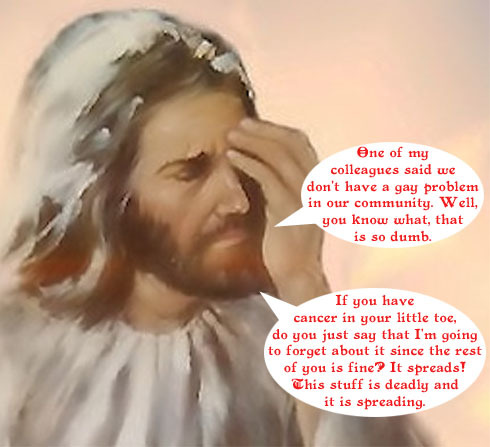
This phrase of St. Paul's, by which he made his readers understand that any success he had as a missionary was due not to any alleged gifts, talents, or good deeds of his but rather to the presence of the Spirit of Christ alive in him has become a kind of template for understanding how we as Christians are to perceive ourselves and be perceived by others. In that Spirit, then, with a generous h/t to The Church of Jesus Christ, let us, first, visit a site called Tea Party Jesus.

Surprise, surprise, the words of Christians in the mouth of Jesus aren't safe for work!


And what would our contemporary American Jesus be if he wasn't hating on fags?


Get the flavor? For what it's worth, I like the site. It's a nice little judgment upon all of us, I guess.

Now, can we do this with some folks a little closer to home? I think so . . .

Gotta Be A Teen To Read This Blog

OnePlusYou Quizzes and Widgets

Created by OnePlusYou - Free Dating Sites


Here I thought the occasional f-bomb would nab me an "R" at the very least. Oh well.

The whole "Free Dating Sites" thing is just an ad. Can skip right through it.

Monday, May 10, 2010

Love, Romance, And Other Disputed Territory

This is an attempt to respond to criticisms of my initial response here.

I guess I should begin by saying that love is, at its root, the most powerful most dangerous, most constructive, most destructive force in human life. It is also the most mysterious. Who among us can really understand it, define it, even delimit it?

I would add that I believe love is not a thing in and of and for itself. It is, rather, a process. One can fall in love - the hormones and pheromones and even sun and moon and sun can line up just so between two people - and out of love - God, does she have to do that again? I hate it when she does that - quite easily. Really loving another human being, letting that other person in to one's life, making room for the possibility of personal transcendence, is something that takes time, involves huge risks, and offers the possibility of learning how to be more than what one could ever be on one's own.

In that regard, I believe love to be, at its heart, not an emotion, but the mutually active give and take between two persons wholly surrendering their individuality toward the final goal of becoming something more. As the quote from McCullers seems to indicate, love is not something between an active lover and a passive beloved. That process I tend to think of more as infatuation; one makes of another human subject an object of one's private feeling and emotive actions. That this object may not have any of the qualities assigned to it by the subject is beside the point. We imbue objects with whatever wish-fulfillment we have at any given time. Over time, however, we may discover how short the object falls from our ideal; no individual can possibly carry the weight of another's desire to be something he or she is not. Disappointment leads to rejection.

Allow me an example from my own life. In the fall of 1991, I met and started dating a lovely woman, funny, smart, talented, gifted, gentle, passionate. I found myself, quite beyond any power I possessed, falling in love with her. I opened myself to her completely, utterly. When we broke up just a few months later, I was devastated. In discussing the issue with some mutual friends, one made the observation that this woman was, as the phrase has it "in love with love". I thought about that and realized that, while she may indeed have felt deeply for me, she was even more interested in that state of sublime, intense passion, that connection between two people. She could break off our relationship when she determined that I had failed to live up to her understanding of what was involved. Had I failed her as a lover, or as a beloved? As a lover, no more so than most human beings fail others in relationships. As a beloved, however, that passive recipient of another's subjective desires, I had failed so deeply that there could be no repairing the damage.

After seventeen years of marriage, I have learned that one doesn't really understand what love is. I can say with some confidence what is not. It isn't sex - a person can do that with anyone. It isn't the yearning after another in the quiet of one's heart and mind. It isn't even, in the end, about happiness. It is, when all is said and done, something one learns to do, always imperfectly, but always with an eye on the goal of mutuality in surrender. One takes the other's surrender with the understanding that, in so doing, one is also trusting that other to accept one's own.

I might also add that, disdaining love as an emotion, preferring it to refer to something lived between two people, the issue of "unrequited love" seems to me to denote something akin to Wittgenstein's "private language". I may hold an infatuation in my heart for another individual. I may express that infatuation, only to have it rejected. This isn't "love", any more than me attempting to communicate to another individual in a language that exists solely in my head is actually communication.

I am not disparaging love, I think. I am only saying that it is a real, existing, living thing between two people. Other kinds of romantic attachments, feelings, even acts - even marriage - are not love. I also don't think I am describing some unattainable goal. Perhaps I was a bit too curt in using the phrase "romantic claptrap", but I hope I have at least made my position a little less unclear.

Music For Your Monday

My father says he saw her in Manhattan in the early 1940's. Maybe. She was around, to be sure. Whether true or not, there is no doubt that Lena Horne, who passed away at 92, had a long, varied career. While not a pure jazz performer like Billie Holliday or Ella Fitzgerald, she could sing jazz. What she did best, though, was add some soul to the lifeless, white pop music Tin Pan Alley poured out its windows and doors. Her signature song, "Stormy Weather", was performed by many, done best by Lady Day (of course), but is certainly memorable.


Here she is doing a Rogers & Hart standard, "Where or When".


Finally, Ms. Horne refused to be limited to music from the 1940's. Here she is doing the late Jim Croce's "I Got A Name", making the song her own.

Sunday, May 09, 2010

Thought-Provoking

This interview with James Baldwin (.pdf), originally in The Paris Review of 1984, is a marvelous discussion. As with everything Baldwin writes or says, this reader is left in awe. At the same time, is it false humility, real humility, or ignorance when Baldwin says the following in answer to a question about his status as a "prophetic writer"?
I don't try to be prophetic, as I don't try to sit down to write literature. It is simply this: a writer has to take all the risks of putting down what he sees. No one can tell him about that. No one can control that reality.

Seems to me this is a marvelous distillation of what it means to be prophetic.

Anyway, I highly recommend the whole interview.

Religious Freedom

Created during the heady years of Republican control of Congress the US Commission for International Freedom issued a report his week critical of what it called the Obama Administration's failure to aggressively pursue religious freedom. Citing everything from Chinese violence against any expression of religious belief to the hyper-Islamism of Iran and Saudi Arabia, the report said that, in regards to religious freedom, the Obama Administration's foreign policy "misses the mark".

One wonders what, exactly, any American administration can to do to effect change in another nation's domestic policy. Considering the heinous regimes the US has supported in the past, and continues to support in the present, whether it is Banana Republics in Central America who killed nuns, South American fascists in the Condor countries the regularly killed and disappeared politically active religious folks, or our current refusal to engage the Saudis, Iraqis, Israelis, or others on religion-based discrimination and violence it seems to me that religious freedom is now, as it has always been, a very low priority for American diplomacy.

It was used, albeit not very effectively, during the Cold War against the Soviet Union. Whether it was the Soviet imposition of "leaders" or monitoring of dissident, unregistered congregations, or the right of Soviet Jews to emigrate to Israel (dealt with by the still-in-place Jackson/Vannick Amendment), conservatives consider "religious freedom" without reference to anything other than itself, and its existence as a "right" in western political thought. Since (most) systems and hierarchies of religious belief, once regularized and bureaucratized, become exclusivist in practice - I say "most" because, for example, if Friends, say, or Baha'i (mentioned in the report because of their repression in Iran) ever controlled government I doubt we would see Quaker thugs roaming the streets beating people who wanted to do violence - it seems to me that promoting "religious freedom" without regard to secularization of the state, legal tolerance of religious minorities, and other civil and human rights, from freedom of speech and assembly, to freedom from state police power such as those in the Fourth, Fifth, and Eighth Amendments to the US Constitution are really quite meaningless.

Furthermore, as a Christian, it seems to me that we are forgetting something central to our own identity. The first three centuries of the Church's existence, forgotten in the past 1700 years of de jure or de facto Constantinianism (in its Catholic, Protestant, and Orthodox varieties), was one of existence as an outlaw faith. The earliest recorded persecution of Christians, while noted as a necessary action against certain groups of Jews in Rome, occurred within a generation of the death of Jesus, in Rome, under the Emperor Nero. By the time St. Augustine was on the scene as Bishop of Hippo in North Africa, the last extended persecution of Christians occurred - and it was, to borrow the language of biology, nearly an extinction event. Christians were tortured, bribed, informants planted, whole congregations were slaughtered or used for sport in the arena.

And Jesus said, in the Sermon on the Mount, this would happen. And we are to rejoice in it. These now-silent witnesses to the reality of faith in human life, individual and communal, should be demanding an answer to an important question: Are our lives, and our deaths, in vain, if now Christians impose their will by force, either legal or military?

While it certainly seems in keeping with our most cherished social and civic traditions to promote religious freedom, in practice, one has to wonder why this is a priority and how it can possibly be accomplished. For example, in reference to China, the overwhelming basis for our relations, strained as they are, is commercial. What possible leverage is there for the US to push for reforms of the Chinese authoritarians when we buy billions of dollars of goods they produce? How can we effect change in Saudi Arabia when they have in abundance the single most important commodity we need to continue to operate? With the exception of Iraq, which the US has effectively ruled since the collapse of Sadaam Hussein's government in 2003, and its deChristianization, the US has little to no power to change the internal policies of any country. The incentive to do so, apart from the legal mandate in the Congressional Act that created the Commission on International Religious Freedom, is almost nonexistent.

I have to wonder what the Obama Administration could do, with any amount of seriousness or vigor, to change the verdict of the panel. I have to wonder, also, why Christians here aren't rejoicing more in the sufferings of our fellows in the faith as a witness to the power of the Gospel.

Saturday, May 08, 2010

Moral Indignation

I have occasionally offered the view that I am not impressed with moral indignation. Claiming some kind of moral high-ground on any topic of controversy usually is a way of insulating oneself from the messy reality that we are all compromised in some manner, fashion, or form related to moral judgments. Way back in the fall of 2001, in the immediate aftermath of the terrorist attacks on Washington and New York, one often heard "liberals" chided for some kind of failure to call what happened "evil", especially after George W. Bush used David Frum's "axis of evil" in a speech before Congress. For some reason still not completely understood by me, it was thought to be an act not only of moral but intellectual acumen, not to say public heroism, for the President of the United States to call an evil act . . . well, evil.

I am still puzzled by this. Thanks to Professor Michael Berube, I found a second part to the whole "agnotology" discussion at slacktivist. The first part offered as an example of the social phenomenon of ignorance the alleged Satanic ties of Proctor & Gamble. In this one, slacktivist discusses something anyone who is not a sociopath would find horrific - kitten-burning.
Every once in a while, I am sorry to say, some sick bastard sets fire to a kitten. This is something that happens. Like all crimes, it shouldn't happen, but it does. And like most crimes, it makes the paper. The effects of this appalling cruelty are not far-reaching, but the incidents are reported in the papers because the cruelty is so flagrant and acute that it seems newsworthy.

The response to such reports is horror and indignation, which is both natural and appropriate. But the expression of that horror and indignation also produces something strange.

A few years ago there was a particularly horrifying kitten-burning incident involving a barbecue grill and, astonishingly, a video camera. That sordid episode took place far from the place where I work, yet the paper's editorial board nonetheless felt compelled to editorialize on the subject. They were, happily, against it. Unambiguously so. It's one of the very few instances I recall when that timidly Broderian bunch took an unambiguous stance without their habitual on-the-other-hand qualifications.

I agreed with that stance, of course. Who doesn't? But despite agreeing with the side they took, I couldn't help but be amused by the editorial's inordinately proud pose of courageous truth-telling. The lowest common denominator of minimal morality was being held up as though it were a prophetic example of speaking truth to power.

That same posturing resurfaced in a big way earlier this year when the kitten-burners struck again, much closer to home. A group of disturbed and disturbing children doused a kitten with lighter fluid and set it on fire just a few miles from the paper's offices.

The paper covered the story, of course, and our readers ate it up.

People loved that story. It became one of the most-read and most-e-mailed stories on our Web site. Online readers left dozens of comments and we got letters to the editor on the subject for months afterward.

Those letters and comments were uniformly and universally opposed to kitten-burning. Opinon on that question was unanimous and vehement.

But here was the weird part: Most of the commenters and letter-writers didn't seem to notice that they were expressing a unanimous and noncontroversial sentiment. Their comments and letters were contentious and sort of aggressively defensive. Or maybe defensively aggressive. They were angry, and that anger didn't seem to be directed only at the kitten-burners, but also at some larger group of others whom they imagined must condone this sort of thing.

If you jumped into the comments thread and started reading at any random point in the middle, you'd get the impression that the comments immediately preceding must have offered a vigorous defense of kitten-burning. No such comments offering any such defense existed, and yet reader after reader seemed to be responding to or anticipating this phantom kitten-burning advocacy group.

One came away from that comment thread with the unsurprising but reassuring sense that the good people reading the paper's Web site did not approve of burning kittens alive. Kitten-burning, they all insisted, was just plain wrong.

But one also came away from reading that thread with the sense that people seemed to think this ultra-minimal moral stance made them exceptional and exceptionally righteous. Like the earlier editorial writers, they seemed to think they were exhibiting courage by taking a bold position on a matter of great controversy. Whatever comfort might be gleaned from the reaffirmation that most people were right about this non-issue issue was overshadowed by the discomfiting realization that so many people also seemed to want or need most others to be wrong.

It is this pose of moral superiority I find horrid. It takes very little moral imagination to call an evil act evil. Indeed, a child of eight or nine can understand pretty readily that burning kittens, or killing thousands of people is morally vicious. I have been chided by moral scolds of both sides of the ideological fence because I refuse to engage in that kind of thing.

Moral indignation is fine for those who have it all figured out, whether they be youth or ideologues committed to this or that principle that rules their world. Pronouncing moral judgments upon this or that or another act is the easiest thing to do; it also helps us avoid the far more difficult, and far more important moral task of understanding why such an act is committed. When serial murderers and pedophiles are dehumanized by calling them "monsters" or "animals"; when terrorists are labeled "evildoers"; even when kitten-burners are labeled "sociopaths" - they are safely out of reach. We and they cannot possibly be related in a moral sense. Whatever drove these individuals to act in the ways they do has no relationship to the ways we live our lives; indeed, being morally vicious they can be considered intellectually unintelligible. Who cares why the priest molested the little boys and girls? Who cares why John Wayne Gacey or Jeffrey Dahmer killed all those people? That they did is sufficient to declare them evil, outside the circle of our empathic concern.

Slacktivist offers the following view on this theme:
Again, I whole-heartedly agree that kitten-burning is really, really bad. But the leap from "that's bad" to "I'm not that bad" is dangerous and corrosive. I like to call this Thornton Melon morality. Melon was the character played by Rodney Dangerfield in the movie Back to School, the wealthy owner of a chain of "Tall & Fat" clothing stores whose motto was "If you want to look thin, you hang out with fat people." That approach -- finding people we can compare-down to -- might make us feel a little better about ourselves, but it doesn't change who or what we really are. The Thornton Melon approach might make us look thin, but it won't help us become so. Melon morality is never anything more than an optical illusion.

This comparing-down is ultimately corrosive because it bases our sense of morality in pride rather than in love -- in the cardinal vice instead of the cardinal virtue. And to fuel that pride, we end up looking for ever-more extreme and exotically awful people to compare ourselves favorably against, people whose freakish cruelty makes our own mediocrity show more goodly and attract more eyes than that which hath no foil to set it off.

Melon morality is why if the kitten-burners didn't already exist, we would have to invent them.

The narcissistic aspect of this phenomenon should be clear; these evildoers exist solely to demonstrate our moral worth. Pronouncing moral judgments, whether its on kitten-burners or Satanists or abortion-providers or racists or whomever - it's a child's game and has nothing to do with serious moral inquiry. I can't even be bothered with calling such acts evil, not because I do not believe them to be so; on the contrary, they are prima facie evidence of the reality of radical evil for those who think such a thing nonexistent. Rather, I do not bother with such labeling because it has nothing to do with understanding how this or that evil event took place. Whether it's a mass murder, a serial child-rapist, or a terrorist attack, we get absolutely nowhere if we call such things "evil" and figure there is no more to be said, done, or thought.

What is far more important, and far more troubling, is investigating how human beings no different from us can engage in acts of radical evil, whether that is kitten-burning, serial murder, or genocide. To those who complained of the alleged silence of "the left" on the moral status of terrorist acts, I can only wonder how they could miss the equally vicious idea, bandied about by Secretary of Defense Donald Rumsfeld, of "collateral damage" during the run-up to the Iraq war. Precisely because it is the embodiment of Arendt's notion of the banality of evil, creating bureaucratic phrases that hide horrors that such a phrase hides far more than it discloses. Of course Rumsfeld was talking about the unintended, but nevertheless forseeable, deaths of thousands during combat.

Precisely because pronouncing moral opprobrium upon acts that are morally evil is so easy, it should be avoided. Whether it's denouncing sociopathic adolescents or dictators, our intellectual and moral effort should aim toward understanding in order to prevent, rather than standing on some kind of pedestal, calling perpetrators of such acts evil, and rest on these as laurels.

May 8, 1993

You couldn't have asked for a better day. Sunny and warm, but little humidity, the azalea's in bloom. My mother has always commented on that. I got up early that day and went for a long walk, down Massachusetts Avenue to a little stretch of park that wound through a shallow, creek-created vale that, if you wanted to walk all the way, took you to Georgetown, right next to the University. I walked part way, then back out and back north on Mass Ave up to Wagshal's Delicatessan where I ordered a sandwich for an early lunch.

It had been a crazy, busy couple days. Friends and family arriving in the nation's capital from all over, including a U-Haul trailer filled with furniture. Meeting and greeting everyone. Getting lost on a drive from National Airport to a hotel in Alexandria. All the while remembering that on Monday, May 10, I would be graduating with my Master of Theological Studies Degree from Wesley Theological Seminary.

At 1:30, all these friend and family gathered in Oxnam Memorial Chapel at Wesley, and, with the Rev. Dr. Kyung Lim Shin-Lee (Dean of Community Life) officiating, Lisa and I got married. A gathering in the quad followed immediately, then a reception in the Seminary refectory. When all was said and done, bouquets tossed, cake cut, some dancing, Lisa and I dodged a hail of birdseed (not always effectively) and headed to the Embassy Suites Hotel in Tenleytown for a quiet - too quiet, really - dinner and a night alone together.

Over the past seventeen years, we've lived a lot of places, are on our second dog, third cat, have two wonderful children, are preparing for her fourth appointment, and yet one constant remains as it always has - one another. I have neither wisdom nor insight to offer as a generalization about marriage. I can say with all honesty that, for all the ups and downs, twists and turns of married life, the simple fact is that Lisa and I have become so close over the years, we finish one another's sentences. We can get one another laughing without saying anything. We have little rituals that are ours alone. Our stories are ours, not separate ones. We have shared laughter and tears, to be sure, but the bond that links us is not simple, romantic love. No, it is something indefinable yet very real. We are not two individuals who share a space and time and separate memories. We are us, we two together sharing the same time and place and memories that hold the same meaning for us. We have grown together, gone from early adulthood to middle age together, and through it all have leaned on one another, occasionally yelled at one another, but never, ever, stopped loving and cherishing one another.

For some reason this anniversary seems far more special than many previous ones. Perhaps it is because we are on the verge of moving, a life-change that makes anyone look backward as much as forward. For whatever reason, I am grateful for the years, for the support I have always had from her, for the simple reality and grace that her presence in my life really is. I am a far better person as her husband than I would ever have been on my own or with anyone else. My hope for the future is really quite simple - that we remain, as we have been, that strange, marvelous thing that is a couple as a single reality greater than the sum of the two together.

Oh, and by the way. I love you, Lisa. Happy Anniversary, baby.

Friday, May 07, 2010

Intellectual Property And Human Rights

Yes, Jim, you were right. Your comment spawned a blog post . . . I'm getting predictable.

This past weekend, listening to BBC America, I heard about the death of an Indian economist (whose name I cannot remember; sadly, I cannot even find a reference to the story on Google!), part of whose work considered the impact of the protection of intellectual property on developing countries. The example offered was patent protection enjoyed by pharmaceutical companies, and how this creates not only barriers for the use of good drugs for impoverished people, but also encourages intellectual piracy. It is, in fact, not uncommon for pirated knock-offs to be offered in sub-Saharan Africa and southern Asia in place of overpriced drugs to battle everything from childhood diarrhea to AIDS. In a recorded interview with the person in question, the example given was actually Lasik surgery. In the US, the average cost is $1600 for such a procedure; a large opthamalogical clinic in southern India actually performs the same procedure, roughly 10,000 times a year, at an average cost close to $10 a pop. Part of the difference is the socialization of delivery in India, as opposed to privatization in the US. This creates an atmosphere in which an entire set of assumptions from profitability to questions of medical necessity are radically reimagined.

The reason for recalling this imperfectly recalled radio story is the treatment of genetically-modified foods in the legal atmosphere of the United States. After developing the first GM food products, Monsanto ended up in court because it sought to patent them. At issue was the question of whether or not something that is alive can be treated as intellectual property. The Supreme Court ruled that, indeed, it can because it is the creation of a particular industry, a particular corporate entity; rather than just "corn" or "rice" or "millet", the Court accepted Monsanto's argument that GM foods were, in a sense, artificial.

While I understand the distinction between the legal argument and other forms of discourses, in this particular case, I find it (no pun intended) hard to swallow. With patent protection, the potential benefits of some kinds of GM food products become extremely limited. Only those agricultural concerns that have enough capital to purchase them can make use of them. Since the alleged benefits of GM foods include their utilization in marginal production areas and by impoverished farmers in the developing world, slapping a patent on a product and demanding higher prices for it creates a barrier that prevents their use that way.

Of course, as I heard on yet another radio chat show (I think it was NPR's Talk of the Nation Science Friday, but again the great Google has failed me . . .), the promised deliver of all sorts of benefits from genetic modification of various crops just hasn't materialized. Even the much-hyped pest-control plants really don't work all that well. So, we have high-priced seeds for plants whose marginal return is negligible. While there are only a few sources for mass produced commercial seed - ADM and Monsanto come to mind as I see their signs in the corn fields here about - one is left with the impression that much of the alleged cost is nothing more than a way of artificially boosting prices by oligopolistic entities.

Faced as the world was just a couple years ago with overpriced rice crops that created the odd situation where warehouses full of the stuff were quite literally rotting because the price put them out of reach of buyers created a dual hazard. While those who purchase rice couldn't afford it, the producers were also impoverished because no one bought the rice at the inflated prices. Such a situation also encourages theft and piracy on a massive scale; those with few scruples obviously see an opportunity and will exploit it.

It seems to me that access to affordable basic food stuffs - grain and dairy, basic meats and fruits and vegetables - is a human right. With the industrialization of agriculture, we face the absurd situation where that most basic ingredient of life, food, becomes so commodified that artificial shortages, political and market manipulations, and legal technicalities interfere with its efficient and even necessary distribution. Yet, there is a claim the producers have upon consumers - to earn enough to keep producing!

It seems to me that discussions of agriculture (at least in this country) are so burdened with unreality - how may times do we hear about small family farms? - that it becomes almost impossible to talk about how to balance their needs of producers and consumers. Including discussions of the industrialization of agriculture, the legal impediments to production and distribution that exist, and the failure of so many of the claimed promises of genetic modification might be a start, I suppose. Keeping in mind, however, that we are talking about food, the very stuff of life, might also help us focus on priorities.

I don't have answers to the complications here. I'm just kind of offering these observations as a conversation starter . . .

Thursday, May 06, 2010

Researched Ignorance

Continuing the whole agnotology theme, I want to mention the fetish on the right for all the books by people like Ann Coulter (whom Alan refers to as "She Who Must Not Be Named"), Bill O'Reilly, Dinesh D'Souza, Jonah Goldberg, and others. Quite apart from the practice of buying up whole warehouses of the books to artificially boost sales numbers, one often hears the claim of "careful research" and the number of footnotes (or, in the case of Coulter, their confusion with endnotes, but whatever) as a sign that such books are far more than simple ideological pamphlets.

For some reason, the mere existence of footnotes seems to exist as some kind of sign that any claims allegedly bolstered by the claimed research cited are beyond question or reproach. I find this a fascinating example of agnotology-in-action. Ignorant of the reasons for citing a source - beyond simple issues of plagiarism and intellectual honesty - the right has adopted the practice of pretend scholarly research in the service of ideological ends. The results can be quite funny, as for instance the fate of Jonah Goldberg's Liberal Fascism is certainly the most laughed-at by the internet Left. Dredging up decades-old smears against FDR, Goldberg's incoherent book offers readers the opportunity to see ignorance paraded around as carefully researched argument.

It was Coulter's defense of one of her books - "It has footnotes!" - that got me thinking about this particular subject. She seemed to think the presence of citation was sufficient as an argument supporting the intellectual legitimacy of her work. With Goldberg's book, this particular schtick has reached a kind of zenith/nadir. Anyone with a modicum of historical knowledge recognized immediately what Goldberg was up to. Even a casual perusal of the book in question - not to mention its tortured journey to publication - should have cost Goldberg not just credibility, but his employment as a commentator on political affairs.

Part of the reason for the spreading of this particular non-intellectual contagion is the ignorance of the use of footnotes. That they serve to show that a writer has done his or her homework is less important than the fact they serve as a way to evaluate the arguments presented and allegedly bolstered by the works cited. Using footnotes serves the reader as a way to ask questions, including that most important one - has the author used the source correctly? Footnotes don't exist to stop critique. They exist as the beginning of serious critique.

This simple, undergraduate reality seems lost on all those right-wing authors who seem to think the claim of "research" and the presence of citations is enough to show that a work is intellectually honest. I'm not sure why it is this reality has escaped them - again, I don't really understand the social dynamics of this phenomenon - but I offer this as part of the problem we face with the flood of books that continue to pour out from right-wing publishers.

Ughnotology

This follow-up piece at Crooked Timber, concerning agnotology, metastasizes in to something ungainly, approaching unreality, as the comment-thread nears 200. I do so love it when straw arguments are presented, by the way, as Quiggin's example, "GM foods are evil", is offered as a test case of left-agnotology. As far as I can recollect, this comment sums up mainstream criticism of genetically modified foods:
Among my friends, there was once a pretty wide streak of shared concern that genetically modified plants might well turn out to be toxic or contributing to long-term health problems in ways we couldn’t predict in advance. And that was a sensible concern, given the manufacturers’ demonstrated disinterest in public well-being beyond their balance sheets. These days, though, that’s very much receded in favor of the issues like property rights.

While there are those who pronounce moral approbation upon GM-foods, for the most part, this continues to be a legitimate criticism. After all, eating something that heretofore did not exist as a food source, containing certain genetic properties not found in nature, and untested because it is unethical to use human subjects in such tests, is a legitimate concern. On the whole, the notion that the whole thing can be summed up, "GM foods are evil" creates an argument that is easily refutable, therefore dismissible.

The various back-and-forths throughout the comments can be summed up as "I know you are but what am I?". This muddies the waters far too much; the potential of "agnotology" to explain certain social phenomena we are experiencing. That human beings not only do not know stuff, but that his process is an active one, with all sorts of feedback loops and reinforcing mechanisms. Whether or not this is a phenomenon limited to the right or not is immaterial. Our current public discourse is rife with right-wing ignorance parading as open-mindedness; it undermines the credibility of scientific inquiry and research; it enables charges of elitism to stand without evidence.

Rather than trade barbs over various "examples", the discussion might have been far more helpful had it concentrated not only on current examples, but considered the ways the cultivation of ignorance is as much a habit, both personal and social, as the cultivation of knowledge. I also think a consideration of traditional, Enlightenment-based notions of the social and moral benefits of an ever-increasing knowledge base is actually disproved by the reality of the active, social pursuit of ignorance.

These are important issues that confront us everyday. Delving in to the good or bad faith of commenters who address hypotheticals is fun in a graduate-seminar kind of way, but unenlightening to me. Thus, the "ugh".

Tuesday, May 04, 2010

Christian Theology And The Question Of Power

When attempting to address the realm of politics in all its variegated forms, immediately we are confronted with power. Politics is the arena where power is sought, battled over, won, lost. The classic definition of power, as I learned it as a wee undergrad oh so many years ago, is thus: A has power over B to the extent that A can get B to do something B would not otherwise do. Even more than the question of "authority", the question of power confronts us when we are seeking understanding of politics.

The state has power over me to the extent that it sets limits to the conduct of my personal affairs. Yet, for this limitation, I have the power of a voice in how far those limits are set, to insist they either be made stronger or weaker, and to elect people to public office who will support my positions on those questions. Furthermore, in exchange for the power to circumscribe my own personal sphere of freedom, the state creates an environment conducive to the exercise of those freedoms not surrendered, or those explicitly allowed. Thus, the traditional "contract" theory can be understood, quite apart from any metaphysical mumbo-jumbo about "the state of nature" and all the other encumbrances it carries, as describing a really existing state of affairs.

The issue of power, however, confronts us with the possibility of its abuse, even in the circumstances described above. Whether it is the usurpation of powers not allotted to government under expressly enumerated limitations or the so-called "tyranny of the majority", we are continually faced with the necessity of resetting the balance among the various actors in the political realm. Part of the reason for the initiation and continuance of this particular way of ordering political life rests on the intuitive understanding, borne out by five thousand years of recorded history, that there is nothing more dangerous, more seductive, than power. It must be faced directly, continually, in order to force limits upon it.

I take as my starting point for understanding a Christian view of power, specifically Divine power, the cross of Jesus as the revelation of God's understanding of Divine power. Right there, God showed a sinful, broken world that power exists in surrender rather than victory. The empty tomb of Easter morning is proof that the surrender of coercive power is infinitely, eternally more constructive than its exertion.

So, we come up against the most obvious conflict - how do we Christians confront the demand for a discussion in terms of power, when we insist on its surrender as the basis for real authority? Since tied up with the passion narrative, theologically speaking, is a redefinition of Divine judgment as Divine gracious condescension, we also must face squarely that, even when beset by earthly powers, the Church must live not only in to and out of that grace, but must be continually in prayer for those powers. Sometimes for their transformation, sometimes for their replacement, but always in prayer that, even in their broken misunderstanding of power they may yet have the winds of the Spirit blow upon them. So, before, during, and after any understanding comes a constant prayerful love.

Living as a witness to the possibilities of surrender, the Church most firmly witnesses to our political arena by being the Church. By living out our faithful understanding of grace, of clothing the naked, visiting the prisoner, feeding the hungry, we witness to the on-going reality that transcends contingent historical political arrangements. In so doing, it not only pronounces a judgment upon them, it also offers a gracious alternative; "this is the way a community of persons living in the crucified and risen Christ understand issues of power; we give up."

What's The Word I'm Looking For? (UPDATE)

This post at Crooked Timber offers yet another example in the on-going discussion of "epistemic closure", with Quiggin offering the word "agnotology" to describe the phenomenon of the right existing in a weird, fact-free Universe of their own making.

Considering my own exposure to such groups on the right-wing internet, I would offer "agnophilia" - lover of no knowledge - as the proper term. These folks aren't just ignorant; they revel in their ignorance, refusing to consider counter-evidence, preferring their biases and arguments not suffer any interference with reality or fact.

UPDATE: Scott McLemee reports on a new anthology entitled (sob, my preferred word is wrong) Agnotolgy:The Making and Unmaking of Ignorance. Check out his review.

That Pesky Constitution

Why do conservatives hate the United States Constitution so much? Every time some part of it interferes with what they really want, they make up all sorts of arguments about how it screws up the country. Whether it's the right to privacy, abortion rights, censoring pornography, even going back a generation to civil rights for minorities and women, the whine is always the same. Who cares what the constitution says?

With the arrest of a suspect in the failed Time Square bombing we are, once again, facing a complaint about the Miranda warnings. One has to wonder. Prisons in the US are filled to overflowing, literally, with people who were read their Miranda rights. Do they not get that?

Probably not.

Virtual Tin Cup

Amazon Honor System Click Here to Pay Learn More